What in Tech is a user-supported site. When you purchase through our links, we may earn an affiliate commission at no additional cost to you. Learn more
We've reviewed the options: here are the top picks
2025 update: We run availability checks on the products we review regularly and notice that some of the offerings in this feature have been running low on stock. We’d recommend checking out each option as an alternative. If everything is out of stock, we’ve typically seen most choices available again a few weeks later.
In the world of car stereos, nearly every head unit chooses to take the cheaper route of only having composite inputs/outputs available as your video solution.
This can be frustrating, as a head unit with input (or even just an output) can open up doors to screen mirroring, a second display for your HDMI device/laptop/games console, and of course, HD visuals from anything you’re sharing.
Thankfully, there are a few great options amongst the many composite head units to do just this.
So today’s feature on What in Tech will take you through the best double din car stereos with HDMI inputs (or output only for cheaper choices).
Overall Best Car Stereo with HDMI Input: Kenwood Excelon Reference DMX1057XR
Kenwood is one of the best head unit manufacturers in the business. It was not a surprise to see that they’re one of the only brands to produce an excellent double din with HDMI input.
Lead by its gorgeous, bright, and large HD touchscreen and decent sound; the DMX1057XR has all of the quality of life features you need in a car stereo system (from Bluetooth to advanced audio customization options).
The unique crowning feature of this car stereo system is, of course, its HDMI input port. With the potential to act as a secondary screen for movies, your computer, or even a games console, its great to see this capability on a head unit when this technology so often settles for just A/V composite connection.
Compatible with both Apple CarPlay and Android Auto, this system can act as a great navigation device for either of the main 2 mobile platforms, with great UI attached to each of its main software pieces (from vehicle information to dashboard camera views, with up to 4 camera connections available).
The build quality is top tier as you would expect for a premium head unit It also boasts a sleek, glossy design to match, with subtle LEDs illuminating the main buttons of the unit.
What else is there to say? Kenwood has created a fantastic product in the DMX1057XR.
Yes, it is an expensive offering, but if you’re after the best HDMI head unit today, this is easily our top choice.
Runner-Up Best Car Stereo with HDMI Input: Pioneer AVH-W4400NEX
Pioneer, another classic car stereo brand, has created the cheapest car head unit with an HDMI input that we’ve seen with good availability.
Boasting many of the same features that make our top Kenwood pick great, the AVH-W4400NEX has a decent screen and audio, built-in wi-fi/Bluetooth, good compatibility with Apple CarPlay and Android Auto, and of course, its HDMI input. This head unit is more than capable of acting as a decent navigator for all of your typical demands from a car system.
The AVH-4400NEX is an excellent device and was very nearly picked as our overall top winner. If your budget for a car stereo with HDMI is closer to this than the Kenwood pick, there’s no shame in picking this device up instead. We gave the top pick to the Kenwood head unit because that offering, for its big price tag, feels like a premium unit in every way; the screen is more vibrant, the UI/quality of life features/connection capabilities are slightly better and many other elements are just a touch above the Pioneer head unit.
But perhaps the biggest difference is the smaller screen size, with the Kenwood’s 10.1″ display being notably larger than the Pioneer’s 7″ screen. The smaller size might work better for your car, we just imagine most people after a head unit with HDMI will be intending to screen mirror/use their screen for HD video, and a larger screen can really help improve that experience.
But we’ll restate; for a mid-range price, you won’t get a better HDMI car stereo than this Pioneer offering. If your budget can’t stretch to Kenwood, we think you’ll love this pick.
Best Budget Car Stereo with HDMI: XTRONS Android 10 TQ700L
Now if you’re after a very cheap head unit with HDMI, this XTRONS stereo may sound too good to be true with its incredibly low price-point.
But there’s a big caveat; it’s HDMI capability is an output only.
This means you won’t be able to plug in a device (like your phone/PC). The purpose of the XTRON’s HDMI is only to output to another screen.
So, if your idea of having HDMI in your car was only important to allow you to mirror what is on your main car stereo to another screen (say, mirroring a movie to the backseat for other passengers to watch) then this might be all you need.
Source: XTRONS
We imagine most readers had other ideas in mind, and if that’s you, you’ll need the above picks to satisfy that.
Other than the HDMI capability, the XTRONS Android 10 is a good head unit considering its very low price. With GPS navigation, Bluetooth, Android/iOS screen mirroring capabilities, and a decent HD touchscreen, it’s a surprisingly decent offering.
Yes, the brand isn’t as large as our top picks, but many users have been pleased with the XTRONS Android 10.
It really all comes down to if you need the HDMI input. If you can live without it/would rather save the money, this is an incredibly cheap HDMI car stereo.
Best Head Unit with HDMI Honorable Mention: LINKSWELL Gen IV
Linkswell, another decent head unit manufacturer has also thrown their name into the HDMI double din game.
With its enormous 12.1 vertical aligned screen, the Linkswell Gen IV feels like more of a traditional nav panel, which if you’re not interested in watching movies, actually provides a really nice user experience. The software for car navigation, music, and screen mirroring a phone all feel more aligned with a vertical orientation.
Elsewhere in the features is everything you’d expect from a premium head unit; GPS, Bluetooth, wi-fi, Apple CarPlay/Android Auto, and decent UI. Not to mention a solid, durable build quality.
Source: Linkswell
With all that said, why is this an “honorable mention” instead of a top-pick?
Well, unfortunately, the Linkswell Gen IV is quite limited in its compatibility, with each model being made for specific car types.
The linked model is for F150 2015 to 2019 and F250/F350/F450 2017 to 2019. There are a couple more floating around on Amazon that may fit your model if you’re lucky.
But overall, while this is a great head unit with HDMI input if you have the right model, we imagine many of you will have to look at our other picks (which is no bad thing, even head to head vs our Kenwood pick, we would still choose Kenwood for most users!).
Alternative Option: HDMI to Composite Conversion with Traditional Head Unit
If, for whatever reason, you’ve looked at the above options and felt that they aren’t right for you (or perhaps aren’t compatible with your system), we wanted to provide one cheap (albeit inferior) alternative to having a double din car stereo with HDMI input.
If your head unit doesn’t have HDMI, chances are it will instead of A/V (composite) inputs (though be sure to check yourself).
If that’s the case, you can purchase this composite to HDMI converter kit that will allow you to plug an HDMI into your A/V car stereo.
So, why do we call this an inferior alternative? There are 2 reasons:
Even with a convertor, an A/V connection will only output standard definition (up to 480p) so you will miss out on HD content.
Stating the obvious but, a bulky converter with extra wires is not a good aesthetic if you’re trying to create a clean dashboard.
With that said, if you can’t afford one of our top HDMI car stereo picks, this is certainly a decent option for the tiny price of a convertor!
Kaelum Ross, BSc is the Lead Writer at What in Tech and a leading authority in PC hardware and software. With a career as a senior IT professional, Kaelum has led multi-million dollar projects covering everything from bespoke software development to complex Windows hardware upgrades. Today, Kaelum uses his expertise to serve What in Tech's readers and has been featured in numerous global publications including New York Magazine and Lifewire.
For those after the best gaming display possible, this combination hits an incredible sweet spot between resolution and refresh rate, perfect for competitive and immersive titles.
Today’s feature is here to break down the best 1440p 240hz monitors available for your setup.
Quick Word on Availability/Where to Buy 1440p 240hz Monitors
This technology is new to the market. Therefore there are, unfortunately, some issues with availability.
Amazon has by far the best selection as it stands, but we will also be including any upcoming 240hz 1440p monitors that may be worth considering and are regularly updating this list to ensure it’s as accurate as possible for availability/pricing.
Hopefully at least one of our top picks (which are all worthy of a high-end setup) are available for you. But if not, we’ve finished the list with some alternatives if you have no luck finding this spec of monitor available. Now, without further ado…
Overal Best 1440p 240hz Monitor: Alienware AW2721D
Arguably one of the most powerful gaming displays on the market today in any category at its price-point, this Alienware IPS QHD 240hz monitor is a beast.
We previously listed it as our top high-end pick. But over time, Alienware has lowered the price of this offering so it’s actually only slightly more expensive than the other mid-range choices (despite it offering significantly better specs in certain areas). You really feel like you’re getting a premium choice for a deceptively low price with the AW2721D.
Boasting Vega DisplayHDR 600, 1ms GTG response time, and a gorgeous IPS display, this offering has everything we would hope for to accommodate the beast-like 2560 x 1440 240hz leading the monitor’s specs (in other words, you don’t feel like you’re buying a monitor just for 240fps and QHD, the picture quality and latency matches the demands of a premium gaming/e-sports setup).
But let us specifically call out where this Alienware pick excels over the mid-range options below:
Up to 600-nits brightness is a fantastic feat with everything else the monitor offers; combined with HDR and the monitor’s contrast capabilities, you’re going to get some fantastic blacks/whites.
98% DCI-P3 color coverage – an insanespec for a monitor focussed on resolution and framerate. You can expect a very vibrant, colorful picture.
One of the best build qualities of any gaming monitor on the market – with a beautiful, sturdy design, reliable tilt/swiveling options, and one of the best HDMI, DisplayPort, and USB output setups on the list.
We love how all of these specs have been built on an IPS panel. We would expect, with its clear quality across the board in color, contrast, and latency, for this Alienware offering to be on a TA/VN panel.
But that’s the beauty of this pick; it doesn’t feel like any corners have been cut.
If you’re in the market for the perfect display for esports, immersive gaming, or another type of high-end setup, we think this is the one for you.
At an incredible price for the way it balances refresh rate, picture quality, response time, build and design; this is, without doubt, the best 1440p 240hz monitor on the market today.
Best Budget 1440p 240hz Monitor: HP Omen X 27” 240 Hz 1ms Monitor
Update note: While this HP Omen choice is usually going to be one of the cheapest 240hz 1440p monitors available for you, be sure to check the prices of our top overall, curved, and second-best IPS options, as these are all occasionally on discount.
Ranking consistently as one of the top picks through all of our updates, this cheap 240hz 1440p HP monitor is fantastic, and our favorite TN panel choice.
The Omen X’s screen still boasts a lot of what gamers will look for in such a high-spec display, including:
1ms response time: perfect for avoiding ghosting on hud-based games and blur on fast-motion titles
AMD Radeon Freesync 2 HDR & G-sync compatibility
With 90% DCI P3 color spectrum and up to 400 nits brightness, you’ll be getting fantastic color accuracy for TN.
Although the specs aren’t as good as our top pick, you can still expect a great picture quality for competitive gaming, immersive titles, media, and general use.
While a lot of people prefer IPS over a TN panel, the monitor still demonstrates sharp colors, blacks, and decent viewing angles.
With its low latency (1ms) and high refresh rate, this is one of the best monitors for Fortnite, PUBG, and readers who take competitive gaming/esports seriously but can’t stretch their budgets any further.
Having a reliable low input lag is, in our opinion, the most important quality in choosing the best budget 1440p 240hz monitor, so we’re pleased to see this pick retains that despite being one of the cheapest picks on the list.
The one notable downside of the Omen X is its stand/mount. While it looks fantastic, it’s disappointing that for this price-range, HP hasn’t included a rotatable/tiltable stand or easy cable routing/management options in the back.
With that said, the important thing here is the quality of the picture and response; and boy does the Omen X smash this department at a price we would not expect this to be achieved in.
Not only is this the best cheap 1440p 240hz monitor, but if it’s a very respectable alternative to our top Alienware pick, and worth picking up if that model is out of stock or your price range.
Best Curved 1440p 240hz Monitor: SAMSUNG 32-inch Odyssey G7
We know that for many gamers, having a curved monitor is an important factor (if you’re never used one before, it’s hard to describe the additional immersion it can add in words).
If that describes you, then this Samsung QHD display is a fantastic choice and comes in at a very impressive low price-point (that often rivals our cheapest 1440p 240hz display picks).
With a choice of the usual 27″ size or a gorgeous large 32″ display, the Odyssey G7 comes with up to 600-nits brightness, 1ms grey to grey response time, and decent color accuracy. In other words, the Odyssey G7 still meets many of the specs integral to a premium gaming monitor.
The 1000R curve is stunning too. The angles from the curvature provide a unique, immersive bonus that suits what we think most people will be looking for.
This Samsung offering is a VA 1440p 240hz display; this panel type is good at balancing viewing angles/display quality and reliable response times at a lower price.
So with all that said, why isn’t this our top overall/budget choice? Well it is a close one to call, but the Odyssey G7 has a couple of slight cons:
While the picture quality and brightness on this monitor is still great by most gaming display standards, the other main choices on this list come out slightly ahead in providing a very vibrant picture (especially the Alienware pick).
Some users report G-sync issues in regards to flickering (though using this software isn’t a necessity for a great display and an overwhelming majority of users appear to have no issue)
The package doesn’t include the high-quality cabling you’d expect for a premium monitor. To get the full potential of your picture, you’ll need to pick up some VEGA-certified cabling (it’s not a big deal, just a bit disappointing for a monitor of this caliber).
Now don’t mistake us; this is still a fantastic display.
The build quality/design is beautiful (as you’d expect from Samsung), the curvature is fantastic and nearly all the specs are very impressive for being one of the cheapest choices on this list.
If a curved gaming monitor is important to you, we think the Odyssey G7 is a great choice.
Let’s start by being clear; this is the most expensive monitor choice on the list by far and is a very premium offering.
But if you have the budget, what you are getting is a pick that excels across the board and offers an unparalleled gaming/work screen real estate.
Let’s start with the obvious, and re-iterate; this is a 49″ super ultrawide 240hz monitor.
The “super” isn’t just a marketing term, this means the monitor extends beyond the usual UWQHD resolution of 3440×1440 (21:9) and is instead a whopping 5120×1440 (32:9).
Doubling the width of the standard 16:9 aspect ratio, what you are getting in the Odyssey G9 is essentially 2 traditional 1440p monitors in 1.
Reaching this as QHD alone is impressive, but with 240hz too? This display is simply stunning and alongside its very deep 1000R curvature, offers incredible levels of immersion during gaming, and a wonderful space for productivity/general use
We’re pleased to say that this monitor excels in its other main specs too, with up to 1000 cd/m^2 and a 2500:1 contrast ratio, the blacks/whites and brightness on this display are breathtaking (especially with HDR1000 content).
Color-wise, you’re getting a 125% typical SRGB coverage, 0.95 DCI color gamut, and 92% Adobe RGB coverage. The panel is VA, but between these specs and the QLED backlighting/quantum-dot technology the display runs with, the monitor is still able to offer the kind of picture vibrancy you expect from a high-end choice.
We’re happy to still see a 1ms GTG response time here too, making the odyssey G9 a great choice for ultrawide gaming/esports, as well as ensuring minimal complications with ghosting/blur.
The G9 also boasts support for Radeon FreeSync Premium Pro, one of the latest monitor software technologies for gaming on very high-end displays.
Between all these specs, you can expect the gaming/general use experience to be one of the best you can find on the market.
Now, let’s talk build quality.
Samsung is usually pretty decent at providing beautiful, durable monitors, but this is one of our favorites from them in a while.
With a heavy, sturdy stand, the monitor certainly feels built to last, which is important for something with this aspect ratio and curvature.
Design-wise, I’m sure the pictures of the monitor speak for themselves; looking like it came out of Star Wars or the Avengers Tower, the G9 boasts a slick black/white aesthetic and a wonderfully unique (and customizable) RGB “infinity core” that tastefully lights the back of the machine.
This is definitely one of the best-looking monitors we’ve come across and perfectly suits the high-tech nature of what the product accomplishes.
What else is there to say? This is the most expensive monitor on the list, but you’re getting what you pay for with the G9.
If you want the best, and ultrawide appeals to you, we think you’ll love this pick.
Second Best IPS 1440p 240hz Monitor: Acer Nitro XV272U Xbmiipruzx
Don’t be deceived by the “second best” accolade; this Acer WQHD 240hz monitor is a fantastic offering and worthy of your consideration.
At one point our pick for the best 240hz 1440p display, the XV272U offers a lot of power at a very respectable price-point.
Built on an IPS display that uses agile-splendor technology to reach 0.5-1ms response times, the display manages to avoid the usual big disadvantage that a lot of gorgeous IPS screens have (i.e. higher latency than TN and VA panels). 0.5-1ms makes this extremely responsive and one of the best 1440p 240hz gaming monitors under $1,000.
The screen also boasts HDR400 & a great color gamut of 99% Adobe RGB. Tied with the IPS panel, you can expect gorgeous colors and sharp blacks/whites for gaming, watching media, and general use (if you’re after a higher nits monitor, then our top Alienware/Samsung picks are ideal, but 400-nits is a decent balance between price and brightness).
With the ability to use AMD FreeSync Premium (or Nvidia G-Sync if desired) the monitor is able to effectively minimize stuttering and screen-tearing which can be a worry for some higher refresh rate displays.
Speaking of refresh rates; while this Acer screen stands tall at 1440p 240hz, there is the option to overclock your display up to 270hz if using DisplayPort or USB Type-C. We’d recommend this monitor as highly even if it didn’t have this capability, so it’s a nice bonus-add and makes it the highest refresh rate 1440p monitor available.
The XV272U also boasts a great build quality. With very thin bezels on the sides and top, the nice screen-to-body ratio makes the Nitro work well in a multi-monitor setup. It comes with decent tilt, swivel, and height adjustment capability too.
Is there anything we don’t like about the XV272U Xbmiipruzx? Well, the model name is horrific, but we won’t drop points for that!
We’re floored by how this monitor manages to tick all the boxes for gaming, esports, and much more. It has a great build quality, gorgeous colors/brightness, a fantastic response time that is uncompromised by its beautiful IPS panel.
The only real issue is that some of its competition is just that much better; with the Alienware display reducing price slightly over time.
But if the top Alienware pick is out of stock, or the specs of this offering resonate more with you, then know it’s still one of the best 1440p 240hz monitor available today.
Lowest Response Time 1440p 240hz Monitor: AOC AGON AG273QZ
This TN 1440p 240hz monitor was one of the first major offerings on the market in its category.
It’s worth noting for one specific feature; a 0.5ms MPRT response time.
This is an impressive spec and really the single crowning feature of the monitor. It puts the offering in a good place (alongside Freesync) to be great, on paper, at ghosting/flicker reduction.
Alongside this are other respectable features like 400-nits brightness/HDR and fantastic build quality (even offering great rotation options for vertical monitor alignment).
So, why is this towards the bottom of our top picks?
Well, while the AG273QZ is a great monitor in its own right, the competition for the best 1440p 240hz monitor is fierce, and this offering is let down in some areas:
Even for a TN panel, the contrast ratio (745:1) is really disappointing on this screen, especially for its high-end price tag. The contrast on our other choices will (largely) look notably better.
While the other monitors on this list are mass-produced, the availability of the AG273QZ is fairly low (unless you’re in the UK/Europe, which has a better listing) – For the U.S., this results in some pretty heavy inflation/price gouging most of the time, and we expect our other choices will nearly always represent a better value for money.
Despite the fantastic MPRT response time, some users have noted issues with flickering on this monitor, which is disappointing given this should be the problem the AG273QZ is best at avoiding.
Finally, the monitor has a 1ms GTG response time, the same as a majority of our top picks. It’s also a little less obvious to find this spec next to the constantly advertised 0.5ms MPRT, which we find a tad deceiving. Yes, with the MPRT latency, this can still be considered a very responsive monitor, but in 2021, fast IPS technology has really narrowed the gap between the practical difference between TN and IPS.
It’s a controversial opinion, but thinking TN is better than IPS for gaming is becoming an outdated view (at least at the highest price-ranges), pro players across pretty much all genres are happy with 1ms GTG/MPRT.
Even if your concern is exclusively competitive, the argument could be made that the improved contrast/picture quality of something like our top Alienware pick would serve you better in identifying surroundings on screen as quickly as possible. While the difference between 0.5 and 1ms is technically noticeable for humans, it’s just not as big a deal compared to the myriad of other effects once we get to this level.
With all that said, if having the lowest response time monitor is the most important thing to do, then know we still gave it a spot on the list for a reason.
The AG273QZ is a great 1440p 240hz monitor if you can live with its shortcomings.
While we don’t give the PD27 one of our “top spots”, it’s worth your consideration if the other monitors are out of stock/price gouged (or if you happen to be very aesthetic focussed).
Boasting many of the same specs as the Odyssey G7 (likely because this display was built on a very similar Samsung panel), the PD27 comes with a great 1000R curve, decent color accuracy (119.76% sRGB), a VA panel, and HDR400.
The PD27, like the AOC display above, also boasts a 0.5ms MPRT response time (this is great to see, but we won’t repeat why we think it’s not as important as you might think as we cover that in the pick directly above).
One stand out feature, as you would expect from a Porsche collaboration, is a gorgeous, very sturdy metal frame. There’s no denying this is a beautiful monitor, we appreciate the craftsmanship and know that some of our readers may get a bit of a vanity kick from the slick Porsche Design logo running across the front (don’t worry, we’re not judging you!).
These are pretty decent features for a QHD 240hz monitor, but there are a couple of reasons why we don’t rank it quite as highly as our other picks.
In a lot of ways, this feels like a head-to-head pick with the Odyssey G7. The G7 offers a notably improved HDR600 over the Porsche’s HDR400 and is usually around 10% cheaper.
To get improved HDR/typical brightness for a lower cost sounds like a good deal to us. Of course, some of you may consider the cost/reduced HDR a worthy trade-off for the sleek design of the PD27.
And if that’s worth it to you, that’s totally fine! We just already like the design of the G7 and its build is not lacking in sturdiness, therefore it feels like the better pick for a majority of setups.
We dislike that there are not too many user experiences for the PD27 to confirm if there are any issues after some medium-term usage too (the Amazon reviews are all for a different 120hz UW model).
With all that said, this 240hz 1440p monitor is still a great product, and have included it for a reason. We only rank it a little lower because of the quality of its peers.
If the design/brand speaks deeply to you, or you were after the G7 and happen to catch a rare point where the PD27 is cheaper, then by all means go for this monitor, it’s still a great choice for a high-end setup.
Unfortunately in the world of 1440p 240hz displays, we’re occasionally seeing these great screens without any availability.
If that is the case for you, don’t fret! The below 2 options are great alternative choices should you want to complete your setup and the above aren’t available.
Capable of a fantastic picture and still boasting an excellent refresh rate, the S2719DGF is a perfect compromise between achieving smoothness and resolution you can’t get in 60hz and 1080p
If your focus is more on ensuring you have a 240 fps monitor (e.g. if you’re a competitive gamer or simply value high refresh rate over anything else), the VG279QM is the best we’ve found in the full HD range
Considering this technology is brand new and targetted for gamers after the best setup possible, this list has focussed on picks that specifically tick nearly all the boxes, as we don’t expect someone wants to pay for a high-end monitor without a decent, responsive picture and reliable build.
With that in mind, the top picks have been ranked based on:
Panel type – When considering VA vs TN vs IPS monitors, some publications/gamers may favor choosing TN options for the perceived low latency. While this is a sensible choice at lower price ranges, the technology available for these premium monitors means that IPS displays, with their typically improved color vibrancy, also offer comparably low response times even for the likes of competitive gaming. Therefore we consider IPS (especially our Alienware pick) the best choice for most readers (if you like VA or TN however, the Samsung Odyssey and HP Omen monitors are respectively great choices and perfect for lower budgets).
Black vs white sharpness – With consideration to the average and maximum nits brightness availability, as well as HDR features and contrast ratios to ensure the top picks have a deep image.
Color vibrancy – With attention paid to the various color gamuts used to measure the top picks (as well as IPS panel superiority in a majority of cases).
Response time – Respecting that many readers are after the best esports/competitive gaming monitor, we’ve ensured our top picks are weighed against their low latency capabilities. This includes consideration for GTG versus other latency recording methods; all of our top picks are extremely responsive, with our top Alienware choice shining in this regard (impressive considering its IPS panel use).
Supporting Software – Technology like AMD Freesync, Nvidia G-Sync (and Freesync 2 and G-Sync Ultimate for some of our premium choices), ensuring our top picks have suitable software in place to reduce risks of stuttering and screen tearing at high refresh rates.
Port availability – Our top picks have decent DisplayPort, HDMI, and USB outputs available as you would expect in high-end picks for PC gaming.
Build quality – Monitors were ranked with consideration for their durability, stand quality, and designs; with nearly every monitor excelling in all of these areas (save perhaps the HP Omen’s stand, which makes up for it with its low price).
And of course, all of these factors have been tallied up against each respective model’s price.
We’re pleased to report that for this technology, we were expecting a majority of the choices on this list to be even more expensive than what they are in reality. Yes, these are pricey displays, but you’re really getting some immense, future-proofed value for a premium setup.
Final Word
And there you have it! After deliberating against our criteria, the above options are easily the best 1440p 240hz monitors available today for gaming, media, and general use.
While we will continue to update this article regularly (already having gone through several iterations), we would say that if you’re in the market now; it’s a great time to buy.
The best options have remained relatively stable for some time, and no upcoming choice looks to significantly rival the quality of our favorite choices.
So with that said, whether you’re going for our top pick, on a budget, or considering the premium option, we think you’ll love picking up one of these 2K 240hz screens as your future main display.
Kaelum Ross, BSc is the Lead Writer at What in Tech and a leading authority in PC hardware and software. With a career as a senior IT professional, Kaelum has led multi-million dollar projects covering everything from bespoke software development to complex Windows hardware upgrades. Today, Kaelum uses his expertise to serve What in Tech's readers and has been featured in numerous global publications including New York Magazine and Lifewire.
I updated this feature in March after reviewing the latest releases of 2025. Although touchscreen gaming laptops are often underrepresented, 2025 is actually a good year for them, with our top 2 releases in particular offering excellent value.
It’s surprisingly very uncommon to see a good gaming laptop with a built-in touchscreen.
This is understandable for many users, but what about the creatives, designers, and touchscreen enthusiasts that want the best of both worlds?
We’ve put together today’s feature to answer just that; we’ll be guiding you through the best touchscreen gaming laptops available today (with a few different budgets in mind).
Overall Best Gaming Laptop With Touchscreen: HP Envy 16 Gaming Laptop 16″
2025 update: If you like this pick but want it at an even higher spec, HP has a 64 GB RAM 4TB SSD version available. Note that these specs won’t improve gaming much, but good for those after more storage and multi-tasking.
If you’re a designer that demands a touchscreen capable of very fine artistic detail or you’re focused on the most powerful gaming possible, we would instead draw you towards Zephyrus Duo pick directly below.
But if you’re gaming focussed but still demand a touchscreen experience there is no better choice today than the GV301QE.
Led by an RTX 3060 GPU, Intel 14-core i7-13700H, 16GB DDR4 RAM & a 1TB SSD; the Envy 16 is very capable of reaching high settings, resolution, and framerates in most of the latest/upcoming titles (and will comfortably be able to meet the best settings @ 60FPS in competitive games/esports even 120FPS for many of them), not to mention its specs also lend itself nicely to video/other production work.
Boasting a 16″ 120Hz WQXGA touchscreen display, if paired with even a budget stylus, we appreciate the utility this screen can provide to creatives/designers, especially given its fairly decent sRGB color accuracy.
We’re so pleased to see that ASUS managed to pack in the 120Hz alongside the touchscreen, excellent resolution, and specs; it really makes all the difference for gaming over a traditional 60Hz screen (which most touch options are).
There’s another great perk we want to highlight with this HP gaming laptop; its excellent design/build quality.
Despite being very thin & light relative to many other 16″ gaming laptops, the Envy feels built to last and boasts a gorgeous look, backlit keyboard, and responsive trackpad.
What’s more, while you can never expect much battery longevity from a gaming laptop (especially when the GPU is in high use), the Envy has good onboard software for fan control. This is such a great addition that means if you need to be portable and aren’t gaming, you can expect to last several hours. Many gaming laptops lack such an option.
With its decent specs, pleasant screen, and fantastic build quality, we really appreciate HP’s answer to meeting this massive market gap.
If you’re looking for the best gaming laptop with a touchscreen (and can’t stretch to our dual-screen picks below) then we think you’re going to love the HP Envy 16.
Best High-End Gaming Laptop With Touchscreen: ASUS ROG Zephyrus Duo SE
What an incredible offering this is.
Recently featured in What in Tech as the most powerful laptop in any category, the Zephyrus Duo manages to get around the 60hz limitation of touchscreens with a unique, innovative setup.
Boasting a half-size second screen above the keyboard, this new type of laptop innovation has been designed with everything from creatives to gamers in mind.
You can throw any type of content you want on there, so the possibilities are pretty much limitless; anything from custom UI in your favorite work software to discord/key thermals/twitch stats during gaming.
As we’ve mentioned previously, there is no laptop on the market with a touchscreen above 60Hz, but a high refresh rate is such an integral part of a high-quality gaming experience.
The Duo manages this by making its second screen touch-based, with excellent pressure sensitivity suited for professionals and passionate creatives alike, the panel rotates to a radius that is very comfortable to draw on for long periods of time, while still also being large enough to be suitable for detailed drawing.
One of my favorite things about the updated Duo model: the newest version now boasts a main 240hz 16 inch WQXGA touchscreen display. An amazing screen for gaming and design work, boasting excellent color capabilities, contrast & 3ms response times.
We think ASUS has cracked the puzzle for a perfect touchscreen gaming laptop with the Duo; having the very ergonomic second touchscreen empowers the main monitor to boast a high refresh rate, which is the best monitor combination you can get.
And this is just the screen capabilities, we haven’t even got to the hardware.
Boasting an RTX 4090 GPU, Ryzen 9 7945HX (the best gaming CPU & GPU), 64GB DDR4 RAM & 2x2TB SSD, the specs on this device are incredible.
Quick note: the Amazon listing does offer cheaper variations of these specs. Tighter budget users can opt for 32GB + 2TB SSD which is still excellent for a high spec build.
Not only can you expect one of the best laptops for gaming at high settings, refresh rates, and picture quality, but also a machine that is more than capable of great performance in your production/creativity software of choice.
Finally, it’s worth touching on the superb build quality of the Zephyrus Duo.
It’s nice to see a unique, premium gaming laptop come with the sturdiness and physical longevity we would hope to see; with a gorgeous aluminum build, decent internal thermal design, tactile individually-lit RGB keyboard, and a great size/weight relative to other similar options. It feels like a high-end offering in nearly every sense.
One limitation worth pointing out is battery life; with any high-end gaming machine (not to mention one with 2 screens) you have to expect a life of no more than a few hours when performing demanding tasks; if you demand portability at a specific time, you can easily turn the second screen off temporarily though.
If you are serious about buying the best gaming laptop with a touchscreen built-in, this is the best choice you can get; and we expect the Zephyrus Duo to reign supreme in this category for a while.
Best Cheap Gaming Laptop With Touchscreen: Lenovo Flex 5
If you want a gaming laptop with touchscreen functionality, the top choices all carry expensive price tags.
That said, if your budget is tight and you’re creatively focussed but still want to achieve some light gaming, the Lenovo Flex 5 is a fantastic budget touchscreen laptop and one of the most popular on the market for a reason.
At an incredible price for everything it includes, the Flex boasts a Ryzen 4500U CPU and 16GB DDR4 RAM.
The 4500U is the standout spec here; Ryzen’s 4th gen is easily one of the best for budget processors and tied in with the integrated Vega 6 graphics and generous RAM size (many options at this budget without touchscreen are 8GB!), you’re not going to be able to play the latest titles like Cyberpunk/Red Dead Redemption 2 at acceptable settings.
But if you’re focused on less demanding esports titles or older games like Minecraft/Fortnite, the Flex can still meet decent standards.
If you’re a fan of emulation, it’s also not a bad budget laptop for just that (with emulators tending to be dependent on CPU capability, so the lack of a standalone GPU is less of an issue).
Your main problem using this device for gaming will be storage space; with a limited 256GB size – the kind of games that the Flex 5 can run will usually be smaller which largely mitigates, but if you have any larger titles in mind, you’ll have to be careful with what you keep installed.
Note: There is a brand new iteration of the Flex 5 out with a 4700U processor (even better for budget gaming/work) & up to 1TB in SSD space; we have focussed on the basic model as its more readily available, but if you see the upgraded version available, we recommend stretching your budget a little further to that if you can.
Of course, if you demand to play more titles for under $1,000, you’ll have to look at non-touch gaming laptops, as you won’t get better value than the Flex for a combined choice.
Touch-wise, we’re simply floored with everything the device boasts for touch capabilities, despite its incredibly low price tag.
With a well-built 2-in-1 form factor with a responsive, pressure sensitivity touchscreen suitable for everything from notetaking to detailed drawing, and a high-quality Lenovo stylus included, many non-touch offerings have the same specs/price as the Flex 5! So it’s no surprise that it’s one of the best-selling budget laptops today.
For those focusing on the touch capability, we also think you’ll really appreciate the 360-degree rotation capability of the Flex, being able to draw in a tablet-like form factor makes all the difference for longer sessions.
Speaking of longer sessions, the Flex doesn’t cheap out on battery life too, able to impressively run up to 10 hours.
Yes, if your wallet allows, we recommend a more expensive pick from the list if you want to play games at high settings.
But if you’re a user that demands a touchscreen, and still wants some graphical capability all for less than 4-figures, you really won’t find anything better than this; it’s the cheapest touchscreen gaming laptop we can recommend, and an incredible offering for its price.
While the top 3 options are our main picks for the best gaming laptops with touch screen, we wanted to quickly highlight a couple of additional choices that may meet more specific requirements/budgets better (these are also excellent alternatives if the above choices are out of stock).
Best Gaming Laptop For Creatives: ASUS ZenBook Pro Duo
Our pick for the overall best dual-screen laptop available today – if you demand a main high-quality touchscreen but still want powerful gaming capability, this is your best option, read our full coverage here.
Best Touchscreen Gaming Laptop Mid-Range Alternative: HP Spectre x360 15T
If your budget is in-between our cheapest Flex pick and the more premium offerings on the list, the HP Spectre x360 is the best machine to fill the gap.
While we would recommend stretching further to one of our picks with an RTX 2000/3000 series card, the 1650ti still packs a decent punch and will serve you well for mid-range titles.
Kaelum Ross, BSc is the Lead Writer at What in Tech and a leading authority in PC hardware and software. With a career as a senior IT professional, Kaelum has led multi-million dollar projects covering everything from bespoke software development to complex Windows hardware upgrades. Today, Kaelum uses his expertise to serve What in Tech's readers and has been featured in numerous global publications including New York Magazine and Lifewire.
We updated this article in March to cover the new models on the market in 2025. Our top picks have been updated to include this year’s improvements.
When buying a new PC, why does it so often feel like you’re getting something that isn’t built to last more than a couple of years?
I know how frustrating this can be. Thankfully, we’ve reviewed a ton of decent laptops and have put this list together to rank them for longevity to save you the heartache of disappointment!
This isn’t a list of the most expensive laptops. I’ve specifically sought out choices that represent a combination of great longevity and value. Yes, the most future-proof laptops will technically be several thousand dollars, but there are huge diminishing returns over the choices below.
Longest Lasting Laptop for Business/General Use: Lenovo ThinkPad E16 Gen 2
Lenovo is nearly always at the top of my list when someone enquires about a non-gaming focussed laptop built for the long-term (think e-mails, web browsing, Netflix, and basic software/Microsoft Office).
ThinkPads have a fantastic reputation as a rugged, high-durability laptop range. They’re not only made to last physically but also boast fantastic battery life and an internal build/thermal quality that retains over years.
Of course, you still need the ThinkPad to have decent specs, and that’s where this E16 model comes in.
The specific capacity that we’re highlighting boasts a fantastic Intel Ultra 5-125U processor & 16GB RAM. This pairing (and the onboard graphics of the Ultra 5) will work together to handle pretty much any business/general use task you can throw at them with great speed.
We love the inclusion of a 512GB NVMe SSD too, which is the fastest mainstream storage solution available for laptops. Not only will this mean the included Windows 11 Professional will run very smoothly, but you’ll have a huge amount of space (more than most laptops) for long-term file storage.
Note: depending on your budget, there are many different versions of the Thinkpad Gen 2 to consider. You can increase the specs to include Intel Core Ultra 7 155U & 32GB RAM & also change the storage space. I was most impressed by the 125U model highlighted in terms of value.
16GB vs 32GB: the latter is a nice upgrade but will have diminishing returns. Don’t feel forced to upgrade to it (I personally run a laptop on 16GB and do lots of intensive tasks).
125U vs 155U: I prefer the value of the 125U, but the 155U is a notable upgrade if you happen to spend a lot of time doing intensive tasks (high-capacity spreadsheets, programming, etc). If you are just a general PC user, the 125U is more than enough.
The E16 has some other nice quality-of-life features we like to see in a premium laptop like a full HD IPS screen, a 720p webcam + shutter for privacy and a USB 3.1 Type-C Gen 1 port.
Overall, if you’re not doing lots of gaming or work that requires a high-end GPU (video editing or rendering), then I think you’ll love what the Thinkpad E15 can do. I’ve not come across anything that balances durability, thermal quality, specifications, and price better than this range.
2025 update: The E16 gen 2 overtakes our previous Lenovo pick from 2024, it’s a brand-new offering on the market and a great time to pick up.I
Longest Lasting Laptop for Gaming / High-End Production: ASUS ROG Strix G16
Now, for those after some serious longevity for gaming or video editing/rendering, you’ll want something with a powerful GPU to go alongside the other high-end specs.
With an absolutely beastly RTX 4070, this is one of the best graphics card available for laptops today and works alongside a top-range i9-14900HX & 16GB of DDR5-5600 RAM to achieve fantastic framerates on pretty much any title available. You can expect Cyberpunk 2077, Red Dead Redemption 2, the latest Call of Duty, and all upcoming games for the next few years to run at an impressive spec.
To be very clear; when it comes to gaming, there is no such thing as full future-proofing. There are always new graphics cards and more intensive games coming out.
With that said, this set of specs is not just fantastic by today’s standard but is good enough that even when they’re no longer “top-of-the-line”, I expect them to hold some real power for way longer than a majority of competitors.
If you happen to use your machine for general use too, know that between the main specs of the G16, it will pretty much destroy any task you can throw at it for a long time.
Another reason we love this machine is its wonderful screen. This is a QHD 240hz display.Not only are you getting the capability to games and other content at an incredibly high spec, but with decent contrast/color accuracy too. We’re impressed by the screen included here, it will be the perfect accompaniment for a top-tier laptop for many years to come, and with the RTX 4070 at the helm, you’ll have a GPU powerful enough to make the most of it.
With any decent gaming PC needs to come to a lot of storage. This G16 model includes a 1TB SSD which will provide fantastic loading times and speed during non-gaming tasks. That said, if there’s anything I wish was better about this laptop, it would be an inclusion of a 2TB drive. Given so many games reach 200GB+ these days, it can be easy to fill up even 1 terabyte of space.
That said, there’s a very important inclusion; a second M.2 SSD slot. This gives you the freedom to upgrade your storage later on. The good thing about this is adding a second NVMe yourself is very easy and usually a lot cheaper than having it built in. So my advice to you is start with the base model, see how 1TB feels, and if you’re running out, pick up a second large drive to meet your needs!
With longevity being the focus, I also rate ASUS’s track record in producing durable and efficient laptops. With a very sturdy (yet ergonomic) exterior, a beautifully laid out inner internal cooling, and options to customize the level of noise/fans yourself within ASUS’s custom software, I’m really pleased to see the design of the laptop suit the quality of the internal specs. You would be surprised how many high-end picks reduce the price by ultimately not creating a product designed to last, especially when it comes to thermal performance.
It is an expensive device, but between its fantastic internal/external build quality, screen and specs? There’s so much value in this choice.
The Strix G16 is such a joy to use, and my comfortable pick for the top long-lasting gaming laptop available today.
2025 update: The Strixc G16 replaces my previous top MSI pick. It’s a great time to pick up a longevity focussed gaming laptop as the 4070 GPU is a fantastic offering.16GB DDR5-5600
Longest Lasting Gaming Laptop (Mid-Range): ASUS TUF Gaming F15
As much as I’d love to recommend the above pick to everyone, I understand many gaming budgets will be in the lower 4-figure range. The ASUS TUF Gaming F15 is perfect for someone after some serious longevity for gaming, but without the budget for our top MSI pick.
Boasting an RTX 3060 graphics card alongside an Intel Core i7-12700H. This GPU/CPU combo is quite formidable at a mid-range price in 2023. You’ll be able to play close to every title in excellent sittings at FHD with high FPS (which will last into the future for many games too).
You’re also getting 16GB DDR4 RAM and a 1GB NVMe SSD. I’m happy to see that ASUS didn’t skimp out and include 512GB here (which would be almost expected at the price). For hungry users, there’s still an additional slot to upgrade later if needed.
You might be thinking “at this price, where does the ASUS TUF Gaming F15 cut corners?”. Well, I can’t really find an answer to that as it excels in its other areas too!
Take its screen for instance, with a decent IPS panel running at 300hz and adaptive sync to counter screen-tearing; you’ll be getting sharp, and smooth gameplay on a laptop that can actually produce high FPS. The color accuracy and brightness aren’t as impressive as some higher-end screens, but it’s perfectly decent for the price.
It’s worth bearing in mind that 300FPS will be achieved in games like Fortnite, LoL, and other well-optimized competitive titles. Don’t expect these framerates while maxing out the latest meaty single-player games. This is completely fine, as ultra-high Hz are more important for competition anyway.
The TUF also boasts a beautiful and sturdy design, a comfortable backlit keyboard with enough tactlessness for gaming, and inbuilt thermals that have had a good track record from most other users. ASUS really focussed a lot on durability in this build, even passing some well-regarded tests for military-grade toughness.
If you can’t stretch to our top RTX 3070Ti pick, don’t fret. This is such a great gaming offering for anyone looking in the mid-range price point.
2025 update: If you like the look of this pick but want something slightly cheaper, there is a 3050Ti model with an 11th Gen Intel CPU to cater to lower budgets.
While I would certainly recommend you pick up the 3060 12700H version if you can afford it, this cheaper model is still an impressive offering for its price and will do well in most modern games.
Now, for general users, we would definitely steer you towards the ThinkPad if possible (even reducing its specs) because those machines are built like tanks, and have long-lasting battery life.
That said, if you’re looking for the cheapest laptop that still offers specs we see as being suitable for the medium-long term (for business and personal use, not gaming/high-end production), then this cheaper Lenovo offering packs a decent punch!
Boasting some specs not often seen from a reputable laptop manufacturer in this price range, you’re getting 8GB RAM, a 256GB SSD & a Core i5-1135G7 processor. We expect these to all provide you with everything you need for general use like basic software, Office, internet browsing, and Netflix/Amazon Prime/Disney Plus for a decent amount of time.
So with all that said, why is this our budget long-lasting laptop choice? Well, there are two areas that may bother some users:
8GB RAM is a notable downgrade compared to 16GB. If you like to do a lot of tasks at once (e.g. multiple tabs/programs), you’ll begin to notice your machine become slower more than you would with 16GB. This usually won’t be observable in the initial year or two, but it will become more of a problem faster than with 16GB.
A 256GB SSD might be plenty for some, but I like the freedom a 512GB-1TB drive gives to longevity focussed users (this is mostly personal preference though, if you mostly use online apps and stream, you won’t be affected too much)
The CPU is a notable downgrade compared to the ThinkPad options. This will be mostly fine if you are a basic user, but its age will show more quickly as the years pass
This makes our take sound super negative, but for the price, the 3i is still a very well-built machine. I would definitely recommend stretching to our top Thinkpad picks if possible, but if that isn’t achievable for you, then this laptop will still serve your personal use better than any other competitors at its price range.
2025 update: If you are interested in the 3i but would prefer even cheaper, there are now smaller-sized models available in this listing. Most of these do have slightly lesser specs than the 3i we’ve linked but are still impressive for their lower price-point.
If you’re looking for a high-performance touchscreen laptop that is as future-proof as a mid-range device can get, the HP Envy X360 edition is a fantastic option.
The latest version of this classic flagship line from HP’s laptop division has a lot going for it, alongside its 15.6-inch touchscreen (with a gorgeous 400-nit IPS panel) is a powerful Intel 11th Gen Corei7-1195G7 CPU with 16GB RAM and a TB M.2 NVMe SSDs (which will make your OS/file use feel like a smooth dream).
With these specs, you can expect this to last a long time for personal use and general work; but the LG Gram excels in another type of longevity: battery life.
With an awesome 3-cell 51W lithium battery, the laptop can last up to a juicy 9.5 hours (of course, don’t expect this for a bunch of intensive tasks, but it’s still a great achievement).
If touch and/or battery are important to you, the X360 is a great pick-up and one of the most popular setups on the market for a reason.
To end this feature, we just wanted to address this common query. Prospective buyers often ask “how long do Lenovo/HP laptops last?”, etc.
The truth is there isn’t a one-size-fits-all long-lasting brand, it depends on the model (namely build/cooling quality, CPU, GPU, RAM).
If we had to name the longest-lasting laptop brand, it would typically be Lenovo, specifically their ThinkPad range.
However, this is a huge generalization, and a $1,000 HP laptop will (usually) last longer than an $800 ThinkPad.
So we’d highly recommend looking at the picks above which have been tailored to this question, but if you want to look further, focus on user reception and laptop reviews of certain models that seem to fare in the medium/long term and making sure you have decent enough specs (including a beefy GPU if you’re gaming).
Kaelum Ross, BSc is the Lead Writer at What in Tech and a leading authority in PC hardware and software. With a career as a senior IT professional, Kaelum has led multi-million dollar projects covering everything from bespoke software development to complex Windows hardware upgrades. Today, Kaelum uses his expertise to serve What in Tech's readers and has been featured in numerous global publications including New York Magazine and Lifewire.
An incredible innovation for serious users: We review the best
We have significantly updated this article for 2025. There’s been a huge wave of new dual-screen models that we’ve reviewed, many of which have overtaken our previous top picks. Bear in mind that some of the below picks are legacy laptops that we’ve included for completeness, but generally speaking, most users will want to pick one of the laptops discussed in the top two picks.
Of all the innovative portable technology we’ve come across, nothing meets the “once you use it, you’ll struggle to go back” category more than a dual-screen laptop.
These revolutionary setups include a second monitor underneath your main display.
Back in 2019 when introduced, some sites wrote off dual display laptops as a gimmick or distraction.
But with the recent new iterations and dramatic improvement in their quality, as well as more publications actually getting to try them, it is fast becoming the next generation of laptops for video editing, productivity, and even gaming/general use.
We’ve reviewed the latest and greatest models. Today’s feature is here to guide you through the best options available today for your different needs and budgets.
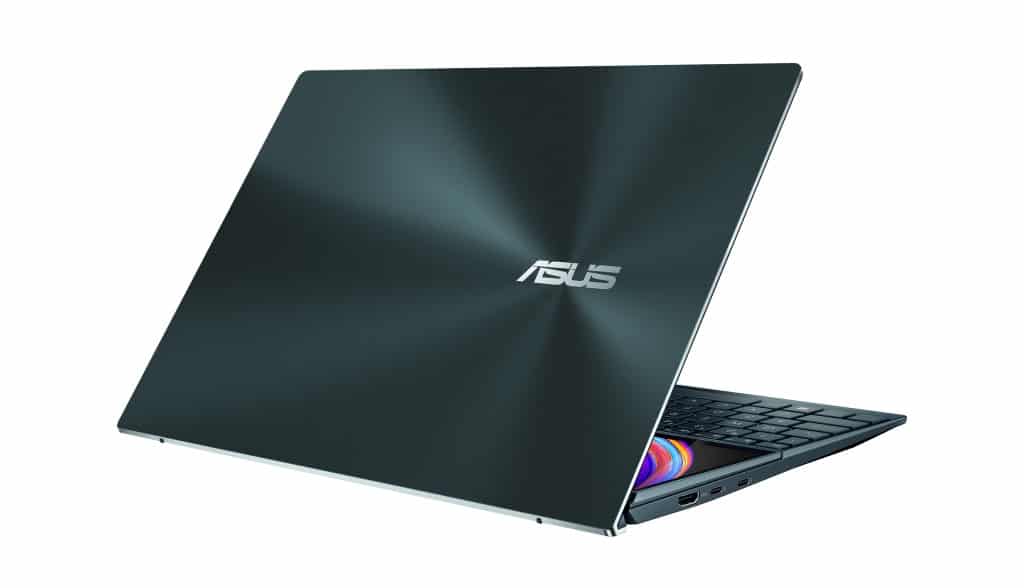
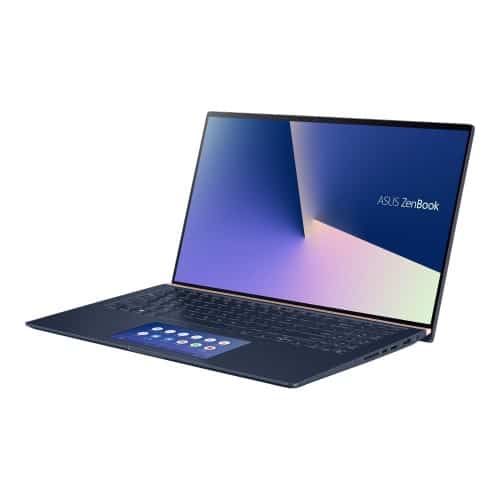
2025 update: There have been some huge releases this year, so you’re somewhat spoilt for choice. The below is the review for the classic UX582 model as pictured, but this year I would divide the best overall pick into 3 options:
The new double-screen ZenBook model: This is ASUS’s new flagship premium laptop. Unlike other dual-screen laptops, the second screen is full-size. The design of this model is fantastic as ASUS have developed a keyboard that can flip between separation from the screens to allow for dual-display, or covering the bottom screen for use as a traditional laptop while traveling. The specs of the screen are fantastic for 2025 too. I would say this is the model most productivity users should go for. The only reason it’s not the sole recommendation is that it does not have a standalone GPU like other models. If you are a gamer or need high graphics processing for your work, I’d recommend the next option.
The ASUS Zenbook Pro 14 Duo 2025 is the best new edition of the classic series (with one half-sized second screen attached to the bottom part of the laptop instead of 2 full-screens). The key advantage here is the addition of the RTX 4060, making it a much more powerful machine for graphics (although if you are solely looking for gaming, check out my gaming pick further below).
The review below is based on last year’s model of the Zenbook Pro Duo, we’ve kept it intact as the core features are the same as the 2025 version (just with lesser specs) and if you are not an intensive user, I recommend looking to see if this model is available as we’ve seen it occasionally go for a reduced price.
There are multiple great options in the multi-screen laptop space, but unless you’re on a tight budget or are looking for gaming, nothing comes close to the ZenBook Pro Duo.
There is so much to love about this offering, but let’s start with the obvious…
The included ASUS ScreenPad Plus is the best second monitor available today. Its specs and software capability combine to provide unmatched productivity options for creatives/professionals compared to any other laptop technology we’ve used.
Boasting 4K OLED IPS touchscreens for both your main screen (3840×2160) & the ScreenPad Plus (3840×1100) with excellent HDR capability, bright 400-nits and a 100% DCI-P3 color gamut, these displays are all capable of an incredible picture.
We really appreciate how ASUS has matched the specs of the main screen with the secondary monitor. Not only do they both have wonderful pictures suitable for professionals, media, and gamers alike, but there are also tons of pre-built and customizable utilities across applications:
For photographers, artists, and other designers -> You have the capability to use the second screen for most of your UI (clearing up the main screen), specific favorite shortcuts, and/or a zoomed version of your picture/design for detail touch-up.
For programmers – > Code windows can be extended by nearly 50% or the bottom panel can be used to display debugs, previews (or even a video call if you’re multi-tasking).
For general use -> Quick app accessibility, displaying the same content across multiple screens, writing notes while watching a main-screen video, the possibilities are huge.
We could go on for music producers, video editors, and many more, but you probably get the idea.
Nearly every popular program today (from Photoshop to Visual Studio) has customizability to get the setup you want with your screen layout. The Pro Duo makes this easier with plenty of presets available.
With the inclusion of the high-quality active stylus and excellent pressure variability on both screens, we really can’t think of a type of user that will be left wanting more from a design/note-taking perspective either.
Ergonomically, the setup feels carefully designed for your head to alternate between the two screens without discomfort, with a very thin bezel between the two displays and a slight tilt in the bottom half of the laptop to create a more comfortable angle (these may sound minor, but its subtle features like this that can make or break an experience long-term, and ASUS has refined the Duo in these important nuanced ways).
We will say that if you’re the sort of user that likes to use their laptop on their actual lap, the Pro Duo can feel a bit clunky. It’s definitely more of a desk/table setup.
What makes this offering extra special is the fantastic specs that match the high-quality external setup.
Led by a powerful Intel 12th gen core i7 CPU, 16GB RAM, and a very capable RTX 3060 GPU, the machine is clearly made with smooth operation in mind, including decent hardware for 4k video editing, advanced designers, and gamers.
With an enormous 1TB PCIe solid-state drive included, we’re pleased to see the storage solution is appropriately sized for creative demands too.
Which Pro Duo version to purchase?
If you search through Amazon, you’ll see a ton of different Pro Duo models. Many sound similar but actually boast outdated CPUs & GPUs. I’d recommend following our updated links to the latest versions we’ve reviewed.
I chose to feature the RTX 3060 model as I believe it represents the best balance between price and utility that most users will want.
If you’re using your laptop for high-end professional work (or simply want the most powerful version), you could opt for the RTX 3080 + 32GB RAM model. This is a great upgrade, but I think it may be overkill for many non-gamers.
If gaming is your main focus, you can get a lot done on either the 3060 or 3080 Pro Duos, with the latter performing about 40% better in gaming benchmarks. We would say, however, that the new Zephyrus Duo 16 we recommend further below would be the ideal pick for gamers.
ASUS has announced a new Pro Duo 14 OLED model; with a slightly smaller, brighter screen that has decreased the resolution to 2.8K in aid of a 120hz refresh rate (alongside a few tiny quality-of-life improvements).
We don’t know what the release date of this version is yet (likely late 2022/early 2023) but we would say it’s not worth waiting out for. The 3060/3080 versions we recommend here are both new 2022 models and will have very similar specs to the upcoming 14-inch version. In addition, the improvements are negligible and many will even prefer the existing 4k 60Hz screen over the new 2.8K 120hz display.
Is there anything we don’t like about the Pro Duo?
Well, to be honest; very little. This dual-screen ASUS laptop excels across the board.
One thing we would point out is a challenge you will get with most dual-screen laptops; the keyboard placement requires some getting used to.
Because these laptops have a second screen built-in, the keyboard is pushed to the very bottom of the machine, and the trackpad to the right (instead of its usual under-keyboard alignment).
Mostly, it just requires some muscle-memory relearning to get used to the new trackpad placement.
The Pro Duo has a lot of gaming potential – Source: aryaan04
Price-wise, yes this is an expensive laptop, but with everything on offer, we are pleasantly surprised by the value included.
When you consider the great CPU, RAM, GPU & storage accompanying the machine’s base specs and how both displays are some of the most beautiful 4k screens we’ve come across, it doesn’t feel like you’re just paying an unfair premium for the second display.
If you are a productivity user, we think the combination of powerful specs and the utility of the ScreenPad Plus could be treated as an investment that can markedly improve your output.
Still, we appreciate this not everyone will have the budget for this, and some of our options below (including the next one) are notably cheaper for you.
The battery life ranges from about 3-5 hours depending on usage. This is disappointing compared to an average laptop, but considering the power draw required for 2 bright, high-res displays, it’s nice to see it can still clock a few hours.
Finally, the Pro Duo has the build quality we hope for from a premium laptop. With a full aluminum exterior, very high-quality hinges, a tactile/satisfying keyboard, and a striking design, this is a rugged product that feels built for longevity.
It even demonstrates this by meeting the US MIL-STD 810G military-grade standard, a certification that involves tests with high pressures, salt fog, light rain/water spray, and certain levels of mechanical shock.
We’re pleased by the thermal design which does a decent job at keeping the system under control. Benchmarks have recorded high temperatures during very demanding activity, but never beyond the realm of normality for a powerful PC.
With everything said, we are simply floored by what a fantastic offering the ZenBook Pro Duo is.
Ticking pretty much every box we could hope for in displays, specs, software, and build quality, this is not just our top pick for the best dual-screen laptop available today, but one of the best PCs available in any category.
Now, as much as we love the Pro Duo, ASUS has crafted a budget dual-screen laptop that is equally compelling relative to its attractive mid-range price.
“Cheap” is of course relative. The Duo will still run you well over $1,000. But any cheaper and the quality of the product would be hampered, we really like the balance ASUS has struck between specs, screen quality, and price here.
Note: Be careful to go for the latest UX482 models instead of the UX481 version, which has outdated GPU/CPU hardware (as do some of the 2021 UX482 models, which is why we recommend following our linked products where possible).
The tech world has come out in near-unanimous praise for the new ZenBook Duo version, with its leading feature being an automatic-tilting ScreenPad Plus that provides an additional 7 degrees tilt for better ergonomics, viewing angles, and airflow.
On top of that, this new Duo model comes with some great specs for a mid-range machine.
With a Core i5-1135G7 Processor (with onboard Iris X graphics), 8GB RAM, and 512GB storage; you are, of course, not going to get the same performance as you do on the Duo Pro with its superior specs and standalone graphics card.
But for cheap to mid-range use, this laptop still packs a punch with the 11th gen Intel CPU leading the charge and would be great for work, media, and production users on a budget.
If your budget is somewhere in between this version and the Pro Duo, there are two higher-spec Zenbook Duo models we’d recommend.
Slightly more expensive is the 1195G7 Duo model with a notably upgraded CPU, certainly worth the ~$100 extra if possible.
If you can stretch further to around the $1,500 mark, the MX450 Duo version is our favorite. Not only is the GPU notably better than the integrated graphics of the other versions, but it also boasts twice the storage space and RAM. These updates would be particularly notable for video editors and gamers.
Source: ASUS
Screen-wise, the UX482 boasts 14-inch + 12.65-inch duo full HD touch IPS panels that still get nice, bright, and colorful with 400 nits and a 100% sRGB color gamut.
The picture quality won’t be as good as the Pro Duo’s 4K HDR screen but is legitimately impressive for the price with everything else included in the offering.
Port-wise, the ZenBook Duo feels nicely up-to-date too. With HDMI 1.4, 2 x Thunderbolt 4 Type-C USB ports, 1 x USB 3.2 gen 1 & decent onboard audio, Wi-fi, and Bluetooth. No corners feel cut on its outputs and we appreciate the double type-C ports.
With military-grade 810H testing certification, sturdy material, tactile keyboard, and a beautiful aesthetic, the ZenBook Duo’s build quality is rivaled by little else at the price point.
Sure, the Pro Duo feels like the all-encompassing choice, but we’re still really impressed by all of the boxes the Duo manages to tick. Even without the second screen, this would feel like a decent, high-quality offering.
But with the duo display in mind as well? If you’re looking for a cheap multi-screen laptop, the latest Duo is a fantastic, high-value offering.
2025 update: There are new versions of the Duo 16 released that bring the series up to 2025 gaming standards. Our favorite model is the 4090 edition which is one of the most powerful gaming laptops on the market in 2025. If you would like something cheaper, the 4080 edition is also an excellent choice. Bear in mind too that while I would recommend forking out for one of these models if possible, budget users would be fine with the ZenBook 4060 model which still packs a powerful punch for gaming..
The ZenBook Pro Duo, with its decent CPU and standalone GPU, can pack a decent punch for dual-screen laptop gaming.
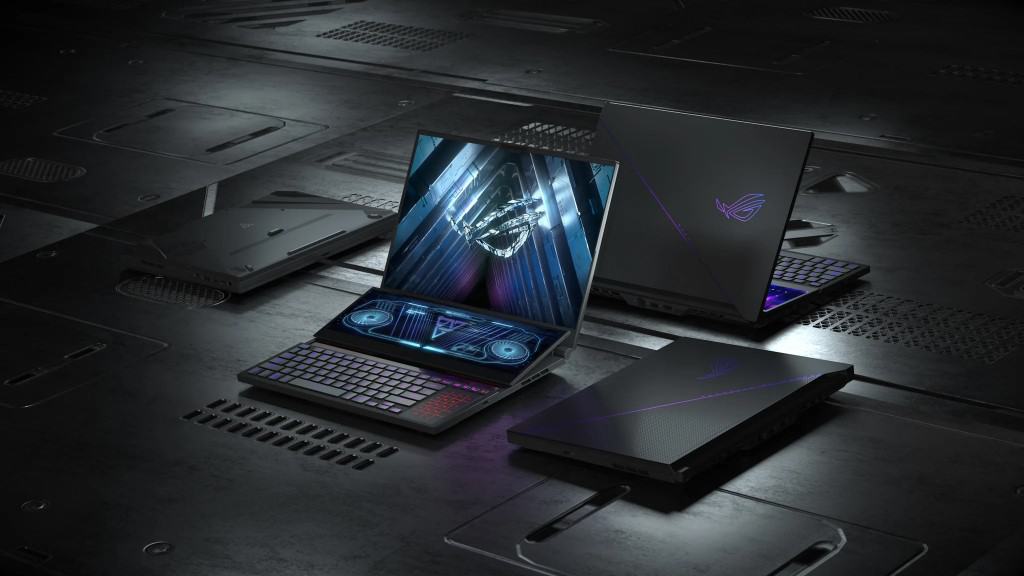
But if gaming is your main focus, then the Zephyrus Duo is a simply incredible choice (and also has plenty of capabilities elsewhere).
Important note: The linked model has fewer reviews due to being brand new on the market. The Zephyrus Duo is already a formidable, popular gaming choice, but we highly recommend our latest model highlights that include 3000-series GPUs.
The specs on the latest Zephyrus Duo models are simply mouth-watering.
Starting with screens. With a ROG Nebula HDR technology, up to 1,100 nits of brightness, and a mini LED panel, the contrast is stunning and better than many premium gaming monitors.
Both of these screens also offer an excellent 3ms response time, G-sync Compatability & fantastic color. The main screen boasts a QHD resolution and 165Hz refresh rate which, from our experience, is a great sweet spot for gamers. We can’t speak of just how fantastic gaming content looks on these screens.
The second display on both models offers a fantastic picture quality rivaling the ZenBook Duo Pro.
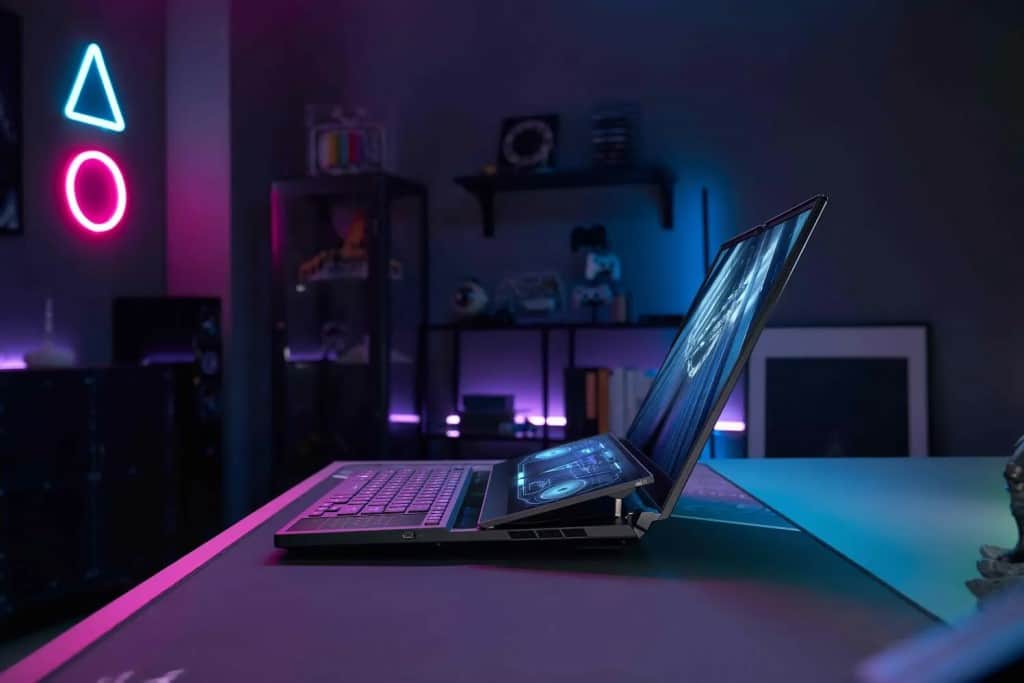
Not only does the second monitor boast a great ergonomic tilt, but also some brilliant software for gamers and creators alike.
Source: ASUS
We’ve already discussed what fantastic utility a dual-screen can offer for productive users, but gamers also have some fantastic options available:
Many modern titles work with the ROG ScreenPad Plus to offer UI menus on the secondary screen (also reducing on the main screen).
Anything from quests in single-player titles to top builds/metrics in competitive games/MMOs
Core hardware thermal UI options if you are focused on temp control or even overclocking.
Easily one of the best streaming laptops for Twitch and more; with a game on the main display and stats/chat/camera angles on the sub-screen.
Any other second-screen software you could find useful; our favorite examples are Discord, Skype, or TeamSpeak.
If you’re a fan of CEMU, this also happens to be the perfect PC to emulate Wii U/DS games (with the best way on the market to emulate these consoles’ second screens).
What’s even more impressive is that the laptop actually has the hardware to accommodate both QHD and 165Hz.
Boasting a fresh-on-the-market premium AMD Rzyen 9 6900HX CPU, 32GB DDR5 RAM, 2TB SSD &, of course, its all-powerful RTX 3080 Ti GPU, there is little more to be desired spec-wise.
Whether you’re after immersive titles like Cyberpunk 2077/Red Dead Redemption 2, competitive games like Overwatch/Fornite/League, or a VR-ready PC, the Duo 16 is very capable of ticking all the boxes (and is also a compelling offering for high-end video editing/design).
The build is rugged aluminum and the overall design is quite striking. The Duo 16 remains surprisingly portable for its 16″ form factor and is a true sight to behold and use. The exception to that rule is that you’ll mostly need a power outlet available when gaming because the battery will quickly dissipate with all of the specs and screens
The keyboard, with its beautiful custom RGB layout, is equally stunning; it’s tactile and responsive relative to many other gaming keyboards. We certainly don’t rank it up there with the best mechanical keyboard offerings, but we haven’t come across much better for laptops.
Now with all that said, the price tag is undeniably huge. We have focussed on the 3080 Ti edition because we love that there is 0 compromise: with the best laptop GPU on the market and an incredible screen/secondary set of specs, it’s as powerful as you could ever need in today’s market.
That said, the 3060 and 3070 Ti editions of the Duo 16 are both excellent in their respective price ranges. We would simply suggest you choose the version that best matches your budget.
If you have the budget, know that we don’t just rank the RTX 3080 Ti Duo 16 as one of the best dual-screen gaming laptops, but one of the top laptops for gaming in any category.
Alternative Budget Dual Screen Gaming Laptop: OMEN X 2S
2025 update: We have kept our OMEN X 2S review for completeness as some of our readers have still been asking me about it, but realistically, we don’t recommend this choice anymore. This is due to the specs being notably outdated, with no models boasting 4000-series GPUs. Even if the Zephyrus Duo 16 is out of stock or out of your price range, we would sooner recommend you pick up a Zenbook Pro Duo for gaming over the 2S.
Lead by its Intel i7-9750H CPU, NVIDIA RTX 2070 Max-Q GPU 8, 16 GB RAM & a 512 GB SSD, despite its lower price tag, the X 2S is still capable of decent gaming at great refresh rates.
Speaking of refresh rates, the 2S boasts a G-Sync enabled 144hz full HD main screen with an IPS panel and decent colors/contrast suitable for high-speed gaming.
One of the most impressive specs of the 2S is the second screen. Despite clocking in at just 5.98-inches diagonally, it’s still full HD with another bright IPS panel.
Even with the more modest specs of this HP dual-screen laptop, the second display is still crystal clear and feels beautiful to use for secondary content.
Another standout feature of the 2S is its fantastic speaker setup designed by Bang & Olufsen.
While we would never recommend any laptop speakers as your main audio solution when some fantastic headphones exist for just that, it’s still a great back-up and worthy for sharing content/media with others.
Source: HP
Another sturdily built device, the 2S looks very sharp. With its tough hinge, tactile RGB keyboard, and thermal design suitable for its specs, there’s little to complain about in the laptop’s physical longevity.
The main problem with the OMEN X 2S is simply its spec age; the RTX 2070-MAX Q still packs an OK punch and is perfectly capable of high refresh rates in most competitive titles and great settings on new games.
But with the RTX 3000 series now on the market, it’s not that 2070 is automatically redundant, but the above choices are light-years ahead in performance and value.
Also, it’s worth pointing out that the second screen is complete without tilt. This is something more common in the first dual-screen laptop generation (some of this comes down to personal preference, but we expect most users to prefer to ergonomics of a 2nd monitor lifted up by at least a few degrees).
So, as good as this offering is/was, you can probably see why we would push you towards any of the RTX 3000 offerings available across the Pro Duo and Duo 16 laptops versions.
Our last main choice is a step in a different direction for a double-screen laptop.
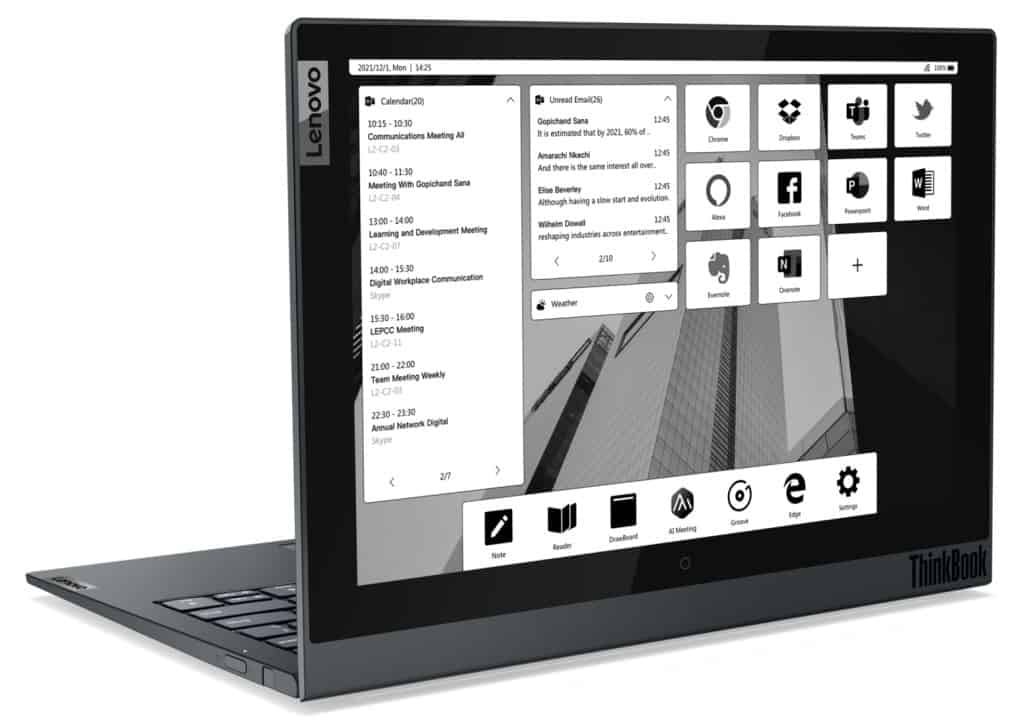
Lenovo is a powerhouse brand in the world of business-class computers, and the ThinkBook Plus represents their latest innovations in productivity for office/meeting spaces.
Instead of the usual second screen underneath the main display, the Plus adopts a screen on the other side of the monitor lid.
This may sound a bit counter-intuitive for productivity, but in the world of business settings and intensively-overstimulating modern work environments, Lenovo has come up with a new take.
The Plus’s second screen is a gorgeous full HD e-ink touch display.
Alongside the high-quality included stylus pen, this e-ink monitor, similar to those found on a Kindle (but higher-quality) is designed to be used while the laptop is closed. Think of the environments where having a laptop fully out is awkward: be it meetings, commutes, or quick impromptu sessions, these are the kinds of settings where the Plus excels.
What’s more, those environments are where an e-ink display is more than suitable; anything from quick note-taking, drawing diagrams to explain a concept, to reading documents/news content.
It may sound like a gimmick, but an e-ink screen on a closed laptop is notably less intrusive and easier to hold in these settings.
Also, anyone who works in modern screen-focussed jobs knows how subtlely exhausting it can be to look at business content on a bright monitor all day (especially when these are often office documents/spreadsheets, black text on white backgrounds can be subtle fatiguing to the human brain over long stretches of time).
This very notion is why so many modern workers still love notes/minutes on good old-fashioned paper.
Source: Lenovo
But I think the ThinkBook’s responsive e-ink touch display represents a great next step for this type of use. Collating, organizing, and editing notes on a PC is so much easier than on physical pads.The Plus offers easy integration to popular apps like OneNote to transfer and manage your business notes, diagrams, and more.
So, we don’t just appreciate the ThinkBook Plus from a productivity perspective, but also from an ergonomic one. Lenovo has designed this setup to give work users a much-needed eye break.
But with all that said, we know working on the main display is still the dominating part of most business users’ days, and that’s what makes the Plus such a compelling offering; it still excels as a single-screen laptop.
Boasting a Core i5-1130G7 CPU, 16 GB RAM & a 512 GB SSD, the hardware is more than capable of great general use, advanced office applications (including intensive spreadsheet capability), and perfect for multi-tasking (video calls, etc.).
The main display is also beautiful, its 13.3″ size keeping it portable for the previously described closed-top use, while still remaining large enough for productivity. Tied with a WQXGA resolution, IPS panel, and decent contrast/color gamut, it’s gorgeous for viewing various content (including media).
The Plus’s specs hit a perfect sweet spot for business laptop users. Anything more wouldn’t provide a marked improvement for most, but anything less would begin to deteriorate its experience and longevity/future-proofing.
We do think that the above choices will be a better pick for a majority of users. We think of the Thinkbook more as a great option for a certain niche.
If you are focused on modern non-design work, or simply love the idea of an e-ink option for your content, we think Lenovo has created a special unique laptop here.
It’s a worthy purchase if you prefer its utility to the other dual-screen Windows laptops we’ve covered today.
While the top 5 dual-screen laptops are our picks for the best of the category, there are a few more options that may be worth considering if you have a niche requirement, we’ve added them as quick-fire choices below.
Cheapest Dual Screen Laptop: ASUS ZenBook Duo UX481
The UX481 is the previous generation of our top budget pick, the ZenBook Duo UX482.
The specs on this last iteration are, of course, not as good as the new model. We think that the price difference for the UX482 models are more than worth it.
But if your usage is fairly basic and you’re looking for the cheapest multi-screen laptop possible, we’re seeing these models occasionally discounted at really low rates, it’s still a great general use/productivity PC if you are on a tighter budget.
Best Dual Screen MacBook: New Apple MacBook Pro 16-Inch
For Apple fans or those that rely on Mac OS, we didn’t want to completely miss you out.
While calling any MacBook a dual-screen laptop is a bit of a stretch, the newest 16-inch pro model comes with a mini-LED strip above the keyboard designed to be customizable with different software for your key options (e.g. color sliders, and other settings that are more easily selected with touch).
With its tiny size, you’re not going to get the productivity joy of our other top picks, but the MacBook Pro has a lot more going for it, and this mini screen is a step in the right direction for improved creative setups.
With appreciation to how a new dual screen laptop is an important investment, a lot of research and deliberation has been put into the various factors that decide what we consider to be the top choices.
We’ve balanced lots of details/nuances that won’t be completely covered here, but the below headings make up a majority of the ranking factors and what is most important for users:
Hardware specifications
It doesn’t matter how gorgeous a dual laptop’s screens are if you don’t have the specs to make use of them.
At the forefront of our decision-making is ensuring that the CPU, RAM, GPU, and storage on offer for our top choices are appropriate for the needs of the specified user.
The ZenBook Pro Duo, for example, balances premium specs suitable for every type of creative professional, including 4k content producers, while not compromising on capabilities for general users and even offering some gaming prowess for those that have entertainment as their secondary concern.
While for those that have gaming at the heart of their decision-making, we have chosen the Zephyrus Duo which, similarly to the Pro Duo, has great all-around specs, but with more of a budget focus on its graphics card to maximize settings and FPS in games.
We’ve also ensured our budget picks like the ZenBook Duo boast enough power to consider them suitable for comfortably running their duo screen setup even at a cheaper price range.
Screen quality
The capability of both the main and secondary screens has been a fundamental part of choosing our top picks.
We appreciate that many creative professionals or those after a premium experience are focused on display capability.
What in Tech has lots of experience reviewing various monitor categories and appreciate how important panel type, contrast ratio, nits-rating, color gamuts, and more can affect the overall quality.
So as well as focussing on the obvious areas like resolution and screen-size, we’ve ensured our top options balance these other vital secondary specs that really maximize how good your picture is.
We’re pleased to say the display specs of our top options, particularly the ZenBook Pro Duo and Zephyrus Duo, are up to the challenge of virtually any type of professional/creative user.
For gamers, we’ve retained a focus on excellent picture quality, but also ensured our top options (the Zephyrus Duo and HP X 2S) boast high refresh rates and low response times, both integral to a high-quality gaming experience.
For budget users, we’ve offered the option to choose between the next-gen dual-screen setup of the ZenBook Duo, still boasting gorgeous FHD screens, or the ASUS ZenBook, which only has a second screen on its trackpad, but boasts a superior 4k main display if that is particularly important to you.
Build quality
With the purchase of an innovative new laptop, we know a focus for users will be on the physical longevity of your prospective device.
A notable part of the ranking has included consideration for the build quality of each laptop (material used, hinges, any relevant certifications, etc.), many of the offerings are also existing popular products which have allowed us to understand the number of users with issues or any challenges with warranty/customer service.
We’re pleased to report that dual-screen laptop manufacturers seemed to have recognized that these offerings, with their notable price-tags, needed to be made to last.
All of our choices are made of decent material and boast quality not always seen at their respective price-range (the top ASUS picks take this even further with their military-grade certifications).
Our build ranking extended to the ergonomics of the choices too; we’ve considered the tactility and responsivity of keyboards, the pressure sensitivity of touch screens & the angle to which the laptops can open.
And finally, we’ve also considered the second screen placement as a qualitative factor; most notably if the screen tilts to a comfortable angle for viewing/drawing, as well as the size of the bezel in between the screens (thinner frames ranking higher).
Thermal solution
Throughout the research and deliberation of how to rank each 2 screen laptop, we’ve put real stock into how devices perform in various thermal/cooling benchmarks, and if their results are acceptable for their relative power outputs.
We are pleased to report that for the most part, the offerings on display throughout this feature have thermal designs, including intelligent fan/heatpipe placements, that work to efficiently cool the systems.
There have been some examples of thermal throttling seen online, even across the top options, but these have usually been minor cases and, to an extent, to be expected with such advanced hardware/screen setups.
Battery life
We’ve stated throughout this guide that the battery life of dual-screen laptops isn’t on par with traditional portable computers; you can expect to achieve between 2.5-6 hours for most offerings (which is still impressive for the amount of power draw a 2 screen setup & premium hardware demands).
Despite this, we’ve still been sure to consider the variability in battery life between our top options as a ranking factor, with the ZenBook Pro Duo and Duo boasting some of the best batteries of the options on the list.
Software & user experience
The best part of having a laptop with 2 screens is simply being able to use the second screen for whatever you want; dragging, dropping, and customizing any type of window you can think of.
Although with that said, we think with this category, it was prudent to provide some slight extra ranking favor to ASUS, which specifically has some decent software availability to make exploiting the utility of a second screen as easy as possible (especially for the new ZenBook Duo model, with access to ASUS ControlPanel, a revamped set of UI options for popular design/productivity software).
We ranked the ZenBooks and Zephyrus offerings at the top for much more than the improved user experience, but it is still an appreciated value-add that is worth calling out.
Ports
All picks have suitable ports for most users, but we have included some consideration in our rankings for those that excel at providing excellent outputs.
The new ZenBook Duo model, for instance, pleasantly including 2 x USB Thunderbolt 4 type-C ports, is an impressive feature at the budget, and is a nice recognition for the many creatives focussed on these picks, who will undoubtedly benefit from high transfer rate options.
Price
We haven’t just dubbed the most expensive laptop the best choice (if we had, we’d be recommending the premium RTX 3080 Zephyrus Duo to everybody!).
While some of our top picks are high-end choices, we’ve ranked based on value to the end-user for different requirements.
The ThinkPad Plus, for example, is more modestly specced, which is a better value offering for business users who don’t necessarily need high refresh rates, 4k screens, powerful GPUs, etc.
While the ZenBook Pro Duo better balances the screen & hardware demands of both professional creatives and users after a premium experience across any function, specifically recommending the cheaper version, which we think represents a better sweet-spot than the 32GB option.
The same consideration has been made for our budget picks (ranking less expensive dual-screen laptops based on their value/capability, not just on which is the cheapest, the latest ZenBook Duo is the clear stand-out with this in mind).
Sound (low importance)
Although not a heavy factor, we’ve considered the speaker sound quality in the above picks during our rankings; as you can expect with modern laptops, no speakers represent sound good enough for primary use, and we’d always recommend a speaker/headphone setup.
That said, the speakers on display in many of these devices are perfectly serviceable for sharing basic content with others/simple use – the HP X 2S, in particular, have impressive speakers as far as laptops go.
In terms of onboard codecs for audio input, there wasn’t a notable difference between any of the options, all capable of outputting great sound with a decent pair of headphones.
What is a dual-screen laptop?
A dual-screen laptop is designed to offer an experience that rivals modern multi-display desktop setups all within a portable laptop unit.
This is done by placing a second screen directly on top of the keyboard area.
This is the ideal placement as it ensures that only a thin bezel lies between the main and secondary screens. Ergonomically, it allows users to quickly look between the two screens comfortably, even for longer sessions.
Some critics initially wrote this off as a gimmick, but that’s become a less popular opinion the more we’ve seen how exciting the possibilities of a laptop with 2 screens are:
Most dual-screen laptops (especially ASUS) have preset software for popular programs to maximize your workspace (e.g. Photoshop UI on the bottom screen with pictures/drawings maximized on top)
Even when there aren’t presets available, customization offers endless options, such as:
Your most important work settings to declutter the main screen
Note-taking during a main screen video lecture
Skype/Discord call and chat while main screen gaming
These are just some examples. With the ability to place any content on the secondary display, the possibilities are as limitless as your imagination; dual-screen laptops are an innovation that is likely here to stay because they provide so much utility for creatives, professionals, and general users.
However, we think in a lot of cases, choosing one of the top picks above is more than worth the price for a few reasons.
The most significant one is that, with everything else these offerings provide, the premium you’re paying for the dual-screen isn’t nearly as bad as many other laptop innovations and feels like a fantastic value add for most users.
Even if you take away the second screen, you are still left with one of the most stunning primary 4K HDR IPS displays, a fantastic CPU, GPU, and RAM capacity for modern computing, an incredibly striking design and build quality that is both fined-tuned for ergonomics and physical longevity.
The premium choices aren’t just good for their second monitor, they tick all the boxes we expect from any high-end PC without corner-cutting.
And if you’re a lower/mid-range user without the budget, the ZenBook Duo is an equally compelling example; competing with many other cheaper single-screen offerings at its price range.
Yes, there is a premium for a duo screen laptop, but:
For creatives and professionals, we would argue the productivity-gains from the second monitor will quickly outweigh the additional cost (in other words, it’s a decent investment).
For gamers, there are certainly some great single-screen options, but there’s a reason why most desktop-gamer setups have a second monitor; not having easy access to other content like Discord calls, guides, or streaming when your main screen is focussed on your game can be frustrating. You don’t need a second screen, but it’s a fantastic upgrade and worth the extra budget if you have it.
We also like that the specs of our top choices tend to lend them well to all sorts of different types of computing.
In other words, you’re not paying for just one type of device; the ZenBook Pro Duo or ROG Zephyrus Duo could both comfortably operate as a 4k video editing PC, a gaming laptop, a media device, and accommodate a majority of other mainstream demands.
With all that said, there are a couple of situations you may want to consider a more traditional laptop:
Low budgets – While we think the extra cost is worth the value-add for most people, we appreciate they are still more expensive than the average laptop. If you find yourself unable to accommodate the cheaper picks comfortably, then we would recommend focussing on the budget options of our longest-lasting laptop feature.
Ultra-portable requirements – Dual screen offerings are very capable of being moved around (especially with their sturdy build qualities) – however – if you are the kind of user who is very rarely settled in one location for more than an hour, prefers using a PC on your lap or is often without an outlet for more than a few hours at a time, DS laptops may not be the best choice due to their low battery life and better alignment on a desk. If this describes you, there are some traditional options more suitable.
For most users, however, 2-screen offerings are easily the best multi-tasking laptops available today and worth the money if your budget allows.
Final Word
And there you have it! The above picks are not just what we think are the best dual-screen laptops available, but with consideration to the incredible specs, build qualities, and value of picks like the ZenBook Pro Duo and Zephyrus Duo, we’d go as far as to call these some of the best laptops available for gaming, video editing, visual work, and other productivity/entertainment goals across any category.
So yes, there is a premium for a second screen. But as far as premium laptops go, this is one of the greatest additions in many, many years to portable innovation. Investing in one for your next laptop isn’t just exciting, but also opens up so many creative ways to maximize productivity and enjoy your entertainment.
Kaelum Ross, BSc is the Lead Writer at What in Tech and a leading authority in PC hardware and software. With a career as a senior IT professional, Kaelum has led multi-million dollar projects covering everything from bespoke software development to complex Windows hardware upgrades. Today, Kaelum uses his expertise to serve What in Tech's readers and has been featured in numerous global publications including New York Magazine and Lifewire.
We updated this article in January to cover some of the latest releases on the market. Our top pick, the Asus PG65UQ, remains the largest monitor by some margin but is now rarely in stock and arguably not as good as the other picks we’ve highlighted. I’d encourage anyone serious about buying a large monitor to go for one of the other choices instead of waiting out for the Asus PG65UQ.
When it comes to work and PC gaming, there’s nothing quite like using a massive monitor.
Resolutions have climbed in recent years to the point that the best monitor manufacturers have begun offering some seriously huge options that still have suitable DPIs for a PC setup.
But the biggest monitor doesn’t always mean the best quality.
So, today’s feature is here to not just here to guide you through the largest computer monitors, but also the ones worth buying after my many reviews through the world of monitors (with different uses, sizes and budgets in mind).
2025 update: The PG65UQ is still the largest monitor available, but I’ve seen it run into a bunch of stock issues recently; it’s rarely been available.
With that said, as my review highlights, this monitor may be the largest, but it’s not the best choice for most.
My strong recommendation? Check out the other picks in this list; if you need do need a 60″+ monitor, the OLED TV is a great replacement, if you want a traditional monitor, the super ultrawide picks below are fantastic.
We’ll start by saying for many users (business/gaming focussed alike) we don’t think this size is necessarily the best pick-up, which is why we’ve focussed on 43″-55″ monitors in most of this feature.
We also think that our next OLED TV choice will likely suit a majority of PC users better for far less cost if you do want an enormous size.
With that said, no list of the largest computer monitors would be complete without the PG65UQ.
Boasting an incredible 65″ size alongside its 4K resolution, DisplayHDR1000 capability, 144hz refresh rate & 95% DCI-P3 & 4ms GTG response time. The PG65UQ has some fantastic capability not just as a gaming monitor, but also as one suitable for media & general use.
With G-Sync ultimate support, there’s great onboard functionality for avoiding v-sync/ghosting issues; this is integral for a display of this refresh rate/size, where screen tearing and other common issues are even more visible if no high-end screen sync technology is in place.
The build quality is also everything I would hope for in a premium display. With a sturdy design that feels built for longevity, not to mention incredibly thin bezels and a subtlely tasteful ASUS logo illuminating underneath.
So with all that said, why do I suggest something slightly smaller?
Well, although the PG65UQ is a beast, we assume that most reading this list will be looking for a PC monitor for gaming, media, or business/general use.
While it fits nearly all the specs perfectly, there is one problem; the 2160p resolution may be a lot, but at 65-inches, it begins to slightly show with a lacking DPI at this enormous screen size.
If you’re in the market for a premium monitor, we expect you’ll be after sharp text and crisp game detail even while sitting relatively close. If this is the case, our 43″-55″ monitors are the better choice, boasting the DPI we think is more suited for a PC experience.
If, however, you’re primarily after a monitor for gaming from afar with a console, then that issue is largely negated.
But there is another lacking area for you; there is no HDMI 2.1 output.
HDMI 2.1 introduces significantly better bandwidth rates and empowers you to play at high refresh rates/resolutions on PS5/Xbox Series X. To buy a monitor of this caliber without it seems wasteful for console gamers (if you’re focussed on PC gaming from afar with DisplayPort, then we have no qualms, and this is a great choice).
If you are in that console-gamer category, or a PC gamer who isn’t opposed to an OLED TV as a primary monitor, we would instead highly recommend the LG CX OLED pick a little further down.
For a significantly smaller price tag, you are getting an HDMI 2.1 display that excels in picture quality, contrast, while also being put together to counter the usual complaints about using a TV as a monitor (i.e. very high refresh rate and low latency).
Although this all sounds like a negative take, we do in fact, really like the PG65UQ. We just think the next pick trumps it in a majority of ways.
If your singular goal is the largest computer monitor possible and you would like to avoid an OLED TV for your setup, then this is the choice for you.
Its DPI may be a tad low, but with its fantastic HDR, color, and refresh rate, it’s still a fantastic gaming monitor and beautifully encapsulates so much of what you want in a big format gaming display/BFGD.
Largest OLED TV for Gaming or Work: LG OLED55CXPUA
I alluded in my review above that for console gamers focused on a premium experience, this OLED TV choice will be better for you than the other options on the list.
That said, this isn’t just for console gamers; if you’re not a user concerned about the effects of OLED burn-in, I think this is arguably the best choice for nearly any user after an extra-large monitor.
This includes those after something for media, general use, or business work. I think you’d be pleasantly surprised by what’s on offer here even if you were intending to avoid TVs.
If you haven’t experienced an OLED before, it’s hard to describe just how incredible the endless contrast ratio can look versus traditional LEDs. With the deepest blacks, and an incredible color range, the picture quality available here is the best on the list.
For general/work use, the sharp contrast is perfect for displaying anything from documents to media, to trading/production software in crisp detail.
Now, the worry with a TV for use with gaming and as a PC monitor replacement is its latency/refresh rate.
But LG has impressively innovated a massive 4k screen that boasts 120hz, G-Sync/Freesync support, and response times as low as 1ms.
I really can’t articulate just how good you can expect your content to look on this screen. These secondary specs essentially completely negate what often makes TVs worse than monitors for PC users.
And for console gamers, this TV supports HDMI 2.1 which is integral to gaming on high refresh rates/resolutions with the latest console generation.
The screen is amazing in lots of ways, but this alone is why I rate this LG TV as superior to any extra-large monitor for console use.
Whether you’re focused on immersive titles, competitive gaming, or non-gaming content, the LG CX ticks pretty much every box.
Size-wise, the largest available is as high as 77-inches, larger than the biggest PC monitor available today.
For most users, I would recommend the 55-inch (at a stretch 65-inch) if you plan to be up close and use it as a monitor replacement due to the decreasing DPI at the top sizes (if you plan to mainly consume content from further away, however, any size is great!).
You may have also noticed that compared to a similar PC monitor like the Alienware 55-inch AW5520QF, this LG TV runs at around half the price.
So, with all of this excitement, there is one caution to mention: OLED TVs carry the risk of burn-in, and the LG CX is no exception.
Burn-in can occur when certain pixels (especially bright colors) are set in the same position for a long period of time over many usages.
Due to the way OLED TVs are created, this can create a slightly transparent permanent “etching” of those pixels.
For TV/console gamers, the issue is minimal as your content will always be moving. The main concern here is when used as a PC monitor, most notably the Windows 10 logo in the bottom left is the main risk for minor burn-in. Or, if you’re a gamer focussed on a single title (e.g. a MOBA or MMO with a static UI) you may carry some small risk.
I’ll be clear though. In my experience, this is a very minor risk (I wouldn’t be featuring it if it was a more emergent issue). Burn-in is reminiscent of plasma TVs; yes it’s possible, but as long as you’re not leaving your monitor on all the time with the exact same pixel arrangement in certain areas (i.e. turning off/running a screensaver during idle moments) then the immense cost saving of the LG TV over the more expensive monitors makes it more than worth it.
Finally, while not straying away from the traditional TV design conventions, the LG CX looks very sharp, understated, sturdily built, and incredibly thin (it’s heavy at larger sizes, but still capable of VESA mounting).
So, with everything said, the LG CX doesn’t just offer the largest PC monitor replacement available with an incredible picture but also does so at a fraction of the price compared to the enormous monitor offerings.
If you can get on board with using a TV as your monitor/gaming solution, I think you’ll love the LG CX.
2025 update: With its great price in mind, the CX series is still our top pick for the best large gaming TV in 2025. That said, LG has released an updated C1 version. The models are fairly similar, with the C1 having some updated software and an improved game mode setting that will take off a few extra milliseconds of latency (nice, but not essential at all). If you are extra serious about having the largest monitor, the C1 comes in an 83-inch version (it’s a very steep increase in price, however, so only consider it if you have a huge budget).
Moving away from the largest 16:9 screens, Samsung instead positioned itself in the market with a focus on super ultrawide screens.
This naming convention may sound like a gimmick, but it refers to the 32:9 aspect ratio of the Odyssey G9. With a 5k resolution (5120 x 1440), this 49-inch monitor is the size of 2 1440p 27-inch screens in 1.
As far as work, general use, and other typical PC applications go, the utility of this is obvious; super ultrawide screens are perfect for productivity and multitasking.
While I recommend a Dell 49″ 32:9 screen further below that’s tailored for work, I think the Odyssey G9 is more than capable of a fantastic business use setup (and is notably cheaper than the other offering). I’ve had the chance to work on it in a limited setup and it didn’t leave me wanting in any way.
But it’s gaming where the Odyssey G9 really shines.
With a 240hzrefresh rate, 1ms GTG response time, G-Sync/FreeSync Premium Pro support, HDR1000 capability & fantastic colors through its QLED IPS panel, the specs for gaming are incredible.
With the plethora of titles that support its UWQHD resolution. Playing immersive games in a 5K UW resolution is an experience that is hard to describe. I love that the G9 also boasts all the specs perfect for more competitive/esports-focused users.
This is also the largest curved monitor available, with 1000R curvature. This rating is the strongest curve you see on mainstream offerings, suitable for users after a real extra layer of immersion (and with the wide aspect ratio, the G9 feels like it engulfs you in your content; it’s quite a sight to behold.
Note: although we are discussing the G9; its 120hz brother, the CRG9, is a fantastic offering at around 15% less in price. Do we think the 240Hz refresh rate is worth the extra price for gamers? 100% But if you are price-focused, the CRG9 is still a premium gaming monitor in its own right (and if you are solely non-gaming focussed, it’s the better choice).
I’m simply floored by what an incredible offering the G9 is. No other screen encapsulates the kind of innovation I would want from a high-end monitor and it’s just such a joy to consume content on.
This isn’t just the widest PC monitor, but the best out of the competitors in the super ultrawide space.
If you prefer the immersion/productivity possibilities of 32:9 over a larger 16:9 screen, then you’re going to really appreciate what this Samsung offering can do.
As much as I gush about the Odyssey G9, there are certainly some other fantastic super ultrawide monitors available.
The U4919DW is the other one I think is worth highlighting. Designed as both the largest & widest monitor for business/general use.
With its 5120×1440 resolution & fantastic contrast/color gamut, the display looks as crisp as you would hope for anything from spreadsheets to video calls.
The real question is if you will prefer this to the CRG9/G9, and that comes down to a few areas.
Firstly, and perhaps most importantly, the U4919DW boasts significantly less curvature with a rating of 3800R.
This has been designed because Dell expects business users to share content more and this curvature is more accommodating to larger viewing angles. A flatter screen can be slightly more ergonomic for “flat content” like spreadsheets (where games can benefit from the dramatic curve of the G9).
The monitor also proudly boasts its KVM capabilities, which allows you to connect 2 PCs at the same time to the monitor (the G9 can also do this, but the instructions are a little less clear because it isn’t marketed for work).
Not only is the picture great, but it’s also designed to accommodate business/general use (while the Samsung CRG9 is preset for gaming, you’d need to tinker with the settings to get an optimized screen for work purposes).
The thing that disappoints us with the U4919DW compared to the Samsung offering above is its price.
It’s certainly a high-end monitor worthy of a premium budget; but the Odyssey CRG9, with its more impressive specs across the board, is cheaper.
With that in mind, we think it’s worth going for the CRG9 over this Dell pick in a lot of cases, even if you are not interested in its gaming capabilities.
That said, if easy KVM functionality, no picture-setup requirements, less curvature & better viewing angles are important to you (and gaming isn’t), the U4919DW is your best large monitor choice.
Largest 16:9 Monitor Cheap Option: Philips Momentum 558M1RY
If you’re focused on a 16:9 monitor for gaming or work, but don’t have the budget for the largest screen at the top of our list and aren’t happy with an OLED TV as a replacement option, the Philips Momentum series is the next best thing.
Still an enormous 55-inch monitor, the 558M1RY boasts some excellent specs across the board at a significantly reduced price tag compared to our top ASUS offering.
With UHD resolution, 120hz refresh rate, DisplayHDR1000 capability, AMD FreeSync Premium Pro (G-Sync seems to run unofficially too) & 4ms GTG response time, the specs are excellent across the board.
When reviewing it, I also appreciated how the monitor manages to retain low latency even with HDR enabled, making it an incredible choice for immersive gaming titles.
One of the surprising USPs of the 558M1RY is its fantastic speaker setup.
On TVs and monitors alike, getting a standalone sound solution is nearly always the best bet. But here? You have a perfectly legitimate audio offering as far as gaming/media goes, with a Bowers & Wilkins-designed setup that emulates surround sound and boasts an integrated woofer.
Note: Through various user experience, we’ve noted that installing the latest drivers for this choice are integral when using it as a monitor (to ensure display/text sharpness).
For console gamers, there is no HDMI 2.1 hereand we still highly recommend sticking to the LG OLED TV choice for your needs (unfortunately, there seems to be very little HDMI 2.1 availability amongst the biggest monitors).
It’s worth also touching on the quality and design of the 558M1Ry too; with an incredibly sturdy build that feels deceptive considering its tiny bezels and ultrathin depth, it’s one of the most beautiful monitors available.
55-inches is still a massive monitor, and with the Philip Momentum’s superb specs, this is a great choice for a high-end setup that demands some of the biggest PC display visibility for gaming or work.
Although the above choices are our absolute top picks for the biggest PC monitors today worth buying, we want to recommend some quick-fire options for users who:
Run into stock issues with the above (these other choices are excellent alternatives).
Want a large computer screen, but not quite as large as these, with some 40-inch monitors below.
Largest OLED Monitor: Alienware OLED AW5520QF
With the low latency of a PC monitor and the unrivaled contrast of OLED, this Alienware screen is a pricey, but stunning offering.
If you instead want a 16:9 screen specifically tailored for work/high viewing angles, this 4k display is beautiful and very capable with non-gaming content.
Its most impressive USP is its ability to operate as a multi-client monitor, capable of running 4 1080p screens simultaneously.
Best 43-Inch Gaming Monitor: Asus ROG Strix XG438Q
If you were surprised that our largest monitor picks got as big as they did, you may appreciate the XG438Q; while still an enormous screen, it’s certainly not as all-encompassing as our top picks but just as high-quality.
If you liked the sound of the Samsung/Dell superwide monitors but can’t stretch to them, Viotek is a great brand for offering a budget version of high-end gaming monitors.
We don’t love it quite as much as the G9, but it’s still an excellent large PC gaming screen.
Filling nearly an identical need to our top Dell recommendation, this wide monitor from LG is a compelling alternative.
We only rate it lower because its availability is historically not as decent, but if you are work-focussed and it is in stock, we think you’ll enjoy its capability.
And there you have it! After deliberation over everything from DPI to color gamuts to build quality, the above are our top picks for the largest computer monitorsworth buying today.
If you were looking for a 75-inch monitor, 100-inch monitor, or something even crazier, you may be disappointed to see that the largest PC displays available don’t go quite that high (unless you count the LG OLED 77-inch choice).
We would say, however, with the current 4k alignment with mainstream options, getting a PC monitor in the 43″-55″ range is the sweet spot, and where we recommend you to go for crisp content if you’re sitting up-close.
Kaelum Ross, BSc is the Lead Writer at What in Tech and a leading authority in PC hardware and software. With a career as a senior IT professional, Kaelum has led multi-million dollar projects covering everything from bespoke software development to complex Windows hardware upgrades. Today, Kaelum uses his expertise to serve What in Tech's readers and has been featured in numerous global publications including New York Magazine and Lifewire.
Covering the highest quality options for serious gamers
This article has been updated for 2025. We’ve update a couple of picks and added some alternatives through the article for other specifications that we’ve enjoyed recently.
144hz? Sounds kind of slow!
If you’re into competitive gaming or looking for the best monitor possible for immersive titles, you’ll know how wonderful playing on a high hertz gaming monitor can be.
Thankfully, there have recently been a few exceptional products to take high Hz displays well beyond the usual 60-144hz + 1080p specs.
In today’s feature, we’ve reviewed the highest refresh rate monitors worth buying for different resolutions and budgets.
Usually, on our top monitor features, there is a close battle for the top choice.
But in this category? There is a clear winner.
With an incredible 500hz, this Alienware display is unrivaled by every other option.
Not only is this the highest Hz 1080p monitor available on the market, but it’s as good an offering as we could hope for with plenty of other decent specs elevating the screen’s quality.
To start, the AW2524H runs on an IPS panel. This is great to see when many of the other highest refresh rate displays have chosen TN/VA. Alienware has also negated the usual main downside of IPS with a 0.5ms GTG response time. With the refresh rate and the incredibly low latency, I easily rank this as one of the best monitors for esports & competitive gaming.
Working alongside the IPS panel is a 390 nits rating, G-sync, Nvidia Latency Analyser, and DisplayHDR 400 capability. We love that this gaming monitor hasn’t sacrificed picture quality for the highest refresh rate (you’re getting the best of both worlds).
Finally, with decent, sturdy adjustment options, thin bezels, and a beautiful design, the AW2524H feels like a premium gaming monitor should. I have no notable complaints on its build quality.
Source: Alienware
500hz vs 360hz vs 240hz Monitors
But let’s talk about 500hz for a moment.
A refresh rate 40% higher than the next common high refresh rate option (360hz), 500Hz is a huge technical achievement by Alienware.
With that said, this jump isn’t going to feel like a 40% improvement to the human eye. We’re reaching the point now where high refresh rates are becoming largely a vanity factor.
I’ve seen firsthand the 240hz, 360hz, and 500hz side-by-side; there is a difference between 240hz vs 360hz, but it isn’t huge (even professional gamers are happy on 240hz, even 144hz screens).
When it comes to 360hz vs 500hz, I honestly couldn’t tell the difference, and many people online seem to share the same experience.
This is why I’ve recommended many other types of picks below, I think gamers would often prefer a lower refresh rate at either a cheaper price, higher resolution, and/or larger screen size.
So really, your pick in this area comes down to your personal preference over resolution/size/refresh rate/budget, which is why I’ve highlighted some other recommendations further below.
We’re a long way away from ever seeing 1000hz monitors and beyond, so expect 500hz to be the king for a long time.
If none of this comparison deters you and you still want the smoothest experience possible, then know this isn’t just the highest refresh rate monitor ever, but a display that excels in the other important factors of what makes a great gaming display.
2025 update:The AW2524H replaces our previous top pick, the ASUS ROG Swift 360Hz PG259QN. It’s a very impressive technical jump, and I doubt we will see anything higher than 500hz for a long time. So if your singular goal is the highest refresh rate, this is perfect for you. But as my review goes into, I think the other picks in our list around the 144hz – 360hz mark will be the better choice unless you are a proffesional gamer.
Now, as much as we rate our top 360hz choice, if you’re focussed on immersive titles as much as you are on competitive gaming, then you will likely want to consider our next 2 choices.
This LG monitor offers an incredible UHD + 144hz combo. While nowhere near as smooth as 360hz, running games at 2160p with a high refresh rate is an entirely wonderful experience in itself.
Similar to our top pick, we love that LG has managed to base this model on an IPS panel with a 1ms response time. Taking the display further, this display also has an impressive DCI-P3 98% color gamut & VESA DisplayHDR 600. Between all these specs, you can expect fantastic blacks & colors, and when tied with the resolution and refresh rate? Well, few monitors are going to produce better output, especially at its respectable price point.
Source: LG
There’s G-sync / AMD FreeSync compatibility included, with a striking design and beautiful build quality. Two design areas specifically stood out to me:
The incredible screen-to-body ratio, with some of the thinnest bezels of a premium display I’ve seen. This choice would make a fantastic high refresh rate monitor for a dual display setup.
The RGB Sphere Lighting 2.0 is included on the back of the unit. This will output colorful lighting onto the wall behind your monitor which can be customized to blend into what you’re seeing on screen. It sounds gimmicky, but combined with its thin bezels, it’s a really nice effect to view in person.
Ranking at the top of our 4k 144hz display feature, there’s so much to love about this LG model. At its decent price point, it’s easily the best choice for someone after the highest refresh rate 4k monitor for gaming.
2025 update: Samsung has recently released a 4k 240hz monitor with some absolutely mind-blowing specs (its Odyssey series is known for the utmost quality amongst high-end choices). That said, we still highly rate this LG model as it comes in at a significantly lower cost and is more available (you’ll also need an exceptionally powerful PC for a 4k 240hz monitor to be fully effective).
Last but not least out of our top 3 highest refresh rate gaming monitor picks is what you could call a “compromise” between the two choices above.
If you want the joys of very high refresh rates but also want a resolution that notably improves graphical capability beyond full HD, this is easily the best pick on the market for you.
Boasting an IPS panel that takes response time even further with 0.5-1ms response time with agile-splendor technology, this is one of the lowest latency monitors out of the premium choices on the market (we will say the difference between 0.5 and 1ms is often negligible even for high-level play, but it’s still a nice bonus).
Tied with these specs is a 99% Adobe RGB color gamut and HDR400. Alongside its IPS panel, there’s plenty of capability here for a gorgeous, bright picture (alongside the ability to use AMD Freesync / Nvidia G-Sync to reduce stuttering/screen-tearing).
Source: Acer
While the standard ceiling for 1440p is 240hz, the Xbiipruzx takes this a step further with the ability to overclock to up to 270hz with DisplayPort or USB Type-C. You don’t need this overclocking for the monitor to be incredibly capable of smooth gameplay, but it’s a nice bonus for those extra focused on building the highest FPS monitor for their setup.
There are no complaints from us on the build quality either. With a sturdy, adjustable frame and beautifully thin bezels, the monitor is perfect for a multi-screen setup if desired. It looks a little plainer compared to our other top picks but this is a very negligible point.
The only thing we don’t like about this monitor is the model name (who knows what Acer was thinking with that eyesore!) but you know a model is good when the name is my biggest complaint.
While it is an expensive choice, we see many monitors well above this price point that don’t match the well-balanced nature of this Acer display’s specs.
If you’re looking for the highest refresh rate 1440p monitor that is worth buying today at a mid-range price point, you’ve found it.
Now, if your budget allows, I’d recommend one of the other 3 picks above for someone after the highest Hz monitor for esports/gaming.
That said, our last two picks are great options if your wallet demands something closer to the $150-300 range.
The Acer XF250Q still boasts a fantastic 240hz refresh rate and is a superb option for someone after an esports monitor.
One of the cheapest 240hz displays on the market, the model still has a lot going for it; with 1ms response time and AMD Freesync compatibility.
Source: Acer
In addition, we like that there doesn’t feel like any skimping on build quality/adjustability here, even going far as to include a vertical orientation option. It’s also from one of the best monitor brands in the business. Sometimes, cheaper options mean going to less reputable manufacturers. That’s thankfully not the case here.
So, where does this choice lack compared to our top picks? Well, of course, the main loss in this category is at 1080p, there is a superior 360hz display available which will be a significant increase for serious gamers. And if you’re happy with 240hz, then the 1440p 240hz options available are notably better.
This isn’t just true in terms of resolution/refresh rate, our top 3 picks also have IPS panels, very high nits brightness, and great color accuracy. This Acer XF250Q model isn’t bad in these areas (certainly superior to many similarly priced picks I’ve reviewed), but it runs on a TN panel and will not give the same premium picture you can expect from our top picks.
With all that said, if this price point is the furthest your wallet can stretch, then know we included this great option for a reason. It is easily my top recommendation for those after the highest refresh rate monitor on a budget.
To round off our list, we wanted to include another commendable budget pick for those after the highest refresh rate monitor at a very low price.
This LG offering strikes an incredible balance; not much more expensive than the cheapest 60hz monitors we would recommend, it somehow manages to run 1080p 144hz with a 1ms response time.
This really is very impressive for the price point. Of course, don’t expect gameplay close to as smooth/sharp as the picks above, but we’re still floored by what they’ve managed to pack in here.
144Hz vs 240Hz
If you’re trying to decide between our two budget picks, we would say the upgrade to 240hz will be worth it for those with powerful PC setups who focus on competitive games (CS: GO, LOL, Dota 2, etc.).
If, however, you’re more of a single-player gamer, or your PC is also a budget build, you will still see benefits from 240hz, but there will likely be diminishing returns compared to say, spending more money on a nicer GPU.
Source: LG
Running on a TN panel (as you’d expect at this price point), the monitor still has serviceable colors/brightness and boasts Freesync compatability.
The build quality is decent for the budget too, with some decent adjustability. The screen-to-body ratio isn’t quite as nice as our other picks, but really at this price point, I’d be amazed if it was!
While we’d love to recommend our top picks to everybody, we appreciate that isn’t feasible for every budget.
Luckily for those tight wallets, LG’s option here is not just a very high refresh rate for the price, but we’d argue it’s the best gaming monitor under $200 in any category.
Kaelum Ross, BSc is the Lead Writer at What in Tech and a leading authority in PC hardware and software. With a career as a senior IT professional, Kaelum has led multi-million dollar projects covering everything from bespoke software development to complex Windows hardware upgrades. Today, Kaelum uses his expertise to serve What in Tech's readers and has been featured in numerous global publications including New York Magazine and Lifewire.
* Specifications throughout our articles are double-checked and intended to inform our users, but should not be treated as factual information. When making final decisions on your products, please check the manufacturer pages to confirm the fine details.
We've reviewed every case from this classic manufacturer to find the best
We’ve updated this feature to cover Phantek’s mid-2024 releases.
Phanteks have been in the chassis business for a long time now, and it shows in their quality.
Their modern-day catalog is a great mix between new innovations and cases that have been refined version after version.
We’ve reviewed a ton of them over the years. So today’s feature is here to break down the best Phanteks computer cases for gaming, production usage, streaming, and more.
Overall Best Phanteks Case: Phanteks Eclipse P400A
Forget Phanteks, this is one of the best PC cases from any manufacturer.
Raved about multiple times on What in Tech, the P400A is an incredible balance between build quality, design, cooling/component availability, and (especially) price.
You very rarely find a high-quality steel exterior in cases of this price range. Accompanied by a gorgeous tempered glass window down the full length of the side. Many competitors at this price point opt for a PSU shroud which I tend to think looks a little cheaper.
The P400A looks and feels incredibly slick, especially tied with its understated LED lighting.
Space-wise, you’ll have everything you need for a mid-range ATX gaming build and a great case for a beginner to build in, with room for:
7 x expansion slots
Graphics cards up to 420mm
2 x 3.5″ & 2 x 2.5″ drive bays
These specs mean you’ll have a good amount of space for a powerful GPU setup while not compromising on storage availability.
The P400A also excels for cooling/overclocking potential too; with:
Air cooling: 6 x 120mm fans
Water cooling: 1 x 360mm front & 120mm rear radiators (can be combined with 2 x 120mm top fans)
There’s a great internal design for airflow, magnetic dust filters, and ridiculous value with 2 included 120mm fans. At the price, I would’ve been happy with the value if no fans were included!
There isn’t much to say against the P400A. In some ways, it’s a jack-of-all-trades case and master of none. There are a couple of picks below that excel in design and features if you have a larger budget.
But if you’re looking for the best balance between cost and performance (without sacrificing anything we’d worry about for a mid-range build) then this is by far the best Phanteks ATX case for you.
2024 update: We’ve sadly seen the P400A run into some stock issues this year. If that’s the case for you, a good alternative is the G500A.
We’ll start by saying for only a tiny bit extra, you can pick up our top pick, the 400A.
I’d highly recommend that if you can, as I think the 400A is worth the extra ~20% cost versus the 300A.
That said, if you’re looking for the cheapest Phanteks case you can find, then this is an impressive budget offering.
Still largely built with a steel/tempered glass exterior (albeit lower quality), the look and feel of the case are decent for its very low cost.
The case still has a good internal capacity, with room for:
7 x expansion slots
VGA lengths up to 330mm
2 x 3.5″ & 1 x 2.5″ drive bays (extra 2.5″ bay can be purchased).
Air-cooling: Up to 4 x 120mm fans (with 1 included, great for the price).
There is certainly less VGA room in the 300A.
However, a majority of mainstream cards will still fit in the 330mm space available with breathing space.
And with a cheaper build, you’re likely looking at a smaller GPU/less overclocking anyway, which this case can comfortably host/cool.
The storage room is a fair bit less. But again, this shouldn’t be a problem for a budget gaming PC case (perhaps stay away if you’re after a tower for editing/production).
While the 300A technically has water cooling facilities, if you’re sticking to this build quality/budget range, we’d stick to air cooling.
While this may sound like a bit of a negative review, we do think the 300A is a good offering and is easily the best cheap Phanteks case today.
We just know that if you can stretch that extra ~20% and purchase the 400A, it’ll be worth it.
2024 update: There are a couple of different listings of the 300A on Amazon. If the one we linked is out of stock, please check this listing.
Now, as much as we rate the 400A, our premium pick is a case with even more capability(if your budget can stretch to it).
There is so much to love within the 719 for an enthusiast build or something more unique.
With high-quality steel, aluminum, and thick tempered glass making up its build, the Enthoo 719 is a beautiful chassis and feels built to last.
The design is not done justice by stock photos. I was really impressed by this case in person. Its design may look a little understated but there’s something quite special about how it looks with a completed rig running.
With a slick LED light running down its front, and the side panel covering the full length of the case (no awkward PSU cover) you have high visibility for your parts; I always appreciate this for enthusiast cases as this is usually where the beautiful GPUs, motherboards and fans come in!
But perhaps what is even more impressive is the capability of the case.
The best Phanteks full tower offering around, you will have:
8 standard + 3 vertical expansion slots
Up to 503 graphics card length clearance
Up to 11 x 2.5″ and 12 x 3.5″ drives (3.5″s require bays, 4 included)
Water cooling: Up to 2 x 480mm, 2 x 360mm & 1 x 120mm radiators
I was super impressed when I first caught the specs here. Not only do you easily have space for a powerful multi-GPU build with all the storage you need for either gaming or production/editing, but you also have the best Phanteks PC case for airflow and water cooling.
I was impressed by the thermal benchmarking and overclocking results for this case. I can only think of a few competitors that will give it a run for its money (most of them within our premium feature).
On top of that, this is also a capable dual-system PC case.
Perfect for streamers and other enthusiast production users, a dual system means you can host asecondary mini-ITX computer inside the case.
While you don’t need to build 2 PCs in here to make the most of what it offers, this is a great additional feature.
There is simply so much going for the Enthoo 719. If you have the money, this is an incredible premium offering and easily the best Phanteks case for those without budget constraints.
Best Phanteks Micro ATX Case: Phanteks Enthoo EVOLV MATX
For those after a smaller form factor, Phanteks have created a really compelling mATX version of their flagship Enthoo ATX case.
The EVOLV MATX has one of the best build qualities we’ve seen for a Micro ATX setup.
With an exterior mix of aluminum, steel, and tempered glass, the case feels very sturdy and the design is strikingly unique.
One of my favorite things about this chassis is its space availability:
4 x expansion slots
2 x 2.5″ and 2 x 3.5″ drive bays
GPU Clearance up to 319mm
Air cooling: Up to 5 x 140mm fans (2 high-quality fans included)
Water cooling: Up to 1 x 360, 1 x 240 & 1 x 120mm radiators
For its tight dimensions, this is a really nice offering spec-wise.
With the cooling availability (combined with decent internal ventilation/cable management facilities), you’ll have enough to comfortably cool most beastly GPUs.
And the storage capacity will likely be plenty for anyone looking at this form factor. More is obviously available in the ATX offerings but 4 drive bays are good for most builds.
The only thing I dislike about the EVOLV is the price. It feels like a premium product in many ways so it’s not a great surprise, but when I compare it with the value of the P400, it’s slightly underwhelming. A 10% reduction would’ve sealed the deal for me.
Despite that, if you’re looking for something a bit more compact, but still capable of great gaming, streaming, or production work; then this EVOLV offering is the best Phanteks MATX case by a notable distance.
Best Phanteks Mini ITX Case: Phanteks Enthoo EVOLV ITX
You might be getting deja-vu from our last pick.
But for the smallest form factor, Phanteks created an equally compelling offering in its Enthoo EVOLV line.
The EVOLV ITX’s exterior is made largely of steel and tempered glass; carrying a similar premium look/feel as its larger brothers at a cheaper price point.
The interior capability is very impressive for the form factor. Phanteks have clearly focussed on making a Mini ITX case for gaming/other enthusiast builds.
2 x expansion slots
GPU clearance of up to 330mm length
2 x 3.5″ & 1 x 2.5″ drive bays (hidden)
1 x included 200mm fan and space for 3 more 120mm ones
Or up to 2 x 240mm & 1 x 120mm radiators
Now of course, in a typical ATX case, these specs are poor.
The build quality of all 3 cases are close to identical. The layout and cooling potential are also all great respective to their form factors (i.e. you’ll of course get more space in ATX, but the ITX/mATX layout is still good for their size).
It really comes down to a few things:
Price: the smaller cases will be cheaper due to lesser materials
Space: check your desired build fits inside the size you’re eying
Aesthetic: purely subjective – I personally like the compact look of ITX/mATX, but many like the large imposing feeling of an ATX tower
Cooling: ITX & mATX are capable, but if this is a huge deal for you, a larger case will give you more room and airflow to play with.
If you are looking at ATX, the only other consideration is that I would rate the Enthoo 719 a superior case to the EVOLV. It isn’t a significant difference though, so if you happen to prefer the look of the EVOLV ATX, then go for it.
Finding an mITX combination that gives enough length for most modern graphics cards, decent storage, and very good cooling availability is close to impossible.
But Phanteks manage it here. And what’s more, they include a high-quality 200mm fan in a case that’s already cheap for the quality you’re getting.
Whether you’re looking for portability, compactness, or just plain style, know that this is the best Phanteks mITX case available (and one of the best of the form factor from any brand).
While we’d steer you towards our top 5 picks above for the best Phanteks towers in most cases, we appreciate some of you will have some specific requirements so we’ve included some more cases worth considering.
Best Alternative ATX Case: Phanteks Pro M
At a slightly higher price-point to the P400, the Pro M is a similarly great offering with a slightly more minimalist, aluminum-finish look and (arguably) a sleeker glass panel.
If you like the aesthetic and have a slightly higher budget to buy over the P400, it’s a great choice.
Runner-Up Best ATX Case Alternative: Eclipse P400A
A popular, beautiful case, the P400A was designed with many of the similar philosophies as our top pick, with some beautiful design changes and the inclusion of 3 RGB fans.
The main reason this case missed out top picks is due to some quality-control issues the model has; if you’re happy with that small risk during delivery it’s still a great choice and we appreciate any case with a decent amount of fans included.
The Enthoo Pro is a classic case and has been a fantastic chassis choice for over half a decade.
Large, sturdy, and at a higher price point than the P400, this is a good “middle-ground” pick between our top overall pick and premium choice or someone after even more airflow with its mesh front.
Kaelum Ross, BSc is the Lead Writer at What in Tech and a leading authority in PC hardware and software. With a career as a senior IT professional, Kaelum has led multi-million dollar projects covering everything from bespoke software development to complex Windows hardware upgrades. Today, Kaelum uses his expertise to serve What in Tech's readers and has been featured in numerous global publications including New York Magazine and Lifewire.
I have significantly updated this article in 2023 to cover the release of new 4000-series GPU PCs. Now’s a great time to buy, with these GPUs set to be the best on the market for some time.
Right now, Skytech has particularly impressed us across most budgets. They’ve been offering great pre-built PCs at a reasonable price while still retaining good build quality, which is why they dominate this list for recommendations.
If you’re looking for a new personal setup or buying a gift for someone, there are some really great offerings out there for a pre-built PC gaming bundle.
With that in mind, today’s feature will take you through my reviews and rankings of the best combination of gaming PCs & monitors available today.
I’ve separated the monitor picks from the main PC/peripherals bundles because 1. I know some of you may not need a new display and 2. monitors are nearly always better value when bought independently (plus if one is out of stock, there are other options available on this list as back-up).
Nearly all of the PCs below come with a mouse and keyboard, but we’ve listed some alternatives at the bottom of the article too should you want other options.
Overall Best Gaming PC Bundle: Skytech Archangel RTX 4060 Ti & Dell S2721HGF
Ranking as the best gaming desktop on multiple What in Tech features, this Skytech Archangel model ticks all the right boxes we think a mid-range buyer will be looking for.
Lead by the fantastic RTX 4060 Ti, your gaming setup will have the best value GPU in 2023, with more than enough capability in managing decent settings and framerates for all current titles (including Cyberpunk 2077/Red Dead Redemption 2/Elden Ring) and will undoubtedly be capable of playing games well for the next few years.
If you’re a fan of e-sports like Fornite, CS: GO & Overwatch (or slightly older popular titles like Minecraft & Fallout 4) you can be sure to run most of these types of games at stupidly high framerates, even with max settings.
Working with the RTX 4060 Ti is a Core i5 12400F, 16GB DDR4 RAM & a 1TB NVMe SSD. These are great specs to work alongside the GPU. Let me make one thing clear; you can find many other 4060Ti gaming PCs on Amazon, some cheaper than this, but many will come with gaps that will bottleneck your performance.
I love the Archangel because it’s well-rounded and very impressive for the price with all specs considered; yes the GPU is where most of the budget goes to, but it’s not severely hindered by any of the other hardware.
All housed in a gorgeous cash with 4 attractive RGB fans, the cooling is decent and the full setup looks fantastic (especially when powered on, stock photos never do these machines justice!).
Alongside the PC an included RGB gaming keyboard and mouse. While these won’t be the same quality as say, a Logitech or Corsair product, they add excellent value for a gaming setup.
Tied to this gaming PC bundle is the fantastic Dell S2721HGF 144hz screen (don’t worry, the display is a lot better than the model name!).
While you can purchase a cheaper 60hz 1080p screen if desired (like the monitor in our pick directly below), we think that if you’re purchasing the Shiva, having a monitor with a high refresh rate will make your gaming experience so much better. With a 1ms response time and a gorgeous 1500R curve, the monitor will be perfect for esports and competitive gaming (27″ is a perfect size for most setups too, you can choose a 144Hz 24″ screen if you need to save a little more money).
Important note on monitors: While the Dell pick is our go-to best value for this gaming bundle, we’d recommend having a quick look at other 144hz monitors in case any are notably cheaper because it’s not uncommon to see them on a large discount (look out for low MS response time & a reputable brand).
I’ve included some more expensive options below that would be fantastic if you can stretch further, and some cheaper ones if this isn’t realistic for you. But with that said, I think the Shiva + Dell combo package represents the best sweet spot between price and quality on the market.
2023 update: The Archangel replaces our previous top pick, the Skytech Shiva. It’s a big upgrade from 6 months ago and a great time to buy a PC in this price range.
Best Cheap Gaming PC Bundle under $1,200: Skytech Shadow & Acer SB220Q
While we would push our readers to at least go for our top choice in terms of the price range for a gaming PC package, we appreciate some of you will be looking for cheaper options.
Our favorite one for those around the $1200 point is this Skytech / Acer combo. Lead by an RTX 3050 graphics card, I love that this machine still manages to boast a 3000-series card at this price. You’ll still manage plenty of decent performance in the latest games (including Cyberpunk 2077, benchmarks suggest similar systems can achieve 50-60fps with medium settings) and a computer that will continue to do so for a good amount of time in the future.
With a Ryzen i5 10400F, the CPU is a little underwhelming. But I think this is to be expected as the budget for the PC went mostly to the RTX 3050 (this is a good decision for budget gaming where the GPU rules the roost). The 10400F does still pack enough punch to not be an alarming bottleneck.
With 8GB of DDR4 RAM, you have enough for now. But in the future, we would definitely recommend upgrading to 16GB (don’t worry, even if you didn’t want to build a PC, adding extra RAM is one of the easiest parts to install).
Another area I’m super impressed over is the inclusion of a 1TB NVME SSD. Storage is usually one of the first areas a manufacturer cheaps out and I find this so annoying. Let’s be real; games can often be 100GB-200GB in size, and you need a decent amount of space. So while we recommend the RAM upgrade, take solace in knowing you have a decent storage off-the-bat (but plenty of space to upgrade further too, if needed).
With an attractive RGB case and a decent provision of cooling, everything else about this gaming computer bundle checks out. Including the added LED gaming keyboard and mouse which are great for a budget setup.
Alongside this bundle, we recommend the Acer SB220Q monitor. This is one of the cheapest Full HD monitors that still offers a decent picture for gaming (with an IPS panel and 4ms response time, the colors and low input lag are great for gaming at this price range).
We love that even at its low cost, this screen still has a solid build quality; with good tilt/maneuver options (many more expensive monitors don’t include such features!).
Overall, if you can’t stretch to our top pick and want the best budget gaming PC package at an incredibly low $1200 price range, you’ve found it!
2023 update: While this bundle is still great for the price range, if at all possible I would recommend forking out the extra $200-300 for out top pick as the jump to a 4060 Ti is well worth the extra cost. If you can’t, there is another version of the Shadow with 16GB RAM and a 3060 GPU which sometimes goes on sale for around $999; that’s a great pickup if you’re lucky to find it at that price. But if not, don’t worry, the Shadow RTX 3050 edition is still a great bundle.
Best RTX 4070 Gaming PC Bundle: Skytech Azure RTX 4070 Ti & LG 32GK650F-B
Now, for those with a decent mid-range budget that want something notably powerful, this Skytech Azure model is a beast of a pre-built gaming desktop package.
While our top pick is a great offering, the Azure is a great increase in capability if you can afford it. The RTX 4070 Ti is one of the most sought after GPUs on the market right now. Between this GPU and the Azure’s other improved specs, you can expect a fantastic performance across gaming and general use (it’s worth noting that diminishing returns kick in when you purchase a more expensive PC, but the 4070 Ti is a nice balance).
Working alongside the GPU is a Ryzen 7 5800X, 16GB DDR4 3200MHz RAM, and a 1TB NVMe SSD. The storage, in particular, is a great addition. With enough space on ultra-fast NVMe for your OS, favorite files/software and games. And like our top pick, you have the option to add more RAM/storage in the future easily if needed (but you likely won’t need to for a long time).
With these specs, you have fantastic capability for a 4K gaming PC setup. With modern games capable of running at these high resolutions/framerates (even for many brand new titles, you can expect to hit 1440p 144hz with max settings, you’ll still have excellent performance and plenty of capability for raytracing/something that is decently future-proofed for the next several years).
Everything is housed in another beautiful Azure case with decent cooling and a gorgeous aesthetic. I expect the included gaming keyboard and mouse won’t be quite up to standard with the expectations of gamers at this budget, but I’ve included some premium keyboard/mouse combos at the bottom of this page if that sounds like you.
To go alongside this powerful gaming package, I’ve chosen the LG 32GK650F-B 1440p 144hz monitor.
If you’re tight on budget, you could pick up the 144hz 1080p monitor from our top pick, but I really think that having a QHD resolution alongside a high refresh rate is what will make this setup extra special. With a huge 31.5″ screen, fantastic 1ms response time, and a decent picture, this LG monitor will serve well for either immersive gaming, or someone focused on a high-paced competitive e-sport that demands fast reaction time. I was really impressed at how beautiful both the screen and build quality were of this particular screen in person. It’s certainly a premium display in every sense.
The RTX 4070 Ti is an amazing card and we’re pumped to see a setup at this price that doesn’t skimp in any area significantly. This feels like a complete gaming bundle for someone serious about a long-lasting system.
2023 update: The Azure replaces our previous top pick. Last year, the same price got you a 3070, so for the same budget to get you a 4070 Ti build is a great sign of the value on display here!
Most Powerful RTX 4090 Gaming PC Bundle: Skytech Azure 4090 Edition & Dell S-Series S2719DGF
This pick is for those after the most powerful PC money can buy. Full disclosure; there are technically PCs that come with more bells and whistles for a higher cost, but I’ve chosen the pick that is top-range, without going into rip-off territory.
At the forefront of this PC’s great specs is the monstrous RTX 4090 GPU. This is the best gaming graphics cards on the market today.
Alongside the GPU is a Intel Core i9 13900K CPU, 64GB RAM & a 2TB NVMe SSD. These are simply incredible specs; some other manufacturers offer a 4090 pre-built PC at similar pricing with weaker CPUs and less storage/RAM, but Skytech has nailed the specs here, all of these accompany a 4090 perfectly for maximum performance.
With this system, you can expect to achieve excellent settings and framerate in any game and that will last well into the future. This is an excellent PC gaming bundle for people focussed on high refresh rate 4k.
With a well-ventilated case, the system looks fantastic and also includes some RGB lighting.
Included in the package is an RGB gaming keyboard and mouse. We will say at this price point, although this kit will be perfectly serviceable (and we recommend trying it before judging), we expect users would prefer the Corsair/Logitech combo we’ve included at the bottom of this page.
To work alongside this powerful pre-built RTX 4090 gaming PC setup we recommend the Dell S-Series S2719DGF as a suitable premium monitor to take advantage of a high refresh rate and 1440p gaming.
This is a gorgeous monitor with a 1ms response time, 350-nits & up to 155hz (overclocked, 144hz by default). Even with a VA panel, the display looks sharp and is fantastic for high-end gaming.
Appreciating that some gamers will want to be playing at 2160p, there is a couple of 4K monitors you can go for. Either this Philips screen for a more reasonable budget or this impressive VIOTEK display for 4k & 120hz. These will also be great choices; or if you want an even higher refresh rate, you can check our other feature on the incredible emerging 1440p 240hz monitors.
Overall, if you’re looking to have one of the most powerful pre-built PC combo possible with the capability to last many years into the future, I think this Shiva setup is pretty unparalleled (without going into ridiculous budgets).
Cheapest Gaming PC Bundle under $650: Alarco GTX 650 & ViewSonic VS2210-H
Let me be clear; I would strongly recommend investing in at least the $1200 gaming bundle above because once you get much further below that price-wise, the options become very limited.
With that said, we appreciate some readers will be looking for the cheapest pre-built gaming PC bundle possible (that we can still actually recommend to play some games).
If that sounds like you, the Alarco GTX 650 is your best option and would be a good gaming PC bundle for kids/beginners.
Quick note: we’re reviewing this PC based on a price of $550. If it fluctuates well above that, it is probably instead worth waiting to save for our more expensive picks.
With an Intel i5 3.10GHz, 8GB RAM, and a GTX 650 GPU, you still have a budget PC here capable enough to decently play Fortnite, Overwatch, CS: GO, Minecraft, and other older titles (with some framerate or setting compromises). We wouldn’t recommend this PC if you’re trying to play any newer titles like Cyberpunk 2077 or Red Dead Redemption 2 however.
Another potential idea with this build is that you can treat the current specs as a base, something to set you up for the short-term, with the option to upgrade to a better GPU when budget allows.
On top of light gaming, this machine should still be fine for personal use, business use, and internet browsing/Netflix.
One thing that is pleasant to see here is the inclusion of its 1TB HDD, Alarco could’ve easily shortchanged this build with a 512GB drive, but 1TB should set up budget gamers for a long time. On the other hand, seeing a hard drive-only build in 2022 is certainly disappointing; if you intend to upgrade anything (other than the GPU), we’d suggest buying a small SSD that can run the operating system.
Even with the price so low, you’re still getting a wi-fi-enabled motherboard, Windows 10, and decent USB port availability.
One important omission on this choice is that it does not come with a keyboard + mouse like our other top picks. Again, in the spirit of tight budgets, it may be more prudent to reuse a mouse and keyboard you already own, if that isn’t doable, you can check out our cheapest control combo at the bottom of this article
We appreciate that the case comes equipped with a decent aestehtic and 3 controllable RGB fans, the cooling in here isn’t anything to shout about but relative to the price? It’s a pretty impressive setup.
To compliment this PC, we think the best monitor for you would be the ViewSonic VS2210-H.
This is the cheapest 1080p IPS monitor right now. Yes, while you could go cheaper and get a 720p monitor, we really don’t recommend this. These monitors are only a little cheaper and look significantly worse in gaming and general use.
The ViewSonic, for its low budget, has an impressive picture. And with the Alarco ‘s ability to play older games on FHD, we think you’ll be pleasantly surprised as long as you can keep your expectations measured for such a cheap build.
All in all, while it’d be great if you can budget for our other picks, we understand that isn’t always possible. And for playing older games, the Alarco still has a lot going for it. This is easily the cheapest gaming package we’d recommend.
2022 mid-year update: In terms of the monitor pick, we’ve been seeing lots of variability on pricing at this very budget range. Instead of going for this specific pick, we’d recommend doing a product search for “1080p monitor” and looking at what is on sale; if your budget is tight, we would say get the cheapest 1080p monitor that is large enough for your needs (typically 22″+).
The above pre-built gaming PC combos all come with gaming mice and keyboards, but if you were looking at this list specifically for just accessories, we’ve included some extra options below.
Additionally, the final option is for those who may want something a little more premium when purchasing the above setups.
Best Gaming Accessories Bundle with Headphones: Orzly 4 in 1 Package
Coming in at a super impressive price-point is this Orzly bundle that includes a well-received pair of budget headphones (you’re, of course, not going to get what you can expect from an audiophile pair, but still great for a cheap gaming package).
Cheapest Gaming Accessories Bundle without Headphones: Havit Package
What’s extra impressive about this Havit keyboard/mouse combo is that the keyboard has enough tactile feedback to be considered mechanical (don’t expect a $100 mechanical keyboard feel of course, but certainly better than we’d expect for a budget gaming rig!).
Now, if you’re purchasing one of the more expensive gaming PCs and want a premium mouse, keyboard, and mouse pad combo, we highly recommend buying the pieces separately as opposed to one Amazon listing.
These 3 are our top recommendations for each accessory, with value in mind (yes these are more expensive, but they’re not simply overpriced for no reason).
The G502 feels like the perfect answer to a gaming mouse. With great DPI settings, precision, ergonomics, and aesthetic, it has everything we think you’ll need at a reasonable price.
The Apex 5 is a beautiful RGB gaming keyboard with great hybrid blue switches that will feel great and tactile for gaming.
And to sit underneath is the Corsair MM300. We’ll be clear, you can just as easily pick up an ultra-cheap mouse pad and it will work nearly as well. But for a top-quality smooth surface, the MM300 is great (we like pads that sit under the keyboard too for presentation).
Kaelum Ross, BSc is the Lead Writer at What in Tech and a leading authority in PC hardware and software. With a career as a senior IT professional, Kaelum has led multi-million dollar projects covering everything from bespoke software development to complex Windows hardware upgrades. Today, Kaelum uses his expertise to serve What in Tech's readers and has been featured in numerous global publications including New York Magazine and Lifewire.
Nowadays, the market for this foundational part is so competitive, manufacturers have come up with new ways to add value to their latest versions.
Luckily for us builders focused on a beautiful PC, the big emerging trend is now the inclusion of RGB lighting within the motherboard, and lots of RGB header availability to light up your PC subtly, or make it look like a glowworm cave.
Not all the options available are great though, which is why we’ve collated the best RGB motherboards available on the market and categorized them for your varying needs.
RGB builds look great in cases with lighter colors/more windows. The reflective surfaces/increased visibility can really add to the effect. So if you’re also looking for a case, there are some great combinations in our best RGB case, best white case, and best clear case features.
Anyway, let’s get to it:
Best Intel RGB Motherboard Overall: MSI MPG Z690 Edge
This one is popular for a reason!
MSI has created what we think is the best RGB gaming motherboard for LGA with the Z690 Edge. Filled with fantastic features at a decent price point against many of the other Intel offerings.
Let’s talk about the RGB utility. To start, you have a gorgeous LED MSI logo alongside some tastefully undestated lighting underneath some of the M.2 shields. This combined with plenty of RGB connectivity onboard, gives you fantastic customization options when installing additional LED strips on your case.
The great header support and onboard design are the standout features from an RGB perspective, but on top of that is also MSI’s fantastic Mystic Light software. With an incredibly wide compatibility range to other LED parts (be it cases, fans, or GPUs) and a multitude of different effect options (anything from rainbow color cycles to lighting in beat with the music you’re playing). It’s hard to get a better base for your next crazy RGB PC build.
But the board isn’t just about being a light show. Featuring 4 x DIMM (DDR4 compatible) RAM slots, LGA 1700 socket for Intel gen 12 processors, 4 m.2 inputs and 3 x PCIe 3.0 (x16, CPU), the board has everything you need for a powerful multi-GPU setup should you desire. Also coming with a bunch of quality software and onboard utility that will expand your ability to effectively overclock your CPU and GPU.
And to round up is the set of great features available through the beautiful I/O port. Excellent HD-quality audio is outputted via a Realtek ALC4080 Codec; which surpasses what many independent sound cards achieve. Not to mention Intel Wi-Fi 6E wi-fi (and Bluetooth) capability. And of course, it includes all the usual ports you will expect to see with a nice addition of USB 3.1 Type C.
If this board fits in your price range, then know you haven’t just found the best LGA 1700 RGB motherboard for Intel 12th gen, but in our opinion, the best RGB motherboard for gaming with Intel.
Best Budget RGB Motherboard for Intel 10th Gen: ASUS ROG Strix B460-H
Asus seems to be on the top of their game when it comes to the best Intel motherboards with RGB header/lighting capability for the new 10th gen series.
If you’re looking at more of a budget combo; say something with an i5-10400, the B460 chipset is a great value proposition and this specific model comes with a great amount of RGB capability to go alongside it.
You’ll still be getting a motherboard with 1 standard RGB header and 1 addressable RGB header on top of the red LED ASUS logo sleekly shining on top of the I/O panel. Not as many headers as our top pick, but still enough to go alongside a sharp RGB PC case for a good looking build.
In terms of specs, this cheap RGB Intel motherboard still has everything you need for a decent gaming, streaming or general use build on a budget.
With 1 x PCIe x16 (CPU) & 1 x PCIe x16 (PCH at 4x mode), 2 x m.2 slots, still boasting the great S1220A audio codec as our top pick, and an I/O panel that still includes a USB C port, there’s plenty here to like. For the price? The Strix B460-H is matched by no other Intel RGB mobo.
Note: The Amazon listing talks about Bluetooth capability – this motherboard does not have this (if this is a concern for your budget build, know that Bluetooth USB adapters that work fine are incredibly cheap).
Don’t expect this board to offer the same kind of overclocking as our top pick. That said, if you’re getting a 10th gen i5 or similar, these CPUs aren’t particularly about OC’ing anyway.
RAM speeds will also be a tad hit (usually) compared to running a comparable build on a Z490 chipset. But that said, the differences will not be anywhere NEAR as noticeable as the price difference between this motherboard and the cheapest Z490 options.
For a budget gaming build with some beautiful RGB aesthetics, this B460 RGB board is everything you’ll need and easily our top choice for the best cheap RGB Intel motherboard.
This may seem a tad pricey for a “cheapest” pick, but this can be common for Intel motherboards. And truthfully, while there are cheaper LGA RGB options available, we simply can’t recommend any of them.
That being said, the B365 is a fantastic choice for someone looking for RGB style without reaching too far into their pocket. With some gorgeous RGB illumination on 3 parts of the board (logo, I/O panel, and underneath) + 1 x addressable and 2 x standard RGB LED headers, you have an impressive amount of lighting available here for the price.
ASRock also has its own software for lighting customization with Polychrome Sync. While not as highly regarded as some of the other offerings here, it’s still got all the central utility you’ll need to configure many interesting lighting formations.
The general features of the motherboard are decent. With 9th/8th gen intel support, 4 x DDR4 DIMM slots, 2 x PCI Express 3.0 x16 Slots, and the usual I/O ports included. The onboard sound won’t be quite as good as the other top offerings but for most users, it’s still going to give you the performance you need.
If you (and your wallet) like the look of the ASRock B365, then know you’ve still got everything you need here to set up an ambitious budget gaming PC build. The same goes for VR, streaming and production.
Best High-End Intel RGB Board: MSI MEG Z590 GODLIKE
With a price as long as its name, the MSI MEG Z590 GODLIKE is a beast of a motherboard (this being the hardest category on the list to decide, with other fantastic options available in this high-end category).
If the price isn’t a barrier for you, this is the best RGB motherboard you’ll find for Intel builds.
Firstly, the RGB utility: you’ve got some of the most gorgeous inbuilt lighting from the get-go with the large MSI logo and beautiful triangular light over the PCIe shield. On top of that is the 1 x 4-pin RGB LED header and 2 x 3-pin Rainbow headers, more than enough for even an intensive set of RGB lights. With the headers and onboard aesthetic combined, you’re going to have some fantastic, customizable case lighting.
Then there’s the general feature set and build quality. Which is pretty much as impressive as you can imagine and too quantitative to go over here. But to name a few highlights:
A fantastic array of onboard temperature control (from Frozr AI-controlled heatsink surrounding the board to the sophisticated heatpipe design for thermal dissipation).
Gen 4 PCIe & Lightning Gen 4 M.2 for unparalleled transfer speeds
An I/O panel with more USB ports than you’ll ever need (including 2 x USB 3.2 type C inputs both with Thunderbolt 4 capability, 8K display support & 10G + 2.5G LAN connectors) and audio ports powered by the fantastic Realtek ALC4082 Codec with ESS ES9218PQ Combo DAC/HPA
4 x DIMM slots, supporting RAM speeds up to 5600Mhz(this would be quite the build for video editing or high-end production).
Dynamic Dashboard II: see the area on the top right that brightly displays “Godlike”? That’s an OLED screen that you can customize to display the things you want to monitor most.
The list truly does go on, this board has been designed to provide the best overclocking facility available today.
If you’re looking for the best RGB motherboard money can buy for an intensive build alongside other very demanding components; then provided your wallet can handle it, this board is going to blow you away.
Best AMD RGB Motherboard Overall: GIGABYTE B650 AORUS PRO AX
As far as price vs performance goes, this is one of my favorite picks on the whole list.
Unfortunately, without getting to the ludicrous price points, AMD motherboards don’t seem to have as much onboard lighting as their Intel counterparts.
But the Pro AX still manages to be a great option for an RGB build; in addition to the tasteful logo LED on the I/O panel, the case boasts 2 x ARGB, 2x RGB & 1 x CPU cooler LED strip connectors. This is a a fantastic allotment for a mid-range motherboard and it empowers you to add a huge amount of lighting to your build. GIGABYTE’s Control Center software also offers fantastic customisability and (as the name suggests) control over your lighting.
Of course, we’re not just here for the RGB. That’s why I really like the PRO AX, it has everything I think you’ll want in an AM5 build; with 4 x DIMM slots for DDR5 RAM, quad M.2 slots, PCI 5.0 and a host of quality-of-life features to allow for more effective overclocking.
This is a great set of features; I’m really happy to see PCIe 5.0 and DDR5 on this board. This isn’t a given with mid-range picks at the moment.
The onboard Realtek ALC1220-VB CODEC will provide you with great sound through the available outputs (and some great onboard software to get exactly what sound optimization you’re looking for). Accompanying them on the I/O panel are the standard ports, with plenty of USB/display options and very impressively for the price point, a decent onboard wi-fi adapter.
Reading through this, I’m sure you’ll see why we’re so excited about the AORUS PRO AX. GIGABYTE has really created a fantastic option here and if it meets your desired RGB style, component requirement, and price point, then we can’t recommend it enough.
Best AMD RGB Motherboard Runner-Up: ASUS ROG Strix B450-F
Closely in second place is the AMD version of our top pick for Intel.
With the same very sleek LED logo in the top left I/O panel and two RGB headers on board, you still have great options to work alongside the fantastic Aura Sync software.
The reason this board didn’t take the same top spot as it did on the intel side is the lack of addressable RGB header and the slick “cybertext” logo also isn’t an LED in this version. This is likely due to the generally lower price point of AMD motherboards.
Aside from that, you have largely the same fantastic offering here for the AMD side: with 4 x DIMM dual-channel RAM slots, AM4 socket for 1st/2nd generation Ryzen chipsets, and 2 PCIe 3.0 x16 / 1 PCIe 2.0 x16. With a host of great onboard features if you wish to overclock.
The I/O panel is standard with everything you’d usually expect, this specific motherboard doesn’t have wi-fi inclusion (and is lower in price as a positive result) but does include the fantastic SupremeFX S1220A CODEC chipset for excellent high-quality audio.
If the Carbon AC doesn’t catch your eye, we love this ASUS offering and would be a fantastic foundation for an RGB gaming PC.
Best AMD Budget RGB Motherboard: ASRock B450 Steel Legend
While we’d recommend spending a little more to get the MSI PRO Carbon AC, this is still a great option for an AMD PC build.
The RGB options here are brilliant for the price. We have the addressable LED lights on the I/O panel and underneath the logo, as well 1 x addressable and 2 x standard RGB headers, plenty for nearly any RGB build and with ASRock’s Polychrome Sync software to customize them to your desire (not quite as good as the ASUS/MSI software but still perfectly decent).
The board includes the usual DIMM DDR4 slots, AMD AM4 socket, and 2 x PCIe 3.0 x16 slots. While not as feature-dense for overclocking as the other models above, you still have some onboard utility that puts it above a standard motherboard.
The I/O panel is also great for the price, with 6 USB 3.1 ports (including 2 x gen 2) amongst the other standard ones. While not the best on the list, the onboard audio will satisfy most.
As far as buying a cheap RGB motherboard goes, this is one of the best value offerings you can find if you’re not looking to spend a little more on the MSI PRO Carbon AC and still has everything you need for a cheap gaming build.
Best AMD High-End RGB Board: MSI Prestige X570 Creation
Just look at this thing.
Aesthetic is just one of the many areas the Prestige X570 excels at (there is little it isn’t good at, except friendliness with a budget!).
Firstly, this is the only AMD motherboard on the list that fits into the E-ATX form factor, giving you optimal space for your build if compactness isn’t a concern for you.
For the RGBs, you have stylish LED strips running across the I/O panel, and lighting underneath, both powered MSI’s great Mystic Light software; which will also give you control over the 1x 4-pin RGB, 2x 3-pin Rainbow & 1x 3-pin Corsair LED connectors available on the board (between these headers and the onboard lighting, you have the best options available on the market for an AMD RGB PC build).
The other quality-of-life features across this motherboard are fantastic. Anything from steel protectors around the PCIe ports to protect your beefy GPUs, to the auto-adjust Frozr heatsink designed to maximize the cooling/overclock potential for the best gaming PC build possible.
With top-tier wi-fi, audio quality, and the highest amount of USB ports and types on the list, the rear I/O panel is also second to none.
Simply put, if you’re building an AMD RGB PC build and want the best performance possible, you’ll be hard-pressed to find anything that comes close to competing with the X570 Creation.
Best Micro ATX RGB Motherboard: ASUS ROG Strix Z490-G
If you’re looking at Micro ATX/Mini ITX builds and a motherboard with RGB headers/inbuilt lighting aplenty; there, unfortunately, isn’t a crazy amount on the market we’re willing to recommend right now (which is why this list only features Intel options for these categories).
That being said, thankfully the ASUS ROG Strix Z490-G exists! It’s crowning feature from an RGB perspective is having both 2x Aura-Sync 4-pin and 2 x addressable 3-pin RGB headers onboard, fantastic for an mATX motherboard. Combined with the inbuilt addressable RGB lighting across the top of the I/O compartment, you’re going to have plenty of lighting utility to brighten up an RGB mini tower.
The motherboard includes 10th gen Intel processor support with its LGA 1200 socket, 4 x DIMM DDR4 RAM slots, and 2 x PCI-e 3.0 x16 inputs (you’re unlikely to need more for a mini-tower).
The I/O panel and additional features are good, with USB 3.1 Gen 2 ports, high-quality audio (not the best on the list but still great for the average user), and great onboard wi-fi 6 (Bluetooth included).
If you’re looking to create a Micro ATX RGB PC, this is without a doubt the best motherboard to do so. If you’re really desperate for a Micro ATX RGB Motherboard for AMD, then check out the AsRock B450m.
Best Mini ITX RGB Motherboard: Gigabyte H470I AORUS PRO AX
Gigabyte has a very impressive offering for the smallest form factor and anyone after a decent motherboard with RGB headers.
It’s very impressive how many of the features are still crammed into this thing from the full form factor-sized models (accepting of course, that there are some removals).
The included RGB LED lighting shines underneath the back of one whole side of the board and is accompanied by 1 x addressable / 1 x standard RGB header connectors. This is all controllable through Gigabyte’s fantastic RGB Fusion 2.0 software. It’s hard to imagine you needing any more lighting in a tiny build like this!
The board boasts what you would expect for CPU and RAM, with an LGA 1200 socket and 2 x DIMM DDR 4 slots (sounds low, but is standard for RTX, and still more than enough for great RAM speeds). There is only one PCI-e 3.0 x16 slot. Again, this is standard for mITX, and I’m assuming you’re not looking at SLI or Crossfire in such a tiny RGB build!
Covering a huge portion of the board is an extended heatsink/thermal pad. This is going to be great to manage cooling in such a compact build, where the lack of space/airflow can often cause problems in gaming /production rigs.
That board also includes a fantastic ALC1220-VB Codecaudio unit, Intel 802.11ax wi-fi 6 adapter, Bluetooth, and a good amount of I/O ports for the size of the board.
For the tiny form-factor AMD builders out there, there’s also the AMD equivalent ASUS ROG Strix B450-I too (with some slight variations in specs but still a great option)!
Overall, we’re really pleased to see that Gigabyte has created an mITX version of their mainstream boards that still feels nearly as impressive as its larger counterparts. We think you’ll love picking this up for your RGB Mini ITX build.
Best Z390 RGB Motherboard: Gigabyte Z390 AORUS MASTER
Previously ranking as one of our top picks for the best overall Intel RGB mobo boards, the Z390 Aurus master is perfect if you’re looking to build a RGB build around a Intel 8th/9th gen CPU.
Boasting a very flashy set of LEDs across the logo, bottom left shroud, top right small logo, and I/O panel; this option certainly has some of the most onboard LED display out of the options in its price range (if you’re looking for RGB abundance).
The MASTER comes with multiple RGB LED headers and the RGB Fusion 2.0 software, a very respectable competitor in features to ASUSs’s Aura sync.
Aside from that, the motherboard is also well equipped for your gaming/production needs, with 4 x DIMM, intel 8th/9th gen support, and 3 PCI-e 3.0 x16 slots.
There’s a host of additional nice quality-of-life utility to this board. To name a couple of highlights: there are nice additional durability features for some of the case’s ports (particularly for the GPUs where this can be a problem), alongside an onboard thermal guard solution for your overclocking requirements.
The included ESS SABRE DAC ES9118 chipset will arguably provide the best high-quality audio of all RGB motherboards outside of the high-end options. With a wi-fi offering similar in quality to our top pick. The I/O panel includes everything you’d expect with USB 3.1 Type C.
Overall, if you prefer the style and feature offering of the Z390 over our top Asus choice, don’t fret: we’re still confident this board will be a fantastic choice for your RGB PC build.
While not quite getting one of the top spots, this item was effectively 3rd place in the “ATX motherboards with RGB lights” category back when Intel 8th/9th gen CPUs were the norm. We would still recommend if it better aligns with your style, price range, or hardware requirements (with an AMD version available too).
The PRO Carbon includes subtle lighting against the I/O panel and underside of the board, alongside the option to extend your RGB LED lights with 2 x 4-pin RGB, 1 x 3-pin Rainbow & 1 x 3-pin Corsair LED connectors. The biggest reason we wanted to include this on the list is that this amount of RGB headers included for the price is impressive and would give you a lot of customization options (especially working alongside the MSI Mystic Light software).
The case is great in the standard areas too, with 4 x DDR4 RAM slots, coffee lake CPU support & 3 PCIe3 x16 slots. The I/O ports being relatively normal but including good onboard audio also.
If you’re a fan of MSI, the board style, or anything else that is shifting you towards this, don’t be put off for it not getting a top recommendation; we’ve added it for a reason. It’s still a great base for an RGB PC.
While the above items are our overall top choices, to end our list is a few extra final picks that may be worth considering for very specific requirements/scenarios.
Best Alternative to Strix Z490-E: ASUS ROG Strix Z490-H
Very nearly taking our top pick over the Z490-E is its cheaper brother, the Z490-H.
While it has 1 less addressable RGB header and a tad less capability for overclocking, it’s still an incredibly stable RGB motherboard and worth considering if you check the differences and value the price decrease more than the changes.
Only a little cheaper than the Z490-E but coming in with very similar features all still suitable for a powerful gaming build, the Z490-A is worth considering if you’re really trying to minimize spend while not compromising on RGB/chipset capability.
If you’re building an ITX RGB PC with a cheaper 10th gen CPU and feel the Z490 chipset is outside of your budget, then this ASRock B460 mobo is perfect for you.
Kaelum Ross, BSc is the Lead Writer at What in Tech and a leading authority in PC hardware and software. With a career as a senior IT professional, Kaelum has led multi-million dollar projects covering everything from bespoke software development to complex Windows hardware upgrades. Today, Kaelum uses his expertise to serve What in Tech's readers and has been featured in numerous global publications including New York Magazine and Lifewire.