EXPERT INSIGHT & TRUSTED REVIEWS

EXPERT INSIGHT & TRUSTED REVIEWS

What in Tech is a user-supported site. When you purchase through our links, we may earn an affiliate commission at no additional cost to you. Learn more

How to Use a Gamecube Controller on Steam

How to use Gamecube Controller on Steam Cover

How to use a Gamecube Controller on Steam

I’ve tested the steps below on 2 different setups to confirm they’re still working in 2026. 

Did you know you can use a GCN gamepad for pretty much any PC game that supports the Xbox 360 controller (and others with a bit more effort)?

We’ve put together the below steps as an easy guide for you to achieve this.

We’re assuming you already have a USB Gamecube adapter (see the links below if not).

This guide is for both the official Nintendo adapters (Wii U / Switch) and the unofficial adapters that support WUP-028 (don’t worry if you don’t know this term, a majority of the adapters, including Mayflash, use this).

Step 1 – Install Wii U USB GCN Adapter / vJoy Device Driver

Firstly, go to Massive’s Gamecube adapter blog and download the latest version of the Wii U USB GCN Adapter (there will be a link near the top of the page).

Once downloaded, you’ll get a standard install prompt, follow the first basic steps as below:

Install wherever you like.

Choose your shortcut preference.

We’ll access the app later so you may like to create a desktop icon.

After these basic steps, you should see the below, click Install.

The program will then run through a brief install and pop-up with the below window.

Note: Please follow this instruction carefully – Ensure you have “WUP-028” selected in the dropdown box (as per the green box below, NOT something else like the red box highlight).

Once WUP-028 is selected, click the “Replace Driver” button (sometimes “Reinstall Driver”).

You should shortly receive the below message after doing this.

Once you close that window, the vJoy Device Driver setup will appear. Click Next.

In the next window, leave the below components ticked/click Next.

Then install.

You may be presented with a Windows Security prompt. If so click “Install” again.
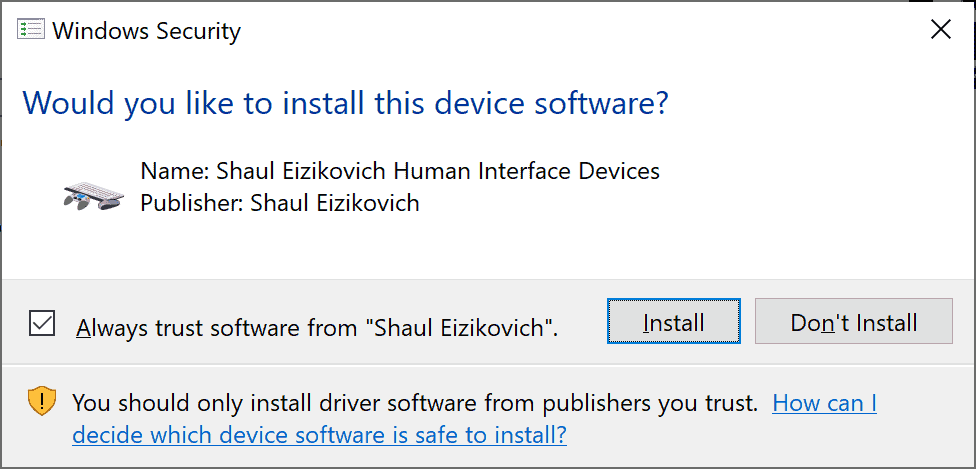
Following this, you’ll get another successful install prompt.

Note: you may receive the below error message (or something similar) after this install. Please disregard this, it doesn’t affect the functionality.

And with that, step 1 is completed! This was required for your PC to “recognize” the Gamecube controller and its inputs.

This first step is also all you need to use a Gamecube Controller on Dolphin (and many other popular emulators). We’ll need to go a little further for Steam/PC games though.

Optional step (recommended)

After following step 1, you should:

  1. Install the latest Microsoft .NET framework available here (very simple/small install similar to the above).
  2. Restart your PC to ensure the software is fully recognized before moving on.

Step 2 – Install x360ce

Next, what we’re going to do is get your adapter/controllers recognized as Xbox 360 gamepads using the x360ce Gamecube config.

This allows Steam to pick them up for its wide library of 360-compatible games.

Go to the x360ce website.

At the top of the page, you should see something similar to the below.

2021 Update: x360ce has released a brand new version (4 or higher) that is suitable for both 32 and 64-bit games in one .exe and is much easier (does not require step 4 of this guide).

We highly recommend trying to download/use version 4+ first, continue to follow the below instructions but ignore the need to download/extract separate 32-bit & 64-bit versions and simply follow the steps for the single 4+ version download.

If you have any issues with version 4+, download the 32-bit & 64-bit versions and follow all steps below.

Download both the 32-bit and 64-bit versions (each is used depending on if the game you’re playing is 32/64-bit).

Once downloaded, we recommend unzipping the files into 2 separate folders. 1 for the 64-bit version, 1 for the 32-bit version.

Our unzipped x64 version is displayed below.

Once that’s done, we’ll then install both versions separately. The process is the same for each version, we’ve used the 64-bit one to demonstrate below.

To start, click on the _x64 file, you will be presented with the below warning.

Click “Create” and it will generate the necessary file/close the warning.

After this, you will receive the below window.

This means the program picking up your “vJoy Device” (i.e. Gamecube adapter controllers) and recognizing it needs to be configured.

With the same ticks as the below (including “search the internet”) click Next >

What this does is search the internet for the necessary x360ce Gamecube controller driver (you’re far from the first person to do this!).

You’ll receive the below window, click Finish.

Note: After clicking Finish, you may receive another “New Device Detected” window. Don’t worry, this is just the same thing happening for each of your adapter ports. Just click “Next” and “Finish” multiple (usually 4) times until it has concluded.

Once these are done, you’ll be presented with the below screen.

Notice the 4 green squares next to each Controller? That’s x360ce picking up your adapter. Try restarting if these don’t appear.


Step 3 – Enable Gamecube Driver / Configure x360ce

Keeping the x360ce window open (we’ll come back later), open the Wii U GCN adapter.

If you added a desktop shortcut, simply click that.

If not, just press the Windows key and type “GCN” and it will appear in the search as below:

You’ll see the below once you open the app. Click “Start”.

The below message (or some similar notification of success) will appear.

Now, return to x360ce.

With your controller plugged into port 1, on the “controller 1” tab, you will now see the Xbox 360 controller buttons on your screen respond when you press down on the Gamecube pad and analog stick!

Nearly perfect, the last thing we need to do is change some of the analog stick sensitivity settings.

For each of the controllers (1-4), go to the “left thumb” tab and change the Anti-Dead Zone settings to 80% and the Dead Zone settings to 30% (as per the green boxes).

This will ensure your analog stick behaves exactly like it would on the Wii U/Nintendo Switch.

And that’s step 3!

Make sure to complete the same setup for the 32-bit version.

Step 4 – Add Necessary files to Steam game folder

2021 Update: If you are using the newest version of x360ce (4 or higher) then congrats, step 4 shouldn’t be required!

When using version 4+, make sure to keep x360ce running in the background when playing games.

If you have issues with version 4+, then follow the above steps to download the 32-bit and 64-bit versions and continue with the below once you reach step 4…

You’re close! The last step to play Steam games with a Gamecube controller is placing the x360ce files into the game folder.

After you complete step 3, go back to the x360ce folder (either 32/64-bit) and you will now see 3 files as below:

What we’re going to do is copy these files to the game’s root Steam folder.

This is most commonly “Local Disc (C:) – > Program Files (x86) – > Steam -> Steamapps – > Common – >*Game Name*“.

If it isn’t exactly that, don’t worry. Have a little look around in your files/search and you will find it.

For this example, I am using Super Meat Boy.

Super Meat Boy is a 32-bit game.

For these, you need to copy the 3 32-bit x360ce files and paste them into the Super Meat Boy root folder, it should then look like the below.

This is what allows the game to recognize the “Xbox 360” controller.

And that’s all there is to it!

Once you’ve done this, open the game via Steam and you will now have a working GCN controller to use with PC games!

32-bit vs 64-bit games

If you’re wondering how you know whether a game is 32 or 64-bit, simply open the x360ce .exe file once you have put the 3 files in the game folder.

If it is the wrong bit-type, you’ll get a warning message and can then simply replace the 3 files with the other bit version.

The below is me trying to put the 64-bit x360ce version in the Super Meat Boy directory as an example:

Not working?

If the above steps are not working, I would encourage you to try the below (in order):

  1. Retry the steps, ensuring you complete the optional/recommended sections (restarting after step 1, etc).
  2. Check out our alternative option below for non-Steam games (will work with Steam games also).
  3. If none of the above works and you have tried your GCN adapter in multiple ports, there may be an issue with your adapter. Try a replacement version (either official or non-official).

How to use a Gamecube Controller on non-Steam games

If you want to use a Game controller for PC games other than Steam, there’s a couple of other options.

For Xbox 360 compatible non-Steam games

If the game you’re trying to play still supports the 360 controller, a majority of these will work by following the same steps above and placing the 3 32 or 64-bit x360ce files into the games root folder.

The only change is that the location of the root game folder will be different from the “steam – > steamapps – > common” layout above, but search for the game in your Program Files and you should find it.

For all other games

If you’re trying to play a game without Xbox 360 controller support, your best option is likely controller mapping software.

This allows you to “map” your Gamecube buttons to the mouse and keyboard actions your game users (e.g. you could map “right-click” to the green “A button”).

We would recommend Xpadder to do this (the best software in this space for many years, and is good for other controllers too).

If you’re looking for a free version, however, AntiMicro is also great.

This approach takes a bit more configuring but if you Google something like “Gamecube Xpadder config” you will find other people who have already mapped out the controller for popular games.

What's Next?

About the author

Picture of Kaelum Ross
Kaelum Ross
Kaelum Ross, BSc is the Lead Writer at What in Tech and a leading authority in PC hardware and software. With a career as a senior IT professional, Kaelum has led multi-million dollar projects covering everything from bespoke software development to complex Windows hardware upgrades. Today, Kaelum uses his expertise to serve What in Tech's readers and has been featured in numerous global publications including New York Magazine and Lifewire.

The 8 Best Dual Chamber PC Cases of 2026

Dual Chamber PC Case

The 8 Best Dual Chamber PC Cases of 2026

An amazing case type for enthusiast builds: here are the best ones

Dual Chamber PC Case

We’ve updated this feature to cover 2026 releases. A couple of alternatives have been added, but most of our top picks remain the same this year.

What is a dual-chamber case anyway?

Let’s take some of the main criteria when looking for your perfect chassis:

  1. Plenty of space for hardware
  2. Good ventilation/airflow
  3. Stylish/made for showing off beautiful components.

A dual-chamber case excels at providing all of these things by essentially having a second “hidden area” for some of your less attractive parts.

Sure, most mid-range cases have some small cable management compartments.

But having a dedicated full chamber gives room for the other “ugly” parts. Think PSUs, hard drives, etc.

This then isolates your GPU/CPU in the “main” chamber, giving you a cleaner presentation and space/airflow for the parts that need it most.

They’re a fantastic innovation for PC builders, I’ve really enjoyed my time working in this format. Which is why I’ve put together this guide on the best PC cases with 2 chambers.

1

Best Dual Chamber PC Case

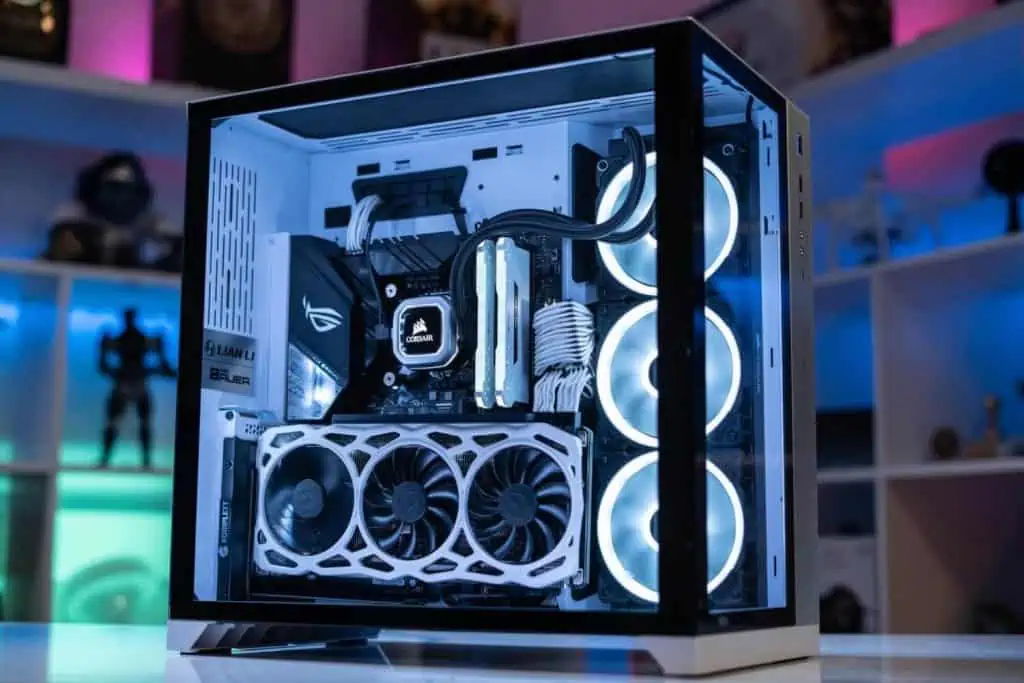
Lian Li PC-011 Dynamic

Our Rating: 10/10

2

Best Dual Chamber Case for Airflow

Corsair Series Air 540

Our Rating: 9.5/10

3

High-End Pick

Corsair Crystal Series 680X

Our Rating: 9/10

4

Best Dual Chamber Micro ATX Case

Corsair Crystal Series 280X

Our Rating: 9/10

5

Best EATX / Largest Pick

Thermaltake Tower 900

Our Rating: 8.5/10

6

Worth Considering

Thermaltake Level 20 HT

Our Rating: 8.5/10

Best Dual Chamber PC Case: Lian Li PC-011 Dynamic

This really is a fantastic tower.

From one of the greatest chassis manufacturers today, the PC-011 Dynamic has been featured many times on What in Tech. It’s also my top choice for the overall best PC case in any category.

The PC-011 is beautiful. Boasting a very thick (0.8-1mm) SECC steel body, aluminum front, and dual-tempered glass layout.

The look and feel are simply fantastic for its price point. With the extra window on the front, you’ll have great visibility for your internal build.

Photos do not do it justice. I’ve built some nice setups in this case and seen many more. What gets me every time is how even something quite basic ends up looking stunning.

Lian Li PC-011 Dynamic

Source: Jinair

There’s plenty of room too, with:

  1. 8 expansion slots
  2. GPU cards of up to 420mm
  3. 2 x 3.5″ / 4 x 2.5″ drive bays (all hidden in the second chamber)
  4. Air cooling: Up to 9 x 120mm fans
  5. Or water cooling: Up to 1 x 360mm, 1 x 280mm & 1 x 240mm

These specs are great for the dimensions. The PC-011 is quite large with fantastic cooling capability.

With more room than our runner-up pick, it’s a good choice if you want to fit very large GPUs.

It’s officially a mid-tower case but would likely manage an E-ATX motherboard if that’s your goal (just check dimensions – we’ve got larger options below).

The second chamber on the PC-011 is wonderfully discrete and has room for all of the cable management and drives/PSUs we expect you’ll need in any kind of build, meaning you can establish a really neat main chamber with great airflow for your intensive hardware.

Speaking of power supplies, this is a great option if you’re after a dual PSU case. The hidden drive caddy in the second chamber can be removed for a second power supply.

Is there anything I don’t like about the case? Honestly…not really.

You could argue that in a feature focused on dual chambers, the second chamber is a little smaller than some of the other picks below. But I think this is a credit to the PC-011. It still includes enough space for PSUs, drives, and cables, without making the separate area look unnecessarily bulky or wasteful.

It is a little expensive. But really, it’s at the mid-range price point that many top-quality cases live in. You absolutely can go cheaper if you like, but I don’t fault the case’s price because I think the value on offer is great.

The fact that you’re getting such a wonderful build quality, aesthetic, space, cooling potential and a perfect internal layout to empower neatness/airflow all at a great mid-range price is simply incredible.

Yes, this is my pick for the best dual-chamber ATX case on the market, but to reiterate, it’s the chassis I think excels the most in any category, and frequently recommend it to my readers if you have the budget.

2026 update: The PC-011 remains our top dual chamber chassis pick for 5 years running! Despite some decent new offerings, nothing overtakes the great balance between features, aesthetics, and price. I also still rank it as the best overall case of the year.

Our Rating: 10/10

Best Dual Chamber Case for Airflow: Corsair Series Air 540

The PC-O11 has fantastic airflow that we think will meet an overwhelming majority of needs.

But if you’re someone who really prefers taking advantage of mesh layouts that ensure ventilation from all angles, you may want to consider the Air 540.

This Corsair offering somehow manages to offer a fantastic set of features/quality while also being one of the cheaper options on the list

Boasting great space in both of its chambers, you’ll have room for:

  1. 8 expansion slots
  2. GPU lengths up to 320mm
  3. Up to 2 x 5.25″, 2 x 3.5″ and/or 6 x 2.5″ drives, more than enough for gamers

It’s nice to see options for optical drive bays here too (even though a majority of people no longer use them, you can still convert 5.25″ bays into more SSD/HDD drive bays if desired).

Corsair Series Air 540

Source: Markill-UK

But it’s cooling where a dual-chamber tower really shines. In the Air 540’s case, there’s space for:

  1. 6 x 120mm / 5 x 140mm fans (including 2 pre-installed Corsair Air Series AF140L fans ideal for a quiet build)
  2. 280mm top & 360mm front radiators

Now that may not sound too impressive for an ATX case.

But remember: with your PSU/drives out of the way, these fans/water coolers are dedicated to cooling your GPU and CPU.

Tie that with the fantastic airflow design and you have a really high-value case for overclocking.

Style-wise, the Air 540 has a unique wide form factor.

With a steel exterior, the cube tower boasts a simplistic, high-quality build. In person, it appears minimalist and monolithic.

This simplicity is perfect because when you’re creating a dual-chamber computer, you want the attention to be on the neat internal parts in the main chamber.

Through its tempered glass, the case beautifully presents the main hardware and gives you more than enough space to cleanly build.

We love the PC-O11D and made it our top choice for a reason. But if you’re looking for something that balances unique style, fantastic features, cooling capability, and value; the Air 540 is also well worth considering.

Our Rating: 9.5/10

Best High-End Dual Chamber Case: Corsair Crystal Series 680X

Having been featured multiple times previously on What in Tech, there are so many amazing qualities to the 680X if you can afford its price tag.

The 680X has some of the best build quality I’ve seen in any case.

With a thick steel exterior, and tempered glass covering its front, top, and hinged side window, the case looks incredible even before you add your hardware.

The RGB version we recommend includes 3 beautiful & addressable Corsair LL120 fans which are some of the best on the market and very expensive if bought solo.

Alongside these is a pre-installed Corsair Lighting Node Pro. One of the best RGB controllers available today, making this a perfect base for an RGB build.

The 2 chamber case offers good internal space too. With:

  • 10 expansion slots (2 for a vertical GPU mount)
  • GPUs up to 330mm
  • 3 x 3.5″ & 4 x 2.5″ drive bays (hidden in second chamber)

The GPU length may seem low compared to the Lian Li, but it’s still more than enough for nearly all mainstream cards. There are also enough storage options if you’re looking for a video editing or server PC case.

Corsair Crystal Series 680X

Source: jjzeng21

What’s even more impressive is the cooling potential:

  • Up to 8 120mm fans
  • 360mm front, 280mm top, 140mm rear & 280mm bottom radiator support

Bearing in mind this is all part of a case with a large secondary chamber where you’re already maximizing airflow to your GPUs/CPU.

Adding this incredible cooling utility on top makes this one of the best ATX cases for overclocking. I’ve been super pleased with the thermal benchmarks from the case during test builds.

Yes, it is pricey.

But you’re getting so much for your money.

From the excellent build quality to the RGB capability, to the fantastic space and airflow design.

If you have the budget, it’s one of the best premium cases available (not just in the dual-chamber category).

Our Rating: 9/10

Best Dual Chamber Micro ATX Case: Corsair Crystal Series 280X

What about those looking for a small PC case?

Well, thankfully, Corsair’s fantastic 680X has a little brother.

And despite the lower price-point/size, it still manages to retain so much of what makes the ATX version great.

The design is essentially the same (but more of a cube shape) with the high-quality steel exterior and triple-tempered glass setup.

The space is great for its Micro ATX form factor, with:

  • 4 expansion slots
  • VGAs up to 300mm
  • 2 x 3.5″ & 3 x 2.5″ drive bays hidden in the second chamber
Corsair Crystal Series 280X

Source: PTjutsu

I would’ve liked to have seen an extra 5-10mm clearance for GPUs, but you should still manage to fit most cards (just please check dimensions before buying your card!).

The dual-chamber is still (impressively) large enough to hide your cables, PSU, and drives despite the smaller case size.

Between the room and cooling, the 280x is a fantastic case for Micro ATX gaming, with:

  • Up to 6 120mm fans
  • 1 x 280mm top & 2 x 240mm front/bottom radiators

Most in this form factor will not perform as well for cooling & overclocking your GPU/s.

It’s pricey for a smaller build, but I think it’s a great example of getting what you pay for.

I’d also argue with the 2 included RGB fans/Lighting Node controller, the price is actually very decent.

If you’re building a mini-tower and want an RGB aesthetic, you really can’t get much better (or more stylish) than the 280X.

Our Rating: 9/10

Best Dual Chamber EATX Case: Thermaltake Tower 900

So what if you’re less constrained by budget and want something extra large and powerful?

Whether for a high-end gaming build, production rig, or server PC, an E-ATX case is a great option.

If you combine such a huge size with a dual-chamber layout, you’ve got some real monstrous capability.

The Tower 900 is one of the best examples, with:

  • 8 expansion slots
  • GPUs up to 400mm (including vertical mount option)
  • Up to 1 x 5.25″, 6 x 2.5″/3.5″ & 2 x 2.5″ drives

You have room in this huge case to host a quad-GPU build if tied with an accommodating motherboard.

The case also offers the most cooling on the list and some of the most out of any Extended-ATX case we’ve seen, with:

  • Up to 13 x 120mm fans
  • 1 x 480mm & 1 x 560mm radiators

The radiators are installed on the left and right sides, meaning if you wanted to make a liquid/air cooling hybrid, you could also still include 5 x 120mm fans.

Thermaltake Tower 900

Source: dogmatic1723

As you can imagine, between this cooling and the very spacious dual chamber, you have one of the best water cooling cases in the Tower 900.

Another factor it excels in is the modularity/customization available.

This means that so much of what is included (anything from drive bays to dust filters) is completely detachable.

Minimizing parts you don’t need will give you more space for parts/airflow, a cleaner presentation, and reduce vibration (great for a quiet PC build).

Last but by no means least is the design and quality.

Rivaled on this list only by the 680x, the Tower 900 looks and feels fantastic.

With an SGCC steel exterior and 3 full-size windows, it’s somewhere in-between a tempered glass chassis and a sturdy fish tank!

Needless to say, it looks fantastic displaying your main components while the dual-chamber is more than enough to hide what you don’t want to show.

It was really a toss-up between this and the Corsair 680X for the best high-end pick.

The reason we gave it to 680X is that an E-ATX case can be a little too large for many builders and I think the Corsair ATX offering has what most of you would need.

But if you’re drawn to the Tower 900’s monumental capability, or simply want the most powerful dual-chamber computer case you can possibly find, then you can’t go wrong here.

2026 update: If you like the look of the Tower 900 but don’t necessarily need something quite so monolithic, Thermaltake has released the Tower 500, which includes a similar build quality and feature set to the 900 (including EATX motherboard capacity) within some smaller mid-tower dimensions.

Our Rating: 8.5/10

Worth Considering: Thermaltake Level 20 HT

Last but by no means least.

While not getting one of our top dual-chamber chassis picks, we’ve included the 20 HT for a reason.

You’ll notice it’s similar to our above Thermaltake EATX choice.

When considering the Level 20 HT vs Tower 900, this case seems to be, in many ways, a slightly smaller version of the 900.

That’s not to say it doesn’t have a ton of room for your parts though, with:

  • 8 Expansion slots
  • VGA length up to 400mm
  • 4 x 3.5″ / 2.5″ & 1 x 2.5″ drive bays

It’s still very much a great fit for a large gaming chassis, with enough room for plenty of GPUs and an ATX/EATX build.

Thermaltake Level 20 HT

Source: BoiOnTheGeetar

The same can be said for the cooling, with space for:

  • Up to 10 x 120mm fans – 2 high-quality 140mm fans are included
  • 2 x 360mm & 1 x 280mm radiators

So there’s slightly less space capability compared to the Tower 900. But let’s be real; that’s still a lot of air/water cooling potential.

Not to mention your PSU/drives/cables are suitably hidden in the spacious second chamber.

This is still most definitely an overclocking-capable choice ideal for gamers/multi-GPU builds.

The build quality is as fantastic as you’d expect for a high-end Thermaltake case.

With an SPCC steel exterior and thick tempered glass windows surrounding the left, right, and front. A nice touch is the addition of a glass panel to the top of the chassis, it’s a clear PC case made to show off your hardware.

With the included fans and the slightly lower price point than the Tower 900, we’ve included this as it’s a great option for someone who likes the look of the 900, but doesn’t need quite the space and wanted to save a little money.

Our Rating: 8.5/10

Quick-Fire Picks

While the top 6 are the best dual-chamber cases for a large majority of users, we wanted to throw in another couple of worthy considerations if your needs are more specific.

Rosewill CULLINAN PX 1

Cheapest Dual Chamber PC Case: Rosewill CULLINAN PX

While we consider the top 2 options cheap dual chamber pc cases for what you’re getting, this Rosewill offering is the cheapest available that we could still recommend (and impressively includes 3 fans).

You won’t get the same build quality, cooling, or feature set, but as far as budget options go, this is a great pick.

Our Rating: 7.5/10

Anidees AI Crystal V3

Best RGB Dual Chamber Case: Anidees AI Crystal Cube

A great case in its own right (especially for RGB lovers), the Anidees Crystal Cube is perfect for someone after a unique aesthetic.

A little more expensive and from a lesser-known manufacturer than our top picks, but you are also getting 5 addressable RGB fans and 2 RGB headers. So if you’re more focused on aesthetics, this isn’t a bad option at all.

Our Rating: 8/10

Best Dual Chamber ITX Case?

You may have noticed we haven’t included a Mini ITX dual-chamber PC case.

Unfortunately, there isn’t one on the market that we’d recommend for enthusiast builds.

Your best option to get the best out of a dual-chamber gaming PC case is the Corsair 280X discussed above.

This case still has a great small form factor and is light enough that is can act as a portable PC case/perfect for an on-desk setup.

Remember that although it’s a Micro ATX case, you can still fit a Mini-ITX motherboard on it if that’s how you want to build.

You may also appreciate the smaller version of our top pick, the O11D  Mini-X. While technically still an ATX case, it has an impressively tight form factor, an ITX build would operate great inside.

2026 update: The Lian Li O11 AIR MINI has entered the market and is another excellent option. Like the 011D Mini-X, it’s ATX case, but its dimensions feel closer to a smaller form factor and would be great for a more portably-inclined build.

What's Next?

About the author

Picture of Kaelum Ross
Kaelum Ross
Kaelum Ross, BSc is the Lead Writer at What in Tech and a leading authority in PC hardware and software. With a career as a senior IT professional, Kaelum has led multi-million dollar projects covering everything from bespoke software development to complex Windows hardware upgrades. Today, Kaelum uses his expertise to serve What in Tech's readers and has been featured in numerous global publications including New York Magazine and Lifewire.

The 10 Best PC Case Brands in 2026

Best PC Case Brand

The 10 Best PC Case Brands in 2026

This feature has been updated after reviewing the latest and upcoming offerings from each brand in 2026. Our top brand picks remain the same this time, but a couple of case recommendations have changed.

After our endless amounts of case reviews over different categories, budgets, shapes, and sizes, it’s clear that some chassis brands have shined better than others.

But which manufacturer makes the best quality computer cases?

Today’s What in Tech feature breaks down the best PC case brands on the market today depending on what you’re looking for.

Treat this page as a hub, as we’ve got separate features on the best cases from each of these manufacturers in the links below.

Best PC Case Brands

Overall Best PC Case Brand: Lian-Li

Oh boy, was it hard to decide how to rank this top spot.

Specifically, the battle between Lian-Li and Fractal Design was neck and neck; with both manufacturers offering absolutely incredible cases across most typical buying criteria.

But as it stands right now, we have to give the accolade to Lian-Li.

You may not be as familiar with this manufacturer as say, Corsair or Thermaltake.

But they’ve been in the PC Case business for a long time. Their flagship models today strike an incredible balance between aesthetics, build quality, internal spec, airflow, and cooling capability.

All wrapped into price tags that feel too good to be true next to some of its competitors.

The PC-011 Dynamic, in particular, is what we consider to be the best PC case available today.

Lian-Li is a seasoned manufacturer on the top of their game.

You really can’t beat their top cases for overall value whether you’re after a PC case for gaming, streaming, or production (whether high-end or more budget-leaning).

All of this is why we consider Lian-Li the best computer case brand on the market today.

2026 update: Lian-Li remains my top PC brand pick for 5 years running. Although the rest of the list is worthy of your consideration, especially if you’re interested in silence (Fractal) or other aesthetics, I’ve been really appreciating Lian-Li’s “quality over quantity” approach in terms of new releases (like the Mini-X O11D), and their flagship cases stand strong.

Best PC Case Brand for Silent Builds: Fractal Design

Now like we said, our number one pick on this list was very hard to finalize.

Fractal Design feels just as deserving to take the top spot.

With a similarly incredible execution in balancing quality, design, and internal specs with fantastic pricing, Fractal has been my personal go-to choice for PC cases for a long time.

There is one key area that separates Fractal and Lian-Li: noise vs airflow.

Fractal Design is the undisputed king of silent PC cases.

They manage to achieve this by surrounding their high-quality exteriors with sound dampening insulation, setups that minimize internal vibrations, and side panels that are (usually) covered in thick metal instead of thinner tempered glass.

With this approach comes a set of very minimalist PC case designs that are beautifully subtle and practically silent (particularly in their mid/high-end models).

With that increased insulation comes a slight loss in airflow/cooling capability.

Now make no mistake, for the amount of sound dampening Fractal achieves in its cases, they still perform very well in temperature benchmarks (often beating many cases that have more ventilation openings) and are more than capable of running a powerful PC.

We just think that for the average builder, the perks of slightly superior airflow and a case focussed on high visibility (for your beautiful RGB components!) will win you over.

But if having a quiet case is even a little bit important to you, know that Fractal Design is easily one of the best PC case brands today, and its flagship models are incredible products.

Runner-Up Best PC Case Brand: Phanteks

Phanteks are one of the more popular manufacturers on this list with a huge variety of great towers.

Among them is one of the best PC cases today in the P400, a great case for first-time builders, and some of the most innovative high-end cases in the Enthoo 719 and the EVOLV series.

Even Phantek’s cheap to mid-range cases are often built with a level of quality that you’d pay more for from many other brands.

We don’t think their offerings in the mid-range are quite as good as Lian-Li and Fractal.

But that’s only because the PC-011 and the Define R5/7 are such fantastic computer cases, it’s hard to compete with them.

But if your budget is a little shorter than those chassis, or is much higher that you’re looking for a specialist case like the Enthoo 719, then Phanteks are still well worth considering.

Best PC Case Brand for Premium Options: Thermaltake

One of the best selling brands on this list, Thermaltake has some fantastic cases on offer.

Although for your typical tower build, our top picks may provide slightly better value, Thermaltake has a couple of special things on offer:

Yes, you are paying a little more for some unique aesthetics, but design is a big factor when buying your case.

Thermaltake is, to put it simply,  a great choice if you’re looking to build something extra unique to show off.

Most Stylish PC Case Brand: NZXT

We’re sure most of you are very familiar with NZXT, and there’s a good reason for that.

Few other brands have made their mark through sticking to a slick, striking aesthetic as this manufacturer.

Most of the flagship models have decent SGCC steel build qualities with some beautiful matte finishes.

NZXT’s cases aren’t just pretty though; they also offer plenty of utility for a large variety of builds.

Their flagship H510 model in particular is a fantastic mid-range case, and we appreciate that they offer comparable quality across their mATX and ITX variants.

If the aesthetic of NZXT is up your alley, know their cases are a great choice for more than just looks.

Most Popular PC Case Brand (Best for Variety): Corsair

There’s probably not a person reading this who doesn’t have some dealing with Corsair.

This classic brand has had cases featured throughout tons of our reviews.

One case, in particular, has been featured more than any other to date: the Corsair Crystal Series 680X (one of the best premium cases available today).

Although we like cases like the PC-011 and the Define R5/7 over Corsair’s mid-range offerings, it is simply incredible how many chassis this brand manufactures at any one time.

Anything from unique designs, to RGB powerhouses to dual-chamber setups, one thing we really commend Corsair for is offering as much variety as possible for its enormous consumer base.

They’re a great brand to pay attention to if you’re focussed on picking something extra unique.

Best Traditional PC Case Brand: SilverStone

On the other end of the variety spectrum is SilverStone.

This classic manufacturer is great at sticking to what it knows best: making traditional-style no-frills PC cases.

And we don’t mean that negatively by any means.

SilverStone cases still look great and perform very well for the price, if you’re after something more minimalist (and aren’t interested in Fractal Design) then this should be your go-to.

Another area they shine in is in the world of horizontal PC cases; combined with their simplistic designs, SilverStone cases are perfect for someone looking for an HTPC case.

Great Unique Cases Alternative: InWin

While not taking any particular top spot, InWin is still a great PC brand that we particularly enjoy for creating some very unique offerings that perform as well as they look.

Cases like the D-Frame, 905, A1 Plus, and 925 have designs you simply won’t find from any other manufacturer; so don’t write them off.

Good All-Round Case Options: Cooler Master

Another very popular manufacturer, Cooler Master has made a name for themselves by offering a great variety of cases in all different shapes and sizes – particularly working well as a cheap PC case brand, with a huge array of budget options.

Both their cheap and premium options are worth considering; our standout choice from them is easily the Cosmos C700P  – this is one of the best choices for high-end enthusiast builds.

The only reason we don’t rank them higher is some of the other manufacturers above simply tend to offer more with their competing products in each price range.

Runner-Up Best Silent PC Cases: Be Quiet!

Last but not least is another option for those after a quiet PC case.

As much as we love Fractal Design, if for whatever reason you are looking for an alternative (be it aesthetic or stock/budget issues), Be Quiet!’s range, as the name would suggest, offer excellent noise-reduction solutions.

The Silent Base 801 in particular is a stand-out offering from them, which you can read more about in our coverage here.


Honorable Mentions

While the above are the best PC case brands on the market today, there are still some other great manufacturers that you shouldn’t look down upon if you’ve found something out of this list that takes your eye.

We have, for example, previously recommended cases from Antec, ASUS, Anidees, Cougar, Azza, EVGA & darkFlash.

None of these brands are bad, (Antec for instance once manufactured one of the most popular cases on the market).

It’s just that the above 10 will cover a large majority of user needs and be the best balance of build quality, price, and features.

But if you’re looking for something extra unique, check out our feature on just that.

What's Next?

About the author

Picture of Kaelum Ross
Kaelum Ross
Kaelum Ross, BSc is the Lead Writer at What in Tech and a leading authority in PC hardware and software. With a career as a senior IT professional, Kaelum has led multi-million dollar projects covering everything from bespoke software development to complex Windows hardware upgrades. Today, Kaelum uses his expertise to serve What in Tech's readers and has been featured in numerous global publications including New York Magazine and Lifewire.

The 15 Best Monitor Brands in 2026 (Gaming, Work & More)

Monitor Brands

The 15 Best Monitor Brands in 2026

I updated this feature to cover the latest releases of 2026. None of the brand picks have changed this time, but I’ve updated a couple of the monitor recommendations throughout the article.

Are Dell monitors good?

Is HP overpriced?

When searching for your next display, it can be overwhelming when you’re met with so many options, one of your many questions is likely which PC monitor brands you should consider.

Well, today, we will be helping you answer just that!

This feature will take you through everything from the best gaming monitor brands, to the best manufacturers for work displays. We’ll also include where each brand shines the most.

The Top 7
  • Best Overall Monitor Brand: Dell / Alienware
  • Best Gaming Monitor Brand: ASUS
  • Runner-Up Best Monitor Brand: Samsung
  • Runner-Up Best Gaming Monitor Brand: Acer
  • Solid All-Round PC Monitor Brand: HP / Omen
  • Great Brand for High-End Monitors: LG
  • Fantastic Gaming Monitor Brand: BenQ

Worth Considering

  • Best Budget Gaming Monitor Brand: AOC
  • Second Best Budget Monitor Brand: Sceptre
  • Great Gaming Monitor Brand: MSI
  • Great Brand for Video Editing / General Use: Philips
  • Great Monitor Brand for Work Display: Lenovo
  • Cheapest Monitor Brand: Viewsonic
  • Cheapest High-Spec Monitor Brand: Viotek
  • Good Gaming Monitor Brand: Gigabyte

Honorable Mentions

  • Good But Limited: Razer
  • Cheapest PC Monitor Brand Alternative: Pixio
  • Cheapest High-Spec Monitor Brand Alternative: Nixeus
  • Limited Cheap Monitor Brand: Monoprice

The Top 7

We’ve ranked this list into 3 parts; “The Top 7” & “Worth Considering” for the best 15 brands, and a few more “Honorable Mentions” for certain companies who we don’t rank as the best, but shouldn’t be completely written off.

Our 7 front-runners are the best monitor manufacturers at balancing great screen specs, gorgeous design/build quality, reputation, and price.

Bear in mind that these manufacturers have 100s of different monitors and who is best will often depend on your needs (resolution, framerate, budget, etc.).

This is why we’ve included the best picks for each brand to guide you while we go.

Best Overall Monitor Brand: Dell / Alienware

At the top of our list is the behemoth manufacturer in all things technology.

Texas-founded Dell has always been a frontrunner in providing a great mixture of budget desktops with everything a simple general/work users would want, and then higher-end displays with great color gamuts, contrast ratios and build qualities.

At this point, however, what makes us consider Dell the best manufacturer overall is their ownership of the Alienware brand.

With this combination, Dell now has something for everybody:

  • Cheap IPS panels that offer great budget use
  • Mid-range monitors for gaming, video/photo work, or a premium office setup
  • With Alienware; high-end monitors that represent the best display technology on offer today with incredible options for premium gamers.

A huge majority of their options also come at a very competitive price-point (you don’t feel like you’re paying an unfair amount for the reputation/service of a well-known brand with many of Dell’s screens).

Our main highlighted monitor today is the SE2719h. This display is one of the best balances between specs and price for your standard user.

With a 27 inch screen, IPS panel, fantastic picture quality for the price, and all hosted in a gorgeous build quality/design, there’s a reason why this is one of the most popular monitors on the market (and with its thin bezels, would be perfect for a dual-screen setup).

For gamers, the Alienware AW2721D is one of the best monitors for gaming today and tops our list of 1440p 240hz screens (a very hard category with a lot of competition). This is a premium monitor of course, and we have more budget-friendly options highlighted by other manufacturers below.

With something for everybody, and often with specs/prices rivaling other frontrunners, we think Dell is on the top of their game today and well deserving of the best PC monitor brand accolade.

2026 update: Dell, alongside their Alienware subsidiary, remain my top pick for 4 years running. With a solid stream of new releases and some fantastic products old and new that stand the test of time, Dell has done a good job at providing options for every major use type and budget in today’s market.

Best Gaming Monitor Brand: ASUS

While Dell is very capable in the gaming sector (especially at the premium range with Alienware), ASUS gives them a run for their money in this category and is equally worth your consideration.

With a huge range of monitors, Taiwanese-based ASUS has its fingers in all of the gaming pies; with some very innovative monitors in the high and low-end price points.

Where we think they shine most, however, is in the mid-range offerings.

Few (if any) monitor companies have more compelling balances between specs for the average gamer, build quality, and price.

Taking our best ASUS monitor pick, the VG27VH1B, as an example: offering 165/144hz options, very fast 1ms MPRT response time, a decent 1500R immersive curvature, AMD Freesync & Nvidia G-sync compatibility, a fantastic 120% sRGB color gamut great technology for sharp blacks all hosted in a full HD 27″ offering with perfect, close-to-frameless build quality.

For all of this to come in its relatively cheap price tag is a fantastic offering and demonstrates just how capable ASUS are of providing some of the best value monitors for gaming.

Don’t count them out if you’re after a more expensive offering too; we constantly feature ASUS across our articles touting more premium specs like the highest Hz, 1440p 240hz, 4k 144hz & 1440p 144hz ultrawide monitors.

While there are a few great contenders on this list for gaming, ASUS offers the best balance of specs and value in today’s market and is our pick for the best gaming monitor manufacturer.

Runner-Up Best Monitor Brand: Samsung

Our next display manufacturer is one that needs no introduction…

One of the biggest players in the TV space, Samsung has extended its reach to providing its efficient screen supply chains to create high-quality monitors and very competitive offerings in some of the main PC display categories.

Samsung positions many of its offerings as business monitors, with lightweight, cheap yet deceptively decent LED screens leading their budget range, their monitors are a compelling choice if you want a great picture quality for general use/media without breaking the bank.

Our best Samsung monitor pick is a shining example of that; the LS24R356FZNXZA is a gorgeous full HD display hosted in a fantastic shell and is a very close competitor to our top Dell pick if you’re after something simple but capable of a beautiful picture for the price (we’d go for whichever is cheaper at the time of viewing if this describes you).

For gaming; we wouldn’t recommend Samsung in most cases for budget/mid-range offerings, but they do have some mouth-watering expensive gaming displays. Our favorite of which is the Odyssey G9, with its QHD, 1000R Curve, 240hz setup in a super-ultrawide aspect ratio (essentially, 2 16:9 screens in one) and dual DisplayPort output, this is arguably the best gaming monitor on the market for those after next-level immersion.

While not our #1 pick due to its gaps in non-premium gaming, Samsung is a behemoth for a reason.

With the company’s huge capability in producing high-quality LED panels, they are easily one of the best monitor brands for work setups (and gaming if your budget is very high!). 

Runner-Up Best Gaming Monitor Brand: Acer

Although we rank ASUS as the best brand for gaming monitors, it was a close race, and just behind them is another Taiwanese powerhouse.

While far from exclusively focussed on gaming, this area is where Acer really shines. With some very compelling options in budget, mid-range, and premium, we often feature Acer for their innovative products, leading the pack for 1440p 144hz ultrawide screens.

We appreciate Acer is also good at balancing offerings with TN, VA, and IPS panels, allowing them to cater to a wide range of user requirements and budgets.

Our best Acer monitor pick is one to rival the ASUS offering above if your budget is just a little tighter.

With a smaller screen size but still boasting a gorgeous quality full HD screen, 1ms response time, and 144hz, the XFA240 bmjdpr contains all the necessities of a gaming monitor (including DisplayPort/HDMI, G-Sync, and more) if you don’t need a 27-inch display at a price that feels like a steal to still get such a quality product from a very reputable brand.

All in all, Acer is one of the best gaming monitor manufacturers in the field today and is easily one of the companies you should focus your searches on when looking for your next immersive setup, whatever the price range.

Solid All-Round PC Monitor Brand: HP / Omen

Don’t be deceived by us not ranking HP as the top/runner-up overall pick, we’ve called these brands the top 7 for a reason!

Californian-based Hewlett-Packard doesn’t have quite the same level of offerings in the mid/high-range, but they have some really fantastic products for a budget office/general use monitor.

Leading that charge is one of the best budget options on the list; the 1D0J9AA.

With the fantastic, sleek build quality you expect from HP hosting a full HD screen with respectable specs; you’re, of course, not going to get the best picture quality at this price range.

But for the budget users? We’re quite floored by how HP has packed such a beautiful offering in this price-tag. Especially considering many larger brands often opt to add what feels like a “tax” to purchase from a reputable manufacturer with decent customer service.

This would be a great option for an office setup (even purchasing multiple units to run a productive multi-screen environment).

On the gaming front, HP’s sub-brand, Omen, doesn’t rule the roost as much as ASUS, Alienware, and Acer, but in certain categories, has some of the best value options.

Our favorite example is in the 1440p 240hz category; whereby the Omen X is one of the cheapest screens in the category, capable of offering a high-end gaming experience at a deceptive low premium price.

While there are some gaps in the mid-range, if you’re looking for a budget monitor that still has a great reputable company behind it, or like the look of some of the high-end value offerings from Omen, know that HP is still without a doubt one of the top PC monitor manufacturers today.

Great Brand for High-End Monitors: LG

If you’re in the market for a premium display, either for top-quality video/photo editing, gaming, or other professional usages, LG is one of the best choices for you.

With a rich experience in the display market, this South-Korean company seems to really understand the demands of users on the premium end, creating some fantastic screen innovations to match these demands like 4k, top-end color gamuts, and contrast ratios, while still boasting compelling price tags.

Our favorite example of this is the 34WN80C-B. With its stunning WQHD setup (in other words, 1440p ultrawide resolution) hosting an HDR10 compatible IPS panel with a superb color gamut, this screen would be a productivity dream for pretty much any kind of work user. We also cover a cheaper 1080p alternative here.

For gaming, LG has a host of other premium innovations on the market and we consistently feature them in many of our gaming monitor posts.

The most impressive amongst them is the incredibly feature-reach 27GN950-B, which is the highest Hz 4k monitor available today, and easily one of the best in any high-res/refresh rate combo category when considering its other specs, build quality, and price. Despite being aimed at gaming, this would also be a dream for 4k video editing work.

While other PC monitor companies seem to come out on top when considering the best picks for a basic office display or a budget gaming monitor, LG is among the best for really cutting-edge screens.

If you’re after the best money can buy (while still retaining impressive value at higher price-tags) LG is one of the top monitor brands for you.

Fantastic Gaming Monitor Brand: BenQ

Last but most definitely not least is a company that has stormed the market in the last decade or so to match many of the largest gaming display manufacturers.

While we give Acer and ASUS the top accolades for gamer monitor brands, we can comfortably say BenQ is on the same level as them and is particularly impressive for those after an esports monitor or someone focusing on fast, reflex-based gameplay (note: Acer/ASUS monitors are great at this too, we’re just talking about in general, for those with a focus on latency above all else).

While the company has plenty of offerings for more immersive titles and even non-gaming, their best capability is when they’re focussed on designing screens for the competitive gaming scene at modest price-points, this will include the highest frame rates, lowest latencies, and lots of quality-of-life features an esports enthusiast will demand to take the edge.

Our pick for the best BenQ monitor is the perfect personification of all of these great traits; the BenQ ZOWIE XL2566K is arguably the best esports monitor at its price range.

At a mid-range budget, the screen manages to pack in a 240hz refresh rate and a visual setup specifically designed to better highlight environmental details (e.g. help the player notice enemy movement ASAP).

On top of that, it boasts great adjustability, a quick-settings change remote, and customizable sideways sliders to avoid distractions in your peripheral; all examples of the great mini-features you often see in BenQ innovations.

For good old-fashioned immersive gaming, this stuff might be overkill.

But for esports players? Having the extra edge in the competition can be what really makes a monitor stand out, which is why we still consider BenQ one of the best gamer monitor brands today.

Worth Considering

The next section contains some monitor manufacturers who we may not think of as the same level as the top 7, but are still great and will often have offerings to compete with the above brands in certain specific specs/price-ranges.

Best Budget Gaming Monitor Brand: AOC

AOC is a fantastic gaming display company often capable of producing options that offer comparable value to the top 7 or sometimes offer worthy budget options by sacrificing an optional spec (e.g. a cheap panel type, fast but slightly slower latency).

The AOC C24G1 is a fantastic budget gaming monitor offering 144hz, 1ms, and a 1500R curve all in one affordable package.

Second Best Budget Monitor Brand: Sceptre

Sceptre has really impressed us as of late, with their commitment to often undercutting larger brands with very comparable specs.

Yes, you won’t always have the same exact specs or a large reputable brand behind manufacturing, but if you want a premium experience on a budget, we think this is a great option.

Take the C345W-2560UN as an example, which is an absurdly cheap gaming ultrawide monitor – we would not expect to see one geared for gaming at this price, but they managed it!

Great Gaming Monitor Brand: MSI

A lot of people might be surprised to not see MSI in the top 7.

As great as the company is, we think that their monitor offerings that compete with other brands are limited (and have some history of less impressive customer service).

There is one huge exception though, the Optix MAG27CQ is one of the best gaming monitors on the market, balancing a QHD, curved, 144hz setup in fantastic build quality and price, this single monitor is so good it pretty much puts the company into this category alone!

Great Brand for Video Editing / General Use: Philips

Philips is a great TV brand that needs no introduction.

While we don’t rate them as high in some monitor categories (not competing with the budget office picks or expensive gamer options), they are a really nice player when it comes to high-quality picture specs for production-focused setups or someone after a nice media/general use screen hybrid.

The 346E2CUAE is a superb example, with a gorgeous 1440p ultrawide screen made better by its excellent contrast and color gamut, it represents what Philips is great at: focussing on picture quality above all else.

Great Monitor Brand for Work Display: Lenovo

Lenovo is a company we love for its domination in the laptop market.

But they are also a decent manufacturer of some aesthetically pleasing, well-specced monitor setups for work (no surprise, as work has always been a leading focus of this brand).

Standing at the top of their offerings is the fantastic Lenovo Q24h-10. With QHD, a great picture quality, and one of the most beautiful thin designs we’ve seen in any monitor, this display exemplifies Lenovo as a great choice for someone looking to build a premium work environment.

Cheapest Monitor Brand: Viewsonic

Viewsonic isn’t a powerhouse brand like many of the ones we’ve mentioned today.

But as far as the companies that focus on the absolute cheapest possible? We think they’re arguably the best for the lower-range choices.

Take the VA2446MH for example, yes it has an included VGA cable instead of HDMI, sure the speakers will be the bare minimum.

But for a full HD monitor with a decent picture quality at this price? If you can’t afford anything more, they’re a respectable option.

Cheapest High-Spec Monitor Brand: Viotek

What if you want to fork out on hardware that is impressive say, in resolution, framerate, and/or latency, but have a very limited budget?

This is Viotek’s specialty, often sacrificing some spec to sell a relatively comparable monitor to its competitors at 10-20% less of the price.

The GNV34DBE is their best offering, which is 15% cheaper than the average curved 1440p 144hz ultrawide gaming monitor and has likely achieved this through its slightly slower 4ms latency.

For some gamers (like those focusing on single-player titles like Cyberpunk 2077/Red Dead Redemption 2), the difference between 1ms and 4ms will be insignificant, so we appreciate Biotek, despite not being a huge brand, still has carved a respectable space for a certain type of user.

Good Gaming Monitor Brand: Gigabyte

Gigabyte, a huge reputable brand in motherboards, GPUs, and laptops, has a few great options in the monitor space (we just don’t rank this company higher due to only having a few options and being a tad more expensive for what you’re getting).

The FI27Q-P is one of the best 1440p monitors for gaming if you have the budget; with up to 165hz, gorgeous colors/contrast, and perhaps the most beautiful monitor design we’ve seen at the price point (with tons of adjustability options).

Honorable Mentions

While we don’t consider these brands part of the top 15, we wanted to include them as there may still be a situation or two where you might be rightly inclined to pick them for your next PC monitor.

Good But Limited: Razer

Everybody knows Razer; a gaming company geared for selling high-spec, beautiful products at a premium.

They only have 1 monitor offering right now, the Razer Raptor, which is why we wouldn’t give them any large accolade.

But the Raptor is a great choice in itself! With stunning picture quality and a beautiful design. You are paying more for the brand and aesthetic, but if it speaks to you, it’s a strong option for a gaming setup.

Cheapest PC Monitor Brand Alternative: Pixio

Pixio is another choice if you’re very tight on cash and none of our competitors seem to have something for you.

We do think Viewsonic is usually the better choice for ultra-cheap displays, however.

Cheapest High-Spec Monitor Brand Alternative: Nixeus

Nixeus is a little like Viotek; a brand trying to compete with many of the premium offerings on the market.

Our issue is, they tend to be at a similar price to the Top 7 or where not, lacking in stability across their products (e.g. complaints of G-Sync not fixing ghosting in games).

They’re not a bad manufacturer, but we can’t help but ask “why go for Nixeus if Dell, ASUS, Acer, etc. offer something similar?”.

Limited Cheap Monitor Brand: Monoprice

Monoprice is a respectable monitor brand in a few very limited scenarios, usually not competing with other value options.

Perhaps the biggest exception is the Monoprice 35in Zero-G, which offers a very impressive value for a UWQHD 35 inch setup.

Final Word

And there you have it! The above are our top choices for the best monitor manufacturers available and we expect in most cases, the monitor you’re looking at should be amongst these companies.

We’ll re-iterate one last time; most of our top picks have tons of choices, this list is about summarising the best average performance of a brand.

For example; even though we cite ASUS as the best gaming display brand, don’t assume that they are the best in every gaming category, it will depend on your individual needs.

So with that said, focus on our top product picks for each brand, or check out our other monitor features here (or below) to find the perfect screen for you!

What's Next?

About the author

Picture of Kaelum Ross
Kaelum Ross
Kaelum Ross, BSc is the Lead Writer at What in Tech and a leading authority in PC hardware and software. With a career as a senior IT professional, Kaelum has led multi-million dollar projects covering everything from bespoke software development to complex Windows hardware upgrades. Today, Kaelum uses his expertise to serve What in Tech's readers and has been featured in numerous global publications including New York Magazine and Lifewire.

The 15 Most Expensive PC Cases You Can Actually Buy in 2026

Most Expensive PC Case

The 15 Most Expensive PC Cases You Can Buy in 2026

We’ve updated this feature after reviewing the latest (and upcoming) options for 2026. Most of our top picks remain the same, but we’ve changed a couple and added some decent alternatives where relevant.

Your eyes don’t deceive you, the cover photo is in fact a computer chassis!

At the highest price range, many of the best PC case brands have created some of the most fantastic offerings on the market.

Some of these are perfect for a high-end desktop (be it gaming or production work).

And some of them are, well…overkill in every sense of the word.

Today’s feature is about highlighting the most expensive PC cases worth buying for those after the best tower money can buy.

But we’ve also included the craziest cases at high budgets too, just for fun.

Top Picks

Quick-Fire Picks

Source: Corsair

Most Expensive PC Case Worth Buying: Corsair Obsidian Series 1000D

While we delve into some crazier options on the list, our top pick is focussing on the most expensive chassis worth buying for someone who’s looking to build the most powerful system possible.

The 1000D is simply a masterpiece as far as PC cases go.

Featured many times on What in Tech previously, the 1000D is a super tower PC case. While this term is often a bit of a “gimmick”, the 1000D lives up to the name as one of the largest cases on the market capable of hosting a dual-system chassis build.

This means you can host two independent PCs in one chassis (one Mini-ITX and one motherboard of any size up to E-ATX).

This utility is perfect for high-end streaming or other users who can take advantage of a secondary PC while their main setup does the heavy lifting in gaming/production.

With that said, the beauty of the 1000D is that you don’t need to run 2 systems to make this high-end computer case worth the money, it has a lot more going for it.

To start, the build quality is some of the best we’ve seen in any case. 

With some of the thickest aluminum and smoked tempered glass side panels (without compromising on cooling), the case is not only incredibly durable but also looks fantastic.

Stock photos don’t do this case justice – When powered on with some bright internal components shining through its tinted glass windows, the aesthetic is really a sight to behold and worthy of its high price-tag.

Inside the premium chassis is room for:

  • 10 x expansion slots
  • Graphics card lengths up to 400mm (more than enough for all mainstream cards and one of the best PC cases for RTX 3090 setups)
  • A very well-equipped front I/O panel, with 2 x USB 3.1 gen-2 type C USB inputs alongside the other expected ports (all with beautiful RGB backlighting)
  • Hidden drive bays for up to 5 x 3.5″ & 6 x 3.5″ storage
  • Air cooling: Up to 18 x 120mm fans (base configuration up to 10 x 120mm + 3 x 140mm)
  • Or liquid cooling: Up to 4 x 480mm + 1 x 240mm radiators (base configuration up to 2 x 480mm, 1 x 420mm + 1 x 240mm)
  • Triple-chamber layout to maximize cable management and airflow of both the main and secondary systems (as well as room to hide “uglier” components like PSUs and the aforementioned drive bays)
  • Decent inbuild smart fan controls which, alongside the fan allotment, makes this the best expensive RGB PC Case

These specs speak for themselves; the 1000D is a powerhouse in pretty much every sense of the word.

With its dual-system capability, superb build quality/aesthetic, triple-chamber layout for maximum airflow/clean internals & unmatched cooling capacity, it’s clear to us that no offering better encapsulates what we’d hope for in the most expensive PC case worth buying than the 1000D.

Whether you are building a high-end desktop for gaming/overclocking, stream, editing, or other production, this case ticks all the boxes and has everything we think you’ll need plus more. 

2026 update: As much as I still love the 1000D and recommend it if you can still get your hands on it, it has largely been succeeded by the 9000D. The 9000D is also an excellent case and boasts nearly everything that makes the 1000D great. My only gripe is that there were some minor aesthetic changes in the later model (namely, plastic feet and a slightly powdery paint finish). These are very minor, but given that this feature is about a premium feel, the 1000D still edges that out from my perspective.

Source: Antec

Best Looking Expensive PC Case: Antec Torque

Next up is another offering featured countless times on What in Tech for its incredible aesthetic and performance.

For the design, we’re sure the stock photo speaks for itself; the Torque is a wonderfully unique chassis.

With its build based on 14 uniquely-curved aluminum panels and dual tempered glass, the case doesn’t just look great, it feels durable and made to last.

As beautiful as the stock photos of the Torque are, it’s another example of a case that is only done justice by a fully powered-on rig in person.

What we like most about the Torque (aside from its mouth-watering looks) is its ability to still host a powerful build despite its focus on a design so far gone from traditional cuboid PC cases.

With room for:

  • 7 x expansion slots
  • GPU clearance lengths of up to 450mm
  • Bays for 1 x 2.5″ & 1 x 3.5″ drives
  • E-ATX motherboard compatibility up to 12″ x 11″

You’ll notice the drive allotment is the spec at play that will be a bit disappointing for some high-end desktop builds.

With Antec’s focus on aesthetics, the storage bays have been minimized to ensure the available drives are only in hidden places (as there is no part more capable of looking ugly even in the neatest of builds).

With that said, a single high-capacity 2.5″ SSD and 3.5″ HDD (alongside whatever NVMe your motherboard supports) is still more than enough for a gaming PC case/most other users (unless you’re looking at building a high-end server or production rig).

Where the Torque really shines spec-wise is in cooling; hosting up to 6 120mm fans or 2 360mm radiators.

You may think this isn’t that impressive for an expensive ATX case, but the Torque’s design is completely open-air.

Because your PC isn’t isolated in a completely covered box like traditional cases, even significantly powerful hardware can be cooled with way less air/liquid cooling in place.

If you want to stand out from the crowd but don’t want to compromise on fantastic capability for overclocking/cooling, the Antec Torque is the best expensive PC case for the job.

Source: InWin

The Most Expensive PC Case Ever: InWin WINBOT

You knew it was coming…

We’ll be clear from the start; we’ve included this pick for fun and don’t recommend this case to anyone with the slightest concern about their budget!

While we’ve focussed on cases worth buying for the most part; a list of the most expensive computer cases wouldn’t be complete without the WINBOT.

InWin is known for being the best chassis brand for creating promotional/limited-run cases. The WINBOT is the grandest example of this style, with a very limited quantity existing worldwide.

It’s one of the rarest PC cases still in the market, usually selling for around $3,000 to $5,000.

With its unique 360 degrees/sphere PC case design, the WINBOT is made up of thick aluminum and plexiglass capable of handling its unique curvature, this chassis is full of unique case innovations like a motorized window opening, 360 degrees rotation that can be aligned with motion detection, and hand gesture operation.

It’s easy to forget this is a PC tower! But it does have plenty of utility for that too, with room for:

  • E-ATX motherboards up to 12″ x 13″
  • 8 x expansion slots
  • GPUs up to 340mm length (still enough for nearly every card available today)
  • Up to 4 x 3.5″ & 8 x 2.5″ drives
  • Up to 5 x 120mm fans or 1 x 360mm radiator + 2 x 120mm fans

Despite its incredibly unique shape, the WINBOT still manages to live up to its expensive full tower title with decent hardware space and airflow inside for a high-end build.

Is the WINBOT worth the money on a practical level? Not in the slightest.

If you’re one of the lucky people who can spend several thousand dollars without batting an eyelid, then the WINBOT is a lot of fun and is the closest to a spaceship PC case we see on the market today (it can’t fly to the moon though).

Source: ASUS

Most Expensive Mini-ITX Case: ASUS ROG Z11

For those building a premium desktop in the smallest possible form factor, ASUS has recently introduced a fantastic offering for Mini-ITX users.

The ASUS ROG Z11 boasts a design that is not only beautiful but also highly capable of hosting powerful gaming, streaming, or production setups (something that can’t be said for every case in the ITX form factor).

Starting with its build quality; the unit is made with a combination of beautiful thick aluminum, tinted tempered glass, and subtle ARGB lighting controllable by a front I/O panel button and ASUS’s signature Aura Sync software.

It’s important for an ITX case to be durable when many users like to build these setups with some portability in mind; which is why we love how ASUS has managed to build something sturdy and beautiful.

Where the real challenge is for even the most expensive mini-tower is the cooling/spec availability, which the Z11 also excels at for its size, with:

  • Support for 3-expansion slot GPUs up to 320mm
  • Up to 4 x 2.5″ & 1 x 2.5″ / 3.5″ drive bays
  • Up to 2 x 120mm & 2 x 140mm fans
  • Support for ATX PSUs up to 160mm

These may not sound very impressive compared to the other expensive mid towers we’ve been looking at. But as far as ITX chassis go, these specs are fantastic.

With plenty of fan cooling to support even a powerful build, the Z11 takes its airflow design one step further with an 11 degree tilted setup; pushing the motherboard to a slight diagonal angle, this layout means the underside of the motherboard/GPU both receive some room for airflow which is a huge plus for a tiny case where every degree of cooling matters tremendously.

With all of this in mind, the ROG Z11 is one of the best ITX cases for gaming with a powerful GPU like the RTX 3090 (just be sure to check the model you’re looking at is less than 320mm wide, which a large majority are).

Asus has created something truly special here. With fantastic GPU space, drive allotments, and cooling for an ITX build all housed in a gorgeous, durable & well-thought-out design; the Z11 is easily our top pick for the most expensive ITX PC case worth buying.

Source: Thermaltake

Most Expensive Micro ATX Case: Thermaltake AH T200

Is it a helicopter?

Is it a spaceship?

No! It’s a PC case!

Thermaltake is another fantastic tower brand and arguably the best at providing a variety of high-quality premium offerings.

Standing at the best for those after an expensive mATX PC case worth buying is the AH T200.

With its open-frame design that rivals our Antec Torque pick, this chassis is built with thick dual tempered glass windows and SPCC steel. This latter material won’t be quite as nice as the Torque’s aluminum finish but is to be expected at a notably lower price and is still very durable/beautiful when compared to nearly every other mATX chassis on the market.

Inside, the T200 has room for:

  • 5 x expansion slots
  • VGA lengths up to 320mm
  • Hidden bays for up to 2 x 3.5″ or 2.5″ drives
  • Cooling: up to 4 x 140mm fans or 1 x 280mm radiator & 2 x 140mm fans

With a similar approach to the Torque, the AH T200 comes with slightly less spec availability (particularly drives and fans) than other comparable mATX cases in order to keep its unique design as clean as possible.

And like the Torque, the lower fan availability is completely offset by the open-air design (in other words, you have a PC case here capable of high-end setup cooling/overclocking even with low fans – a great perk).

Price-wise, although it’s undoubtedly a premium case, it’s one of the cheapest options on the list.

This is often the case with the micro ATX form factor, which is the leading choice for budget cases that still provide expansive space for mainstream builds.

So if you’re after a case that provides a comparable capability to our more pricey offerings like design, build quality and space, while coming in at a lower price-tag, the AH T200 is a great option and one of the best mATX cases on the market.

Source: Azza

Most Unique Expensive PC Case: Azza CSAZ-804V

Azza specializes in some of the craziest designs possible at the premium price-range, and leading them is the 804V pyramid PC case.

Made with very high-quality aluminum, thick SPCC steel, and tempered glass, its build adds up to one of the most durable expensive towers around.

The metal finish and sleek, sharp corners make this offering incredibly striking.

We appreciate the 804V isn’t just form over function though, with room for:

  • 2 x expansion slots with vertical GPU installation option
  • Graphics cards up to 295mm in length (lower than other picks but still capable of many mainstream cards, just be sure to check the width of your choice)
  • Bays for up to 2 x 2.5″ & 1 x 3.5″ drives
  • Air: up to 4 x 120mm fans with 1 x Hurricane II Digital RGB Fan included on the case ceiling 
  • Liquid Cooling: up to 1 x 360mm radiator

Of course, compared to the other most expensive ATX cases worth buying on the list, the hardware space is notably lower.

But this is to be expected with such a unique pyramid design; with its layout designed to accommodate a single-GPU build, and with the RTX 3070, 3080, or 3090 leading the market, a one graphics card is all you need for a powerful gaming PC case today.

The internal cooling of the case is well-equipped for a powerhouse build too, with subtle gaps in the glass to work alongside the fans/radiators for decent airflow.

We appreciate the layout of the case also lends itself well to a clean build, with the drives hidden in the bottom and all the visual attention on the main compartment (this unit will look fantastic with some RGB hardware should you look to go down that route).

The one layout issue we’d call out is cable management; some users have cited some slightly clunky accessibility to the hidden spaces available for routing. The 804V is very capable of hiding your cables, it’s just worth pointing out you will have a bit of a challenge putting it together.

What we like about the 804V is it represents a truly crazy design, but its price range isn’t nonsensical like InWin’s sphere PC case.

In other words; it’s a chassis that is still clearly made for mainstream consumption and is worth buying if you’re after a unique build that can perform.

2026 update: For serious PC builders after a unique design, we still love the Azza 804V. That said, in the last year, a literal tank PC case has emerged with all the base needs of a serious build covered; if you’re after a unique aesthetic, these are the 2 best choices available today.

Quick-Fire Picks

The above cases are our top picks are the most expensive CPU cases worth buying (or wanted to highlight for hilarity, in the WINBOT’s case).

However, there’s a bunch of other worthy contenders for those after the best premium offering/someone with more specific requirements or a different aesthetic; and we’ve covered them below!

Thermaltake Core P8

Best Expensive Clear PC Case: Thermaltake Core P8

With cooling to rival the 1000D and one of the most beautiful aesthetics to show off an internal build, we love the Core P8 and talk about it more in our premium feature.

Fractal Design Define R7 XL

Most Expensive Case for Quiet Builds: Fractal Design Define 7 XL

One of our favorite cases of all time in any category, the Define 7 XL is a masterpiece from the brand king of quiet cases; if you want the perfect chassis for a silent build, you don’t need to go any more expensive than this. Read our review here.

Cooler Master Cosmos C700M

Most Expensive E-ATX Case Runner-Up: Cooler Master Cosmos C700M

While we think the 1000D does what C700M does a little better, it’s still a great choice if you prefer its aesthetic or specs on offer and is still one of the largest chassis on the market for a high-end PC.

FSP CMT710

Most Expensive Dual Chamber Case: FSP CMT710

This is a “for fun” pick as there are cheaper dual-chamber cases that perform better for a high-end setup.

But there’s no denying this FSP case has a wonderful, crazy aesthetic and is still decent enough to host expensive hardware if you’re in love with its design (and have big pockets).

AZZA CSAZ-802F

Beautiful Expensive PC Case Alternative: AZZA CSAZ-802F

Azza likes to work in unique shapes; while it doesn’t stand out quite as much as a pyramid, the 802F looks stunning and its cube shape is more naturally suited to the requirements of a PC. This is one of the best expensive desktop cases available for someone wanted to balance a unique shape with capability.

Cougar Conquer 2

Craziest PC Case: Cougar Conquer 2

This case speaks for itself! If you want something extra large with more curvature, edges, and crazy colors than any other option on the market, the Conquer 2 is for you and comes with a layout and accessibility features design for a high-end gaming build. Check our review here.

iBUYPOWER Snowblind S

Best PC Case with In-Built Screen: iBUYPOWER Snowblind S

While not as pricey or impressive for high-end overclocking/cooling as some of our other picks, a mid-tower with a screen built into the side panel window will be the kind of extravagance a lot of people have in mind when looking at the most expensive PC cases.

It’s a great mid-range case and is still capable of decent performance alongside it’s screen aesthetic.

InWin A1 Plus

Most Expensive ITX Case Alternative: InWin A1 Plus

As much as we love our top ASUS ITX case pick, if you’re after something even smaller, the A1 Plus is the best premium option.

With wonderfully tight dimensions, a unique ARGB light base, and included PSU, there’s a lot going for it which is why we’ve featured it many times.

MSI MPG SEKIRA 500X

Striking Expensive PC Case: MSI MPG SEKIRA 500X

Last but not least is an offering from PC gaming giant MSI.

While not as big in the case manufacturer space, they’ve managed to put together a really beautiful option with the 500X capable of hosting a powerful gaming build.

Our only trepidation is the cooling is not quite up to par with other full tower options, but if you’re in love with the aesthetic, it’s still worth considering. 

The most expensive PC cases missing from the list?

If you look around the web, you’ll undoubtedly come across other offerings which are very pricey but not on this list.

We reviewed many more of the most expensive computer cases while writing this feature, but we wanted to focus more on highlighting products that actually offer something for their expensive price-tag.

Take, for example, the JONSBO MechWarrior, which offers similar utility/aesthetic to the Antec Torque at double the price (and from a less reputable brand), or the Thermaltake Core W200 which has a significant history of difficult customization.

So if you don’t see an expensive chassis on this list, know we likely haven’t included it for a reason!

What's Next?

About the author

Picture of Kaelum Ross
Kaelum Ross
Kaelum Ross, BSc is the Lead Writer at What in Tech and a leading authority in PC hardware and software. With a career as a senior IT professional, Kaelum has led multi-million dollar projects covering everything from bespoke software development to complex Windows hardware upgrades. Today, Kaelum uses his expertise to serve What in Tech's readers and has been featured in numerous global publications including New York Magazine and Lifewire.

The 8 Best EATX Cases of 2026

Best EATX Case Cover

The 8 Best E-ATX Cases of 2026

Extra large options for serious enthusiast builds

Best EATX Case Cover

We updated this article in June to cover the latest options from 2026. After reviewing new and upcoming releases, most of our top picks remain the same, but we’ve included some additional options where relevant.

There’s no tower like a full tower.

As we’ve seen in recent years, ATX and mATX form factors have become more popular for your average gaming build.

But if you are looking for the most powerful PC possible, there’s no beating an E-ATX computer case.

These monoliths offer incredible features across the board.

Whether it’s gaming, production, server builds, or streaming; I’ve reviewed and ranked the popular options (and some smaller cases that can handle EATX) for your next powerhouse PC.

1

Fractal Design Define R7 XL

Overall Best EATX Case 

Fractal Design Define R7 XL

Our Rating: 9.75/10

2

Thermaltake View 71

Runner-Up EATX Case

Thermaltake View 71

Our Rating: 9.5/10

3

ASUS TUF Gaming GT501

Best Budget EATX Case

ASUS TUF Gaming GT501

Our Rating: 9.25/10

4

Corsair Obsidian 1000D

Best High-End EATX Case

Corsair Obsidian 1000D

Our Rating: 9.5/10

5

be quiet! Dark Base Pro 900

Best Quiet EATX Case

be quiet! Dark Base Pro 900

Our Rating: 9/10

6

Corsair 680X

Best Dual Chamber EATX PC Case

Corsair 680X

Our Rating: 8.5/10

7

Thermaltake AH T600 Snow Helicopter

Wildcard Pick

Thermaltake AH T600 Snow Helicopter

Our Rating: 9.25/10

8

Phanteks Enthoo Primo

Honorable Mention

Phanteks Enthoo Primo

Our Rating: 9/10


Fractal Design Define R7 XL

Best EATX Case Overall: Fractal Design Define 7 XL

This case is simply fantastic.

It’s no secret that I rate Fractal highly for their work on creating the best silent PC cases.

But the new 7 XL model isn’t just great for noise reduction, it excels across the board as a premium chassis.

Let’s start with space.

The 7 XL is huge. For storage, it supports up to:

  • 18 x 3.5″/2.5″ drive brackets
  • 5 x 2.5″ dedicated positions
  • 2 x 5.25″ optical bays

You will not need more storage than this case can host (unless you’re building a house).

This utility would also make it an incredible option for video editing/production/server builds.

So what if you’re like most gamers and don’t need that many drives?

That’s the beauty of Fractal’s high-end cases, they offer great modularity/customization.

This means you’ll be able to remove any unnecessary drive brackets and free up more space for a multi-GPU build and/or better airflow.

That includes GPUs up to 359 mm in length (549mm in an expandable open layout it needed) alongside 9 + 3 expansion slots.

You have the freedom here to install the best graphics card setup possible.

Fractal Design Define 7 XL

Source: JrRay25

Now how are you going to cool/overclock all of this hardware? Well, you have:

  • 13 fan mounts across the case (120-140mm) with 3 high-quality quiet fans included.
  • Great radiator support: up to 420mm top, 360mm front, 280mm bottom & 120mm rear.

Whether you’re looking for a water cooling case, air-cooling build, or a hybrid; the utility you get here for the price is incredible.

The 7’s internal size is so impressive it can act as an EE-ATX motherboard (but check dimensions beforehand for such models).

The front I/O panel is great. With 2 x USB 3.0, 2 x USB 2.0, 1 x USB 3.01 Type C, and the usual HD audio ports (all very stylishly integrated).

Finally, there is the build quality; with a large steel base and a slick, monolithic design, the 7 XL is gorgeous.

I’ve been consistently impressed with the sound-dampening panels on Fractal’s premium units and this offering is no exception. They seemed to have outdone themselves here.

There isn’t much we dislike about the 7 XL other than the price tag. There’s no denying it’s an expensive chassis and with all of the storage space, it might be more than some of you need. But for what’s on offer, it’s not out of a respectable range (even the cheapest cases on this list are in the same ballpark, it’s to be expected with E-ATX enthusiast builds).

If you prefer a transparent side panel, the window variation will still offer great sound reduction compared to other extended-ATX cases, with nothing sacrificed in the way of cooling or hardware space.

Simply put, the 7 XL is a brilliant high-value pick from a manufacturer on the top of their game.

If you’re looking for the all-around best E ATX case, this is my pick for you.

2026 update: While some enticing new E-ATX cases have come into the market, the Define R7 XL is still the best all-rounder and our top pick for over 3 years. No other chassis has come close to the fantastic balance between storage, aesthetic, sound & price of this Fractal offering.

Our Rating: 9.75/10

Thermaltake View 71

Best E-ATX Case Runner-Up: Thermaltake View 71

We’ve raved about the 7 XL above, but the second-place option by Thermaltake is still a fantastic offering.

It’s hard not to talk about the design of the View 71 first.

With 4 beautiful, high-quality tempered glass windows surrounding the front, top, left and right sides, the case looks incredible.

Not to mention the 3 high-quality LED fans included in the RGB model. This would be a perfect basis for an RGB build or if you’re looking for something a little more flashy.

The build process and customization of this case are also top-tier.

Offering wonderful modularity for bays/other parts and a (largely) tool-free design, you’ll be well placed to get exactly what you want out of the case.

There are few storage bays here compared to the 7 XL, but still more than enough for most builds with up to 10 2.5″ / 7 3.5″ drives (or a mix).

The case does a great job in the rest of the size department too, with:

  • Huge space for an SLI/crossfire PC build if desired (including vertical GPU install options).
  • Up to 9 overall decent-sized fans (120mm-140mm).
  • Good room to spare for decent ventilation and airflow.
Thermaltake View 71

Source: demoante

The View 71’s crowning feature for gaming, however, is its fantastic radiator compatibility, with:

  • Front: up to 420mm
  • Top: up to 420mm
  • Right-side: up to 420mm
  • Rear: up to 140mm
  • Bottom: up to 240mm

It’s the best water cooling EATX case available in its price range.

Fractal Design Define 7 XL vs Thermaltake View 71

There is not much separating these cases in terms of quality, what will be best for you will likely come down to what your needs are.

I ranked the 7 XL in first place as I’ve had a lot of experience with both the case and the brand’s fantastic long-term quality. I also love the extent to which it excels at noise reduction despite the enormous size. The tempered glass of the View 71 is gorgeous, but it also makes the case a little fragile compared to many of the other picks here built to be somewhat sturdier at their enormous sizes.

But I’ll reiterate: it’s a very close race, which is why we rate the cases so closely overall.

If you happen to like the design more than the 7, aren’t as bothered about maximizing silence, or want to focus on water cooling, this is perfect for you.

Our Rating: 9.5/10

ASUS TUF Gaming GT501

Best Budget EATX PC Case: ASUS TUF Gaming GT501

The GT501 is very popular for a reason (many reasons, in fact!).

We appreciate this may not be quite as cheap as you’d hope for a budget pick, but we have to caution that if you’re looking at an extended ATX build, you’re going to want to spend more than you would on smaller form factors.

That being said, this offering is fantastic and the cheapest PC case we would recommend for a large build.

Despite officially being a mid-tower, you’re still getting great space for:

  • GPUs up to 420mm long (with 7 PCI-e slots and an extra 2 for vertical installs)
  • Up to 7 120mm fans or 2 x 360mm, 1 x 140mm radiator support
  • 3 x 2.5″ drive bays & 4 x 3.5″/2.5″ bays
ASUS TUF Gaming GT501

Source: ASUSTECHMKTJJ

What really gives this case incredible value though, is the 1 included 140mm rear fan and 3 pre-installed RGB fans which you can use alongside your other compatible RGB parts with Asus’s fantastic light control software (Aura Sync).

Despite the price and inclusions, the GT501 still manages to have great build quality and plenty of features to make the build process smooth.

The carry straps on the top are a nice extra perk. Don’t underestimate how convenient these will be when you’re building in such a large tower, they’re heavy to move!

We’re really impressed by what Asus has achieved here in the price range. There isn’t really much separating it in terms of quality from our top picks. I do prefer the View 71/ Define 7 XL’s designs though, and if you’re in this category of an enthusiast setup, I think considering aesthetic is a worthwhile venture!

If you can’t afford our other top choices or prefer the design of the GT501, then know it’s a fantastic chassis and more than capable of building a gaming monster.

2026 update: I’d still highly recommend the GT501 if this fits within your idea of a budget pick. That said, if you really need to be tighter on cost, Corsair’s 4000D case is one of the most formidable new offerings on the market. It’s technically a mid-tower, but still manages to boast E-ATX support at around the $100 mark, very impressive!

Our Rating: 9.25/10

Corsair Obsidian 1000D

Best EATX Case for Airflow: Corsair Obsidian 1000D

Now let’s be real. This is a lot of money to spend on a PC case.

And you can accomplish a lot with the other options available on this list.

But, if you’re one of the lucky ones that can afford this and want nothing but the best super tower for as much power as possible, this is it.

Let’s start with the crowning feature for high-end builds: dual system PC support.

What is a dual system PC?

It’s the ability to have a secondary Mini ITX motherboard (with its own dedicated parts) on top of your main E-ATX motherboard.

That means you can have another PC operating in your machine doing secondary tasks.

On top of the obvious production/gaming uses, this is one of the best streaming PC cases if you can afford it. Allowing you to play games on your main mobo, and stream with the secondary one.

Corsair Obsidian 1000D

Source: six60six

With VGA card support of up to 400mm, 5 x 3.5″ / 6 x 2.5″ drive positions, and an overall huge size allotment in the case,  you’ll have more than you need to create the best multi-GPU PC you can.

So how can you overclock and cool all of this?

The case offers fantastic air/water cooling options with:

  • Front: 8 x 120mm fans or 2 x 480mm radiator (the best we’ve ever seen on a front panel).
  • Top: 3 x 140mm fans or 1 x 420mm radiator
  • Rear: 2 x 140mm fans or 1 x 240mm radiator

It’s really hard to imagine needing more cooling even for the most expensive gaming PC.

The 1000D also has one of the best front I/O panels in any case. With 2 x USB 3.1 type C ports (on top of 4 x USB 3.0 & 2 HD audio ports). All topped off with very stylish RGB backlighting.

There are more perks to talk about in this case, from amazing build quality to great ease-of-use build features. But you’d be here all day reading if we went through each one!

The only real downside (and the reason we won’t give this case a straight 10/10 rating) is that we expect many users simply won’t need what’s on offer here. The extras included in the 1000D vs the Define 7 XL & View 71 are only for the absolute most powerful PC builds.

That said, not only is it one of the best dual system PC cases money can buy, but its utility would be incredible even for a standard one-motherboard setup.

If you can afford its hefty price tag, boy are you in for a treat.

Our Rating: 9.5/10

be quiet! Dark Base Pro 900

Best Quiet EATX Case: be quiet! Dark Base Pro 900

While the Corsair 1000D is the undisputed powerhouse for expensive gaming builds, and we love our top Fractal pick for quiet builds, we’ve included this option for anyone focusing on a silent PC with a higher budget.

We’ve written previously on the quietest cases available and the Pro 900 was our pick for the top high-end option.

The internal dimensions are fantastic. Suitable as an XL-ATX case, you have room for 2 x 5.25″, 10 x 2.5″, and 5 x 3.5″ drives (with options to extend further with additional bays if needed).

Similar to the 7 Xl, this space is made more valuable by the very high level of modularity available. With multiple ways to remove unused bays/other components to maximize airflow and space for parts.

This comes in handy, for example, if you want to install very large GPUs. Up to 470mm if the HDD bracket is removed.

The Pro 900 supports up to 9 fans with 3 silence-focussed 140mm ones pre-installed.

be quiet! Dark Base Pro 900

For water cooling, you can get up to 2 x 420mm and 1 x 140mm radiators in here, offering plenty of potential for overclocking.

With thick SECC/aluminum surrounding much of the case and a great tempered glass window should you choose the transparent option, I was really impressed with the sturdy build quality.

To top it off is a feature-rich front I/O panel. In addition to the usual USB 3.0/audio inputs, you’re getting a USB 3.1 type C port, a universal fan controller, and (on the Rev. 2 version) a wireless QI charger.

Define 7 XL vs Dark Base Pro 900

Both cases perform similarly in terms of decibel-level tests, so you’re not really getting an improvement in noise reduction with the extra cost of the Pro 900.

What you’re really paying for is to have even more space on offer for certain hardware, the largest we’ve seen in any silence-focused built.

I think the 7 XL will satisfy even the most significant of requirements, but if you see the dimensions/layout of the Pro 900 as a bonus, then by all means go for it.

If you liked the look of the 1000D but it was perhaps out of your price range, or you were keen on still building a quiet gaming PC, you can’t go wrong with the Pro 900.

Our Rating: 9/10

Corsair 680X

Best Dual Chamber EATX PC Case: Corsair 680X

I love the 680X. It’s not the first time it’s been highlighted on What in Tech.

What is a Dual Chamber PC Case?

Nearly all (decent) cases come with “compartments” behind the motherboard for cable management and (sometimes) SSD placement.

Dual chambers take this one step further and have a dedicated “mini-case” in the back to not only offer you ample room for cables, but also the space to hide your other “uglier” components (PSU, HDDs, etc).

This is great for making the build process super easy and maximizing ventilation on your best-looking hardware. Allowing you to show them off clutter-free.

Speaking of showing off, this case’s build quality and design are top-tier.

With 3 tempered glass panels, a high-quality steel/plastic construction mix. In the RGB version, you’re also getting 3 included controllable RGB fans.

Corsair Crystal Series 680X

Source: jjzeng21

Note: This is a bit of a rogue pick as the 680X, officially, is an ATX case.

However, there are multiple examples of users who have installed an E-ATX mobo here and its dimensions do seem suitable for such a build.

I wanted to include it as a dual-chamber setup would be great for the very demanding builds you tend to get when building a huge, E-ATX desktop.

But sadly there aren’t any great dual-chamber full towers I can recommend (a great option is the Corsair Air 540, but despite supporting E-ATX officially, it is smaller than the 680X).

Just check the size requirements of your desired mobo before you purchase.

With that said, although you’re not getting the size of a super/full tower, you can still:

  • Fit 3 x 3.5″ HDDs and 4 x 2.5″ SSDs in the hidden chamber
  • Support multiple GPUs up to 330mm (with vertical install capability)
  • Install a good number of cooling options:
    • Up to 8 x 120mm / 7 x 140mm fans
    • 4 water cooling radiators up to 280mm, 360mm, 280mm & 140mm for top, front, bottom, and rear respectively

If you’ve got the size requirements figured out, the Corsair 680X is a fantastic case for those looking for a special aesthetic and would be great for a large RGB PC build.

Our Rating: 8.5/10

Thermaltake AH T600 Snow Helicopter

Best Looking EATX PC Case (Wildcard): Thermaltake AH T600 Snow Helicopter

OK, look at this thing.

This may not be to everyone’s taste, but I simply had to feature it as a great E-ATX open-frame case option.

Looking like a transformer halfway through turning into a chassis, the design is simply incredible and perfect if you’re craving a unique build.

The build quality is what you’d hope for at the price tag. From a brilliant case manufacturer, the entire exterior is made of high-quality steel, tempered glass, and has great removable/modular options to make your build process easier. I was really pleased with how easy it was to work in this case, you don’t always get this for unique-looking cases.

Thermaltake AH T600 Snow

Source: RoyalDovahKiing

The T600 isn’t just about the exterior though. You’re still going to be able to create a powerhouse, with:

  • GPUs of up to 440mm (if water pump removed, 300mm while installed)
  • Up to 10 x 120mm or 7 x 140mm fans
  • Up to 1 x 480mm and 2 x 320mm liquid cooling radiators

The biggest spec weakness is the drive availability, only offering space for 2 x 3.5″ or 3 x 2.5″.

This is very low. I expect because they wanted to only included spaces where they can be hidden given the case’s focus on design.

With that being said, even for an expensive gaming pc, you can easily manage with this amount (installation of M2 storage is also an option with the right motherboard).

You’re of course paying a premium for the cases’s aesthetic.

But wow, it looks fantastic! And it still has everything you need to create a well-cooled, overclocked, multi-GPU machine.

Our Rating: 9.25/10

Phanteks Enthoo Primo

Honorable Mention: Phanteks Enthoo Primo

Don’t be deceived by this pick being so low down the list.

The Primo was very close in the consideration for runner-up and deserves nearly as much attention as much as the Thermaltake View 71.

The case seems deceptively large due to how slim it is, there’s a lot of space to play around with here:

  • Up to 5 x 5.25″ and 6 x 3.5″ / 12 x 2.5″ drives
  • Up to 10 140mm fans with 5 pre-installed (including 2 LED ones on the front)
  • GPU size allowances up to 515mm (just note this is if the reservoir bracket and HDD cages are removed)
  • A 30mm cable management area in the back of the case

And finally, the Primo is a beast of a liquid cooling case.

Phanteks Enthoo Primo

Source: FastRedPonyCar

With 5 separate spaces for decent-sized radiators (1 being a side installation with an HDD cage removed), it’s one of the best water cooling options in today’s market.

The manufacturing quality is fantastic. Largely made of a mix between steel and aluminum.

You’ll have plenty of modular capability during your build. I had a easy enough time removing unneeded elements and once done, really felt like it offered great additional airflow for the slim form factor.

Reading this, you’ll see why I’ve still included it despite not getting the runner-up spot.

The only reason we didn’t rank this above the View 71 is the slightly higher price point.

But if this is in your range and you like the design/features, you won’t be disappointed.

2026 update: If you’re still looking for more options, a couple of other new great E-ATX cases on the market are the LIAN LI V3000 & the ASUS ROG Hyperion GR701. Although I think these are fantastic options, I haven’t added them to the main picks as I feel like the above offerings are better value for what they offer in their respective categories. But if you particularly like the aesthetic or feature-set of either one and don’t mind the premium, they’re both great choices. 

Our Rating: 9/10

What's Next?

About the author

Picture of Kaelum Ross
Kaelum Ross
Kaelum Ross, BSc is the Lead Writer at What in Tech and a leading authority in PC hardware and software. With a career as a senior IT professional, Kaelum has led multi-million dollar projects covering everything from bespoke software development to complex Windows hardware upgrades. Today, Kaelum uses his expertise to serve What in Tech's readers and has been featured in numerous global publications including New York Magazine and Lifewire.

The 8 Best 8TB SSDs in 2026 (2.5″, M.2 & External)

8tb SSD

The 8 Best 8TB SSDs in 2026

We've reviewed the top picks for serious data users

8tb SSD

We have updated this feature for 2026. There’s also nothing game-changing on the horizon, so it’s a good time to pick up an 8TB SSD from our current selection.

It’s crazy to think how far we’ve come since the days of marveling at 20MB drives & even smaller portable storage.

Who knew 30 years later, we’d be enjoying 8TB solid-state drives!

There are now some very decent high-capacity offerings available from leading storage manufacturers. They still, however, vary heavily in type, quality & price.

So today’s feature is here to guide you through the best 8TB solid-state drives. We’ve reviewed the main market options  and ranked them with different budgets and requirements in mind.

1

Best 2.5″ 8TB SSD

SAMSUNG 870 QVO

Our Rating: 10/10

2

Best M.2 8TB SSD

Corsair MP400

Our Rating: 9.75/10

3

Best External 8TB SSD

Glyph Atom Pro

Our Rating: 9.5/10

4

Cheapest External 8TB SSD

VectoTech Rapid

Our Rating: 9.25/10

5

Runner-Up Best NVMe 8TB SSD

Sabrent Rocket Q

Our Rating: 9.25/10

6

Best Enteprise 2.5″ 8TB SSD

Intel SSD DC P4510

Our Rating: 8.5/10

7

Alternative Cheap External 8TB SSD

U32 Shadow

Our Rating: 8.5/10

8

Best Cheap 2.5″ SSD

Micron 5210 Ion

Our Rating: 8.5/10

Quick word on where to buy 8TB SSDs

If you’ve already looked at 8TB SSDs online, you may have run into some products that are 80-90% cheaper than the reputable options we recommend below.

How is that possible?

As you may have guessed, I’m here to tell you these cheap listings are fake 8TB SSDs. They’re usually made using a smaller drive with data re-writes to make them “appear” like they are 8 terabytes (but will quickly stop working when pushed above their original spec).

You have to be very wary of such listings, they often still come with a host of good reviews by using an old product page (e.g. a well-rated 1TB SSD) and then updating it to an 8TB fake.

We’d recommend sticking to the options on this list that represent the best value for authentic 8 TB solid states, and even when buying our recommendations, remember to purchase from Amazon directly (or one of their third parties with excellent customer feedback).

If you still want to look at other options, we strongly suggest sticking to reputable brands like Samsung & Corsair.

Best 2.5″ 8TB SSD: SAMSUNG 870 QVO

What a fantastic offering this is.

From one of the kings of flash memory, Samsung’s 870 QVO product line doesn’t just offer enormous size options but does so with great technology to ensure decent longevity while still managing to be the cheapest 2.5-inch 8TB SSD we’ve come across.

Not only does the 870 QVO boast read speeds up to 560 MB/s & write speeds up to 530 MB/s, but benchmarks also suggest that speeds get close to these numbers in real-world performance. This isn’t always the case, with “maximums” provided by manufacturers occasionally not mirroring reality.

Having excellent speeds is integral for many people with larger drives when considering the significant data transfer that can take place between your various storage units.

The specs also make the 870 QVO a fantastic 8TB SSD for PC gaming (if you’re buying for a console like the PS5/Xbox Series X, be sure 8TB is supported – if not, the 2/4TB versions are also well worth their smaller price-tags).

Based on QLC technology to achieve its excellent price-point, Samsung works around the usual limitations of a QLC SSD setup by implementing an Intelligent TurboWrite & a stability-focused ECC algorithm to ensure terabytes written (TBW) up to 2800 (twice that of the previous iteration, which was already a well-received, stable product by QLC standards).

Whether you’re after an 8TB SSD for video editing, general storage, or other average user needs, we really appreciate the longevity on offer here (if your requirements are for your OS running as fast as possible, the 870 QVO is still a decent choice, but you may want to consider the M.2 picks below).

While it’s nothing to go crazy for, we appreciate the decent design and build quality of the 870 QVO too; balancing minimalism and sturdiness in its tiny package.

Another nice-to-have is software capability; the utility for data migration/cloning, Samsung Magician speed optimization, and general drive management are fantastic additions and all easily available.

Finally, it’s worth noting the incredible value of the 870 QVO. It has little diminishing returns price-wise, with the 8TB SATA SSD version (usually) costing around double a 4TB SSD. This is a great feat, with larger drives often coming with a premium for their utility in only taking a single output.

Ticking practically all the boxes we think most users are looking for in a serious storage solution for their computers while maintaining a fantastic price, the 870 QVO is easily our overall top pick for the best 8TB solid-state drive today.

2026 update: The 870 QVO remains our top choice for 4 years running! We’ve not seen another offering balance quality, reliability and price at the same level.

Our Rating: 10/10

Best M.2 8TB SSD: Corsair MP400

If you’re after the fastest 8TB solid-state drive possible for a PC setup, power-house brand Corsair has a brilliant offering for M.2 NVMe users.

With read speeds up to 3400 MB/s & write speeds up to 3000 MB/s, we’re pleased to say that, like the Samsung 870 QVO, the benchmarks and user reception demonstrate that these speeds are attainable in real-world performance.

Not only is this the fastest 8TB SSD worth buying in today’s market, but its 3d QLC NAND architecture still boasts up to 1,600 TBW, a great balance between longevity and the cheaper utility of QLC.

The great differentiation between the MP400 and the 870 QVC (other than port requirements) is the price.

As fast as the MP400 is, it comes at over 50% more expensive than the 870 QVC.

Would we recommend it as one of the best SSDs for your operating system and intensive read/write requirements? Absolutely.

But appreciating the high cost, it’s worth point out that while the MP400 is 6x faster than nearly all of its 8TB SATA SSD competitors, that does not translate to anything close to 6x operational performance.

In other words, while it’s a great investment if you can afford it, running your system from the 870 QVO would still provide decent speeds (you could also combine it with a smaller MP400 M.2 drive running your OS/main software and an 870 QVO 8TB for your general storage/media if you want to optimize cost and speed).

If you’re running cloud storage, or an intensive virtual machine setup, investing in MP400s will be fantastic if you have a motherboard with decent M.2 capability.

Unlike traditional SATA solid-state drives, it’s a little more common to see larger NVMe 8TB SSDs cost more per byte for their additional size.

In other words, for the MP400 8TB, you can expect to pay around 5-10% more than 2 MP400 4TBs. But with M.2 slots usually more limited than SATA outputs, we think the extra price is more than worth it for users serious about maximizing their storage.

With unrivaled speeds, size, and great compatibility across PCIe, the MP400 may be expensive, but considering you’re getting one of the best M.2 drives in any category, we think it’s more than worth its hefty price tag.

Our Rating: 9.75/10

Best External 8TB SSD: Glyph Atom Pro

While Glyph may not be a household name like Samsung and Corsair, they’re a reputable manufacturer, especially in the premium SSD space.

One of the best examples of their accomplishments is the Atom Pro, which doesn’t just provide a portable, rugged 8TB external SSD, but also one that operates on an NVMe interface to reach speeds comparable to some of the best M.2 drives.

With read speeds of up to 2800 MB/s and write speeds up to 2600 MB/s (that are actually attainable in real-world performance based on benchmarks and user hands-on), they may be a tad lower than our top M.2 above, but to achieve these speeds for an external solution that needs to also balance portability/durability? The Atom Pro’s specs are very impressive.

There are a few reasons we consider it better than the competition, but the main one is that we think the type of users after an 8TB external drive will more likely be those looking for significant transfer speeds and/or read speeds.

Whether you’re a 4k 60FPS video editor, production users, or someone who wants to use this enormous space for a dedicated portable PC storage with OS/Games/media, the NVMe specification and speed of the Atom Pro poses a lot of value to you.

Its capability as a powerful portable storage solution is really solidified by its build quality; not only is it deceptively small (with a nice crevice around the sides to fit the cable through during travel), but it’s one of the most durable SSDs we’ve come across, even boasting 810F military standard grading to endure intensive conditions.

With all that said, while we do rank this as the best external 8TB solid-state drive, we appreciate that it is a very expensive offering.

As stunning as the read/write speeds are on a portable solution, if you don’t see yourself using them to their full effect (e.g. running an OS from an external SSD or transferring large files with a focus on haste) then you may be better off looking at our cheaper external pick below.

It’s worth adding that you need a device that supports Thunderbolt 3/4 to achieve the specified speeds (formatted as a Mac SSD, but easily changed to a Windows drive with a simple reformat at the point of install). We would have liked to see an in-built USB-C.

That said, with an adapter, it would undoubtedly still reach decent speeds on another connection, but if you’d prefer a built-in solution (or don’t need to pay extra for the additional speed), our cheap external SSD choice below will better suit you.

We’re floored by what Glyph has put together with the Atom Pro; with unparalleled durability, portability, speed, and storage size.

If you have the budget, know that you’re not just getting one of the best 8TB external solid-state drives, but one of the great portable storage solutions in any category.

Our Rating: 9.5/10

Cheapest External 8TB SSD: VectoTech Rapid

In the world of 8TB SSDs, cheap is a relative term.

While still expensive, the VectoTech Rapid offers fantastic value when compared to some of its closest competitors and will likely be the better answer for many external drive users who don’t need the immense NVMe speeds of our pick above.

Led by a 3d NAND setup, we appreciate the Rapid running on a USB 3.1 Gen 2 Type-C connector which, in our opinion, is the best input today with great balance between speed and compatibility.

With speeds up to 540MB/s (reflected largely in benchmarking), the Rapid may be slower than the Atom Pro, but at its price-point, it offers great value for less average users.

As nice as it is to use an NVMe setup for anyone who has demanding read/write needs, it’s worth point out that the capability of the VectoTech SSD is still great for those who prefer the cost savings over the change in spec.

With speeds akin to our top 2.5-inch SATA Samsung pick, the VectoTech is still perfectly capable of running an OS, 4K video editing (@30FPS), and other demanding activities.

Despite being a cheap external 8TB SSD (relatively!), we appreciate the decent demonstrations of longevity for the Rapid. Its smaller brothers were introduced on the market several years ago, with many long-term users citing a persistence of great performance.

When you tie that in with the 3-year warranty and durable aluminum frame, it’s nice to see no compromise made on ensuring the lifespan of the Rapid considering the investment.

Yes, it may not reach the heights of the Atom Pro, but for around half the price? It’s undoubtedly the best external 8TB drive with value in mind.

2026 update: There have been a handful of other external 8TB SSDs entering the market in the Rapid’s price range. I still rank the Rapid at the top with its decent benchmark speeds, value, and longevity. That said, if you are very budget focussed, I’d recommend viewing the options and checking if another happens to be on sale. The Rapid is good, but if there’s another option with similar speeds from a reliable manufacturer at a decent price, I would say go for it.

Our Rating: 9.25/10

Runner-Up Best NVMe 8TB SSD: Sabrent Rocket Q

Of all of the head-to-heads that were considered here, nothing was as close as Corsair MP400 vs Sabrent Rocket Q 8TB.

Both from 2 power-house storage manufacturers boasting 5-year warranties as a testament to their longevity (with up to 1,800 TBW on the Rocket Q, it comfortably gets around the limitations of QLC compared to lesser SSDs).

Both 8000GB SSDs also sell for close-to-identical pricing, so the value isn’t a competitive difference either.

The main reason we rank MP400 as number #1 is purely down to its slightly superior speeds, up to 3400MB/s read & 3000MB/s write vs Sabrent’s 3300MB/s read & 2900/s write.

Benchmarks also suggest that the Rocket Q runs slightly hotter than the MP400, but not to the points of concern (i.e. a decent cooling solution/M.2 heatsink should be suitable for operation).

These are negligible differences, but with both SSDs representing excellent specs across the board, they’re the only real separators.

We would take this as a good thing, as it means anyone in the market has 2 fantastic options; if this Rocket Q offering is cheaper or available when the MP400 isn’t, then by all means go for it.

The Rocket Q is comfortably in the same league and very close to equally worthy of the best 8TB M.2 NVMe SSD title.

Our Rating: 9.25/10

Best Enteprise 2.5″ 8TB SSD: Intel SSD DC P4510

If you are looking for a solution for serious business-grade storage (or simply want the highest-end 8TB SSD for general consumption) this Intel SSD is your best choice.

The P4510 series stands out by fitting the 2.5″ form factor while utilizing a U.2 PCIe connection to achieve 3200 MB/s read & 3000 MB/s write speeds (reflected in hands-on benchmarks).

Not only are the read/write speeds almost comparable to our top M.2 pick, but the P4510 series boasts excellent secondary specs that promote it as a great tool for business-level storage (virtual machines and other high-grade needs), with very low latency and fantastic read/write IOPS ratings.

Important note: To be clear as above; this drive does not operate on a SATA connection like a traditional 2.5″ SSD. You need a U.2 output on your motherboard (needed to reach the speeds that SATA cannot provide), so ensure your motherboard has this available before purchasing.

The other standout point where the P4510 earns its price tag is its TLC-based lithography.

Intel, who is one of the most reputable brands for enterprise-tier storage, manage to use this TLC setup to achieve a mean time between failure (MTBF) of 1.5 million hours.

The drive is also optimized compared to many higher-end SSDs for great temperature ranges and low vibration ratings (again, clearly a focus for critical enterprise server usage in mind with this level of quality).

There’s no denying that this longevity is a stunning offering and we know that some users will specifically be looking for an 8TB TLC drive, but the idea that QLC is always a big problem is a bit of an over-simplification.

Yes, drives use QLC architecture to meet mainstream prices, but stand-out choices like our top Samsung QVO pick dramatically increase the TBW to double that of the previous iteration/many competitors.

And when considering QLC vs TLC, yes, the latter has a lower risk of issues, but a high-quality QLC drive also has great longevity, the difference between the two comes at a dramatic cost.

While the P4510 is the better drive (if you have a U.2 connection), it costs nearly twice the price! For most users, we’re not sure if it’s worth the extra. Drives with significantly less TBW than the Samsung 870 are used by millions of people for operating systems, games, and more.

For this very reason, the P4510 and its specs are designed for enterprise/server usage, which almost feels like an acknowledgment from Intel themselves that the mainstream QLC drives are a worthy option for the average consumer.

If however, you’re working in a demanding environment that will require lots of data overwriting and the lowest risk possible for an 8TB SSD (production users, business-critical infrastructure/VMs, etc.) or you simply want the best 8TB drive regardless of cost, then the P4510 8TB is absolutely the best option for you.

Our Rating: 8.5/10

Alternative Cheap External 8TB SSD: U32 Shadow

If the VectoTech Rapid is not available, the U32 Shadow from Oyen Digital is a fantastic external SSD alternative.

There isn’t much separating the Rapid vs the Shadow, with identical warranties, similar temperature maintenance, sizes, and durable aluminum bodies; despite not coming from household names like Samsung & Intel, they are decent USB-C gen2 SSDs (both with Thunderbolt 3 capability).

So why do we think the Rapid is better? Well, speed-wise, benchmarks seem to suggest the Rapid can performance slightly faster (in the region of +2.5%, like we said, not much difference!).

Additionally, and perhaps more importantly for most, the Rapid has been on the park for longer, with a larger user base citing its longevity than the U32 Shadow’s limited (but positive) reception.

Given that, at the time of reviewing, the SSDs are identical in price, we think these fine-tuned differences are significant enough that it’s worth going for the Rapid.

But as a second option, whether the Rapid is sold out or temporarily price-gouged, we still highly recommend the U32 shadow as an alternative budget external 8TB SSD.

Our Rating: 8.5/10

Best Cheap Enterprise 2.5″ SSD: Micron 5210 Ion

As far as consumer-grade SSDs go, we think the Samsung QVO fits the bill perfectly for all 2.5″ SATA users.

If however, you’re building a large-scale enterprise solution but don’t need the incredible speeds and rewriting capacity of the premium Intel offering above, the Micron 5210 Ion fits the gap nicely.

With up to 540 MB/s read & 360 MB/s write speeds, the 5210 is a decent runner for many operational environments as far as SATA drives go.

You’ll notice the write speeds are significantly lower than our top Samsung SATA SSD, this is because the Ion is designed for a balance between value and endurance by not just basing itself on QLC and the notion of low re-write expectations (i.e. this isn’t the best drive to do tons of writing on, and is instead better for static data where possible).

With that in mind, the 5210 Ion achieves a mean time to failure of 2,000,000 hours, a great feat that wouldn’t be possible without its low write-focus setup.

While we wouldn’t recommend the drive over the 870 QVO for mainstream users & gamers, if you’re building a server farm that will include storage for needs of low re-writes like long-term documentation, static and static VMs, you will likely appreciate the excellent value of this cheap 8TB SATA SSD.

Our Rating: 8.5/10

What's Next?

About the author

Picture of Kaelum Ross
Kaelum Ross
Kaelum Ross, BSc is the Lead Writer at What in Tech and a leading authority in PC hardware and software. With a career as a senior IT professional, Kaelum has led multi-million dollar projects covering everything from bespoke software development to complex Windows hardware upgrades. Today, Kaelum uses his expertise to serve What in Tech's readers and has been featured in numerous global publications including New York Magazine and Lifewire.

The 10 Cheapest PC Cases Worth Buying in 2026

Cheapest PC Case

The 10 Cheapest PC Cases Worth Buying in 2026

This feature has been updated to cover cases new (and upcoming) for 2026. Our main picks are the same this time, but we’ve added some relevant alternatives.

Though we love to recommend cases in all shapes, sizes, and price-ranges, we know that some readers are on very tight budgets.

That’s why today’s feature will take you through the Cheapest PC cases for gaming, work, and more.

We’ve specifically chosen very cheap PC cases that are still worth purchasing, and some options are on the list may cost a tiny bit more for having great extras for a budget build (e.g. fans included) so read each one before you judge on price alone!

Top Picks

Best of the Rest: Quick-Fire Picks

Source: Cooler Master

Overall Best Cheap PC Case: Cooler Master N200

Now yes, there are some cheaper towers around (we go over them further below).

But if you’re looking for the best value cheap PC case, and especially the cheapest PC case for gaming we would recommend, the N200 is your best choice.

Why? Well, you’re not just getting a very cheap Micro ATX Case, but also:

  • Decent build quality for the price from one of the best PC case brands, with extra ventilation and mesh panels to maximize airflow.
  • 2 x 120mm included fans (fantastic for the price) which combined with the airflow design, will be enough to get a build up and running
  • Perfect space for a budget gaming PC case with 4 x expansion slots and GPU lengths up to 355mm (more than enough)
  • Great storage space with up to 3 x 2.5″ & 4 x 3.5″ drive bays (more than enough for budget builds)
  • 5.25″ optical drive bay space if you require a DVD/CD drive.

This really is an excellent package. We really appreciate the inclusion of the 2 fans at this price-point (pretty unheard of, especially from a large manufacturer). Assuming you’re looking at purchasing a graphics card in the low to mid-range price point; then all of the included cooling will likely suffice, but you have options to expand with up to 2 further 120mm fans in the future if needed.

If you’re a non-gamer looking for something without a GPU, then this will handle your needs without spending any more money on additional fans.

There are other features in this case that we’re shocked to see at this price point: decent cable management, USB 3.0 port on the front I/O panel, and an all-around decent layout to work in as you’re building.

There’s a reason we’ve featured the N200 multiple times before. When we think of the cheapest PC case worth buyingthere really is no greater contender.

2026 update: For 5 years running, the N200 remains my top pick for the cheapest PC case worth buying. No other chassis has managed to retain the balance between quality and price displayed here for ultra-cheap builds.

Source: Fractal Design

Cheapest PC Case for Quiet Build: Fractal Design Core 1100

Another surprisingly cheap PC case from one of the best manufacturers in the chassis space (and the best for silent builds), the Core 1100 is the cheapest Fractal Design case around, but still retains some of the company’s signature features.

The build-quality is simple as you’d expect for the price, but the front of the case has a nice aluminum-brush finish to give this case a deceptively slick aesthetic.

The 1100 has been designed to provide a reduction in noise through its build, with a vibration dampening setup on the 3.5″ drive bays (a common noisy part) and the included high-quality Fractal 120mm fan. 

You’re of course not going to get the same silent PC as you would with the mid/premium-tier choices, but at this price range? You can’t expect much more (if you’re really dedicated to a silent PC, there are some excellent choices if you can consider a larger budget).

This is one of the cheapest mini-tower cases around (which is the most common form factor for budget builds), with room inside for:

  • 4 x expansion slots
  • GPU length clearance up to 350mm (enough for any budget card)
  • 2 x 3.5″ HDD or 3x 2.5″ HDD/SSD or 1x 2.5″ HDD/SSD or 1x 3.5″ HDD bays
  • 2 x 5.25″ optical drive bays
  • Room for additional 1 x 120mm & 1 x 92mm fans

As you can see, the specs aren’t quite up to speed for gaming with the N200. We’d definitely recommend our top pick over this for that purpose.

But if you’re looking for the cheapest HTPC case or something for office work? This would be a decent quiet runner.

Source: Zalman

Cheapest PC Case for Airflow: Zalman S2

Now, as capable as the N200 is for a cheap gaming PC case, if you’re looking to purchase a premium GPU, or you simply like to have a windowed PC case, the Zalman S2 will likely be your better choice.

The first ATX case on the list, this is one of the cheapest mid towers available. What makes that more impressive is that the S2 comes with 3 pre-installed fans. Simply unheard of for an ATX case at this price.

The GPU clearance length is actually a tad less at 330mm; but this will still be more than enough for nearly every card (just check length before purchasing). The reason we like this case for airflow (other than its incredibly valuable 3 fan inclusion) is its:

  • Decent ventilation setup, with mesh and other vents surrounding most sides of the case
  • ATX form factor, meaning there’s a little more room to breathe within the case (you can still set up an mATX motherboard within it if you wish)
  • Room to install an additional 5 x 120mm fans in the future (not necessary for a budget build, but nice to have the option for overclocking/dual-GPU setups at a later date)

The build quality is perfectly serviceable for the price range, with the option to pay a tiny bit more for a tempered glass side (but an acrylic window is fine if you’re on a tight budget).

This cheap ATX case also has room for:

  • 7 x expansion slots
  • 2 x 2.5″ & 2 x 2.5″/3.5″ drive bays (perfectly decent for a budget setup)
  • Front I/O panel that includes a USB 3.0 port

What else is there to say, if you want an incredible deal on a larger chassis for a gaming build, the S2 is the cheapest ATX case with the level of airflow it offers.

Source: MUSETEX

Cheapest PC case with RGB Fans: MUSETEX 903-N4

Our next option is for those after something a little flashier.

Of course, with the introduction of RGB fans, comes a slightly higher price-tag, but the 903-N4 is still a very cheap deal for what you are getting. On top of the 4 included RGB fans (with front I/O light controller), you’re also getting a case with a decent build quality that includes 2 x tempered glass windows (many non-RGB cases at this price don’t even include one!)

This is certainly the best looking PC case on the list; and what’s more, with its included fans and decent internal ventilation, you’re still getting one of the cheapest gaming PC cases with good cooling out of the box.

This ATX tower has room for:

  • 7 x expansion slots
  • GPU lengths up to 380mm (this will almost certainly be enough for you).
  • E-ATX motherboard support (unlikely suitable for a budget build but a nice option nonetheless)
  • 3 x 2.5″ & 3 x 3.5″ drive bays – more than enough for gaming, also great for a budget media PC case
  • Option to add an additional 2 x 140mm fans (but not required)

As you can see, excellent specs for a cheap gaming PC case, or simply someone looking for a chassis for non-gaming that’s a little head-turning.

Yes, there is a slightly cheaper option for a case with LED fans.

But this cheaper choice only offers fans that output static colors, not RGB. The 903-N4 is, by far, the cheapest RGB PC case. The difference is that you can actually customize and change the colors of the RGB lights. In cheaper cases, they are usually a static rainbow-color, which isn’t nearly as good for creating your own style/aesthetic.

If you can’t afford the more luxurious light-focussed PC cases, the MUSETEX 903-N4 is the best cheap PC case with RGB fans without question.

Quick-Fire Picks (Best of the Rest)

While the top 4 picks are what we consider the cheapest PC cases worth buying for a majority of gaming or budget work needs, we appreciate there will be some users with more specific requirements, and perhaps some more who are looking specifically for a case as cheap as possible regardless of value inclusions like fans. The picks below are worthy for you to consider if you fall into one of these camps.

HEC HX210

Cheapest PC Case (Under $30): HEC HX210

The cheapest PC case we can find that is suitable for a “traditional” build. There are some quality drops here compared to the above picks that we don’t think is worth the saving (with significantly less value when you consider fans), but you could certainly still build a budget setup with this.

Zalman T4

Cheapest ATX Case with Fan: Zalman T4

If you want an ATX case, but don’t feel the need to have 3 fans like the Zalman S2 (2 is still enough for a beginner budget build), the T4 is another great value pick.

DEEPCOOL MATREXX 30

Cheapest Tempered Glass PC Case: DEEPCOOL MATREXX 30

This isn’t just the cheapest Micro ATX case with tempered glass, but the cheapest in any form factor. With a fan and decent mesh layout, this would be good for a budget build (but if you’re looking at gaming, you’ll want to add at least 1 more fan, ideally 2).

Thermaltake Core V1

Cheapest Gaming ITX Case: Thermaltake Core V1

For those after a cheap ITX case for a gaming build, one of the best Mini ITX cases happens to be a very cheap offering, read more about it here.


Goodisory 05

Cheapest Non-Gaming PC Case: Goodisory 05

The cheapest PC case on the list (and the cheapest we could find). This could only be recommended to someone with very basic needs (e.g. a budget HTPC case) due to its tiny size (no room for GPU). If you have even remotely serious non-gaming requirements, we’d recommend the N200 or Core 1100 over this.

Rosewill SRM-01B

Cheapest Micro ATX Case Alternative: Rosewill SRM-01B

One of the most popular cheap PC cases, we don’t think this option is as good as the other Micro ATX choices on the list, but it’s still not a bad deal if you prefer the style/inclusions.

What's Next?

About the author

Picture of Kaelum Ross
Kaelum Ross
Kaelum Ross, BSc is the Lead Writer at What in Tech and a leading authority in PC hardware and software. With a career as a senior IT professional, Kaelum has led multi-million dollar projects covering everything from bespoke software development to complex Windows hardware upgrades. Today, Kaelum uses his expertise to serve What in Tech's readers and has been featured in numerous global publications including New York Magazine and Lifewire.

The 6 Best 1TB Flash Drives of 2026

1TB Flash Drive

The 6 Best 1TB Flash Drives in 2026

1TB Flash Drive

We have updated this article for 2026 after reviewing the latest and upcoming flash drives. Our top picks remain the same this time, but we’ve included a couple of additional options.

1TB pen drives! I remember when 1GB was impressive, what a world we live in.

That being said, there are a number of fake 1TB flash drives around, and even the legitimate ones vary in quality.

Today’s feature is here to take you through the best 1 terabyte flash drives available today (and some very portable SSD alternatives for those more focussed on speed).

1

Overall Best 1TB Flash Drive

SanDisk 1TB Extreme PRO

Our Rating: 9.5/10

2

Premium 1TB Flash Drive Pick

Corsair 1TB Flash Voyager GTX

Our Rating: 9/10

3

Best 1TB Pen Drive SSD

KESU Portable External SSD

Our Rating: 9.25/10

4

Best Cheap 1TB Flash Drive

PNY Pro Elite 1TB USB 3.0

Our Rating: 9/10

5

1TB Thumb Drive Alternative

ARCANITE 1TB

Our Rating: 8.75/10

6

Smallest SSD Alternative Pick

Sabrent Rocket Nano 1TB

Our Rating: 8.75/10

A Quick Word on Fake 1TB Thumb Drives

“If it’s too good to be true, it probably is”.

This is a motto you’ll definitely want to have when looking at where to buy a genuine 1TB flash drive. There are unfortunately loads of fake products. And what’s more, some of these sellers are deceptive.

Take this one. Very cheap, tons of verified 5-star reviews, seems legit right? Well, the seller originally sold a 1GB flash drive on this listing, for which all of the positive reviews (2-10 years old) are referring to. Recently it was deceivingly changed to 1TB and is clearly well below the expected price (around $150-250). We’re sorry to say you’re not going to be getting the largest flash drive size for $50 for a long time.

We’d recommend sticking to the below picks as much as possible. If you’re looking at anything else, be it Amazon or any other site, make sure you’re getting a reputable pen drive brand (Sandisk, Corsair, etc.).

Now with that said, let’s get started…

Overall Best 1TB Flash Drive: SanDisk 1TB Extreme PRO USB 3.2

Now, if you’re not particularly bothered about speeds, you can go to our cheap/budget picks further below.

But when purchasing such a large drive, we think it’s worth paying a tiny bit extra for a device that can transfer masses of data at a fantastic rate.

This is where this SanDisk 1TB USB flash drive shines. For only a little bit more than our cheaper options, you’re getting a pen drive from arguably the best storage brand in the game, with fantastic read and write speeds (up to 420 and 380 MB/s respectively).

The Extreme PRO’s design is sturdy (with aluminum reinforcement), includes SanDisk’s secure encryption software for sensitive data, and is fully USB 2.0 / 3.0 backward compatible.

If you are purchasing such a large storage solution, we think it’s a no-brainer that you’ll go with a trustworthy brand with great read/write speeds.

The Extreme PRO is comfortably our pick for the best 1TB pen drive available today

Quick note: As much as we love this SanDisk offering, flash drive availabilities are often quite sporadic. If this isn’t available or is listed for say 30%+ the price of our cheap/alternative choices, then go with the other models.

2026 update: The Extreme is still our comfortable top pick for 2026, representing the best balance between speed, durability, and price. That said, it’s worth pointing out that SanDisk has released a 1TB USB-C flash drive at a very impressive price point (about 20% cheaper than the Extreme). The problem lies in its read speeds at 150Mb/s, a notable decrease; if this, however, isn’t a big concern for you, the Luxe is a great alternative.

Our Rating: 9.5/10

Best Premium 1TB Flash Drive: Corsair 1TB Flash Voyager GTX

Our next pick is for those after the best 1TB USB drive possible regardless of price.

With speeds up to a mouth-watering 440Mb/s read and write, the Voyager is the fastest 1TB flash drive on the market today.

On top of that, the zin-alloy reinforced casing and sturdy design make this the most durable USB drive too. Perfect for a professional user who will be consistently changing content on the drive and wants something built to last.

We’ll be clear: coming in at around 30% more expensive than our other choices, this Corsair 1TB thumb drive will have diminishing returns for most users (who will be fine with the SanDisk, PNY, or Arcanite options).

But if you’re really after the best, most durable 1TB flash drive, regardless of budget, this is for you.

Our Rating: 9/10

Best Cheap 1TB Pen Drive SSD: KESU Portable External SSD

OK so, this isn’t a USB thumb drive, but a solid-state drive.

We know that this is a list for the former, but we think that a lot of you will actually prefer this solution, so wanted to present it to consider.

1TB Flash Drive vs External SSD

Traditionally, this battle would be decided by size vs speed. External SSDs are usually faster readers/writers but are significantly bulkier & heavier.

However, the reason we’re presenting this KESU offering (and an even smaller alternative at the bottom of the list) is that it’s tiny for an SSD.

This drive has higher read/write speeds than any pen drive on this list (despite being one of the cheapest options) with up to 540MB/s on both.

This is seriously impressive speed.

The downside? Well because this is an external SSD, the input on the drive is female as opposed to male like the rest of the one-terabyte USB flash drives on this list.

That means that instead of being able to plug the drive in straight from the pen, you need to carry around a USB cable to put into the drive and your PC.

For some of you, this might be a deal-breaker as we know a big part of buying a pen drive is the ultra-portability.

KESU also isn’t the big brand that SanDisk and Corsair are, but this drive has had decent reception and we think it’s a fine option for those after a budget 1TB drive.

Overall, if you’re more interested in fast read/write and low price tags than avoiding carrying around the wire alongside your tiny drive, this is a fantastic choice.

2026 update: The KESU drive is still a great option, but we’ve been seeing it run into stock issues a lot this year. If you prefer the idea of a cheaper SSD offering, SanDisk’s 1TB Gen2 drive is a great product. It’s not as small as the KESU, but still very portable and of course, boasts SanDisk’s much more reputable brand.

Our Rating: 9.25/10

Best Cheap 1TB Flash Drive: PNY Pro Elite 1TB USB 3.0

For those after a budget 1TB flash drive, this PNY offering is a fantastic choice.

A popular product, this has already been tried and tested by many other consumers, the Pro Elite holds up in a lot of ways, and value-wise is an incredible offering for the price.

Prices on flash drives are sporadic depending on availability. At the point of writing this 1TB flash drive review, the PNY stick was 15% cheaper than our top SanDisk choice. Bear that in mind when choosing between them if the prices you’re seeing are different relatively.

So what’s the drawback/why do we consider this a budget pick? Well, the write speed is notably slower than most of the other items on this list at up to 250MB/s.

Now for many of you, this likely isn’t to be that big a deal and you’d rather save the money (PNY is an established enough brand too that you don’t need to feel like you’re “cheating out” on quality).

We prefer the SanDisk 1 TB flash drive as its write speed seems more appropriate for such a large storage solution.

But it’s really up to you. If you’d rather save some money, this PNY USB drive is a great choice.

2026 update: The PNY Pro Elite has a new 2nd version released and it’s fantastic, boasting 50% better speeds and a nicer design.

We have kept the 1st version in this article as we’ve been seeing it appear occasionally for great value, and it still reads/writes fast enough for most. If however it’s not available, or you feel like the extra read/write speed will really benefit you, then we highly recommend the Pro Elite V2.

Our Rating: 9/10

Alternative Pick – Best of the Rest

The above options are our main picks for the best 1TB pen drives available today. That said, we’ve thrown a couple of other options worth quickly considering for certain requirements.

ARCANITE 1TB USB 3.1 Flash Drive

1TB Thumb Drive Alternative: ARCANITE 1TB USB 3.1 Flash Drive

In quality, Arcanite is in-between the PNY and SanDisk picks. But price-wise? It’s more in line with SanDisk (i.e. slightly less valuable). If however, the SanDisk/PNY sticks aren’t available, we recommend you go with this as a fantastic backup option.

Our Rating: 8.75/10

Sabrent Rocket Nano 1TB USB 3.2

Smallest SSD (1TB Thumb Drive Alternative): Sabrent Rocket Nano 1TB USB 3.2

If you liked the sound of our cheap SSD pick, there is an even smaller option available in the Sabrent Rocket Nano.

Note that although this pick is pretty much the smallest thing on the list (even with wire included), we didn’t rank this as highly as there are some performance degradation concerns over time; still worth considering if ultra-portability is the most important thing to you.

Our Rating: 8.75/10

What's Next?

About the author

Picture of Kaelum Ross
Kaelum Ross
Kaelum Ross, BSc is the Lead Writer at What in Tech and a leading authority in PC hardware and software. With a career as a senior IT professional, Kaelum has led multi-million dollar projects covering everything from bespoke software development to complex Windows hardware upgrades. Today, Kaelum uses his expertise to serve What in Tech's readers and has been featured in numerous global publications including New York Magazine and Lifewire.

The 5 Best PC Cases Without Windows in 2026

Best PC Case Without Window

The 5 Best PC Cases Without Windows in 2026

The best choices for a minimalism and silence

Best PC Case Without Window

We have updated this feature for 2026 after reviewing the latest options. This time around, our picks remain the same, other than mentioning a couple of decent alternatives for options that sometimes run into stock issues.

As popular as a tempered glass chassis is nowadays, we know that showing off all of your PC’s bells and whistles isn’t to everyone’s taste.

What about those after a more minimalist build?

Whether it’s for a cleaner style, noise reduction, or anything else; today’s feature breaks down the best windowless PC cases available today for different budgets and sizes.

1

Fractal Design Define R5

Overall Best Case Without Window

Fractal Design Define R5

Our Rating: 10/10

2

Corsair Carbide 200R

Best Budget Pick

Corsair Carbide 200R

Our Rating: 9/10

3

Fractal Design Define R7 XL

Premium Pick

Fractal Design Define 7 XL

Our Rating: 9.5/10

4

Cooler Master N200

Best Micro ATX Option

Cooler Master N200

Our Rating: 9.5/10

5

silverstone sg13b

Best Mini ITX Option

SilverStone SG13

Our Rating: 8.5/10

Overall Best PC Case Without Window: Fractal Design Define R5

2026 update: The Define R5 remains our top pick for 5 years running. We’ve reviewed some other windowless cases that have entered the market since, but nothing that ticks the boxes quite as well.

I really cannot speak highly enough of the Define R5.

Not only is this the best computer case without windows, but it’s one of the greatest towers on the market today in any category (and our favorite case from Fractal Design, who are a fantastic manufacturer focused on no-window options).

The build quality of this case is top-tier. With a majority steel (+ metal finish) exterior that gives the chassis an understated but stylish look (stock photos do not do it justice).

Fractal Design Define R5

Source: Gabiche

Fractal towers are known for their sound-dampening abilities without notable compromise on performance. Building your setup in the R5 gives you a fantastic balance between silence and cooling. You’re getting a fantastic windowless PC case for airflow, including room for:

  • Up to 9 140mm fans + 2 great Fractal Design Dynamic GP-14 fans included
  • Or up to 420mm top, 360mm side, 240mm bottom & 140mm rear radiators

This is a really impressive allotment for its size. The form factor often offers a lot less. Not that you need to have all 9 fans to run a computer well, but it’s nice to know you can max out this capability if you’re going for overclocking or a seriously powerful setup. I’ve seen the R5 actually outperform many of its open-air competitors for running an intensive setup in thermal benchmarking.

The hardware space is great too, with room for:

  • 7 expansion slots
  • VGA cards up to 310mm in length (if you need to, removing the HDD case can up this to 440mm, but most mainstream cards will fit in the 310mm space).
  • 8 x 3.5″ / 2.5″, 2 x 2.5″ & 2 x optical drive bays

Between the cooling and internal space, it’s a great windowless PC case for gaming. Beyond that, anybody with high storage needs is going to be spoilt with options building in the R5 (think video editing, production work, or server builds).

What else is there to say? Between its fantastic build quality, cooling performance, sound dampening, and space for powerful hardware all rolled into a mid-range price, the R5 ticks all the boxes and is, without doubt, the overall best PC case without a side-panel window.

Our Rating: 10/10

Best Budget PC Case Without Window: Corsair Carbide 200R

As much as we love the R5 for gaming and work builds alike, if you’re looking for a cheap windowless PC case, the 200R is a great substitute for its price.

One of the flagship budget options by powerhouse Corsair, this chassis has a steel exterior. Albeit a thin material with a basic finish, we still respect that Corsair has not gone for plastic in such a low-price PC case. It looks and feels decent compared to its budget counterparts.

This windowless chassis is a compact ATX case, with decent room for:

  • 7 x expansion slots
  • Graphics cards up to 420mm in length
  • 3 x 5.25″, 4 x 3.5″ & 4 x 2.5″ drive bays
  • Fan setup: Up to 8 x 120mm fans (2 included)
Corsair Carbide 200R

Source: Octothorpe

For its size and price, the 200R has an impressive allowance for fans and hardware.

You are, of course, not going to get the same level of cooling & sound dampening as the R5 (but again, with its low price in mind, it’s a great offering). That said, for a budget build, we think what’s on offer here is more than enough to cool some less-intensive GPUs.

We like also that even at this budget, Corsair hasn’t avoided including 2 fans which will be enough to get your build up and running.

If your wallet is tight, this is my comfortable choice for the best cheap PC case without a window on the market today.

2026 update: The 200R is still my top budget pick, but we’ve seen it run into stock issues occasionally. If it ticked the boxes for you but is unavailable, Fractal Design has a very similar offering in the Core 1100. It’s an mATX case but I expect it will be an excellent alternative for smaller budget builds.

Our Rating: 9/10

Best Premium PC Case Without Window: Fractal Design Define 7 XL

We’re back to Fractal. The next option is for their top-range model which is perfect for anybody trying to build the most powerful silent PC setup they possibly can.

The Define 7 XL is a huge E-ATX chassis, with incredible space for:

  • 9 Expansion slots with a further 3 for vertical install options
  • 359mm GPU clearance (or up to 549mm when removing some modular case parts)
  • Drive bays included: 8 x 2.5″ / 3.5″ (up to 18 available), 2 x 2.5″ (up to 5 available) & 2 x optical″
  • 30mm routing space for cable management
  • 9 x 120mm fans (with 3 x Dynamic X2 GP-14 included)
  • Or  2 x 480mm, 1 x 280mm & 1 x 140mm radiators

The 7 XL has pretty much everything you could need, even in a powerful high-end build.

Fractal Design Define 7 XL

Source: Azerai

With incredible storage space, this is one of the best server PC cases I’ve come across.

As far as gaming goes; between the excellent cooling capability and its monumental space for hardware, I’ve seen the 7 XL excel for overclocking, multi-GPU setups, and much more.

Fractal R5 vs 7 XL: Note that if you’re looking for a standard single-GPU build with modest overclocking or you don’t need the incredible storage space on offer in the 7 XL, then the R5 will suit you better.

If budget isn’t a concern, you could still pick up the 7 XL for the increased airflow space, but it would be a bit of an overkill if you’re not intending to utilize its massive layout for something extra powerful.

What’s even more impressive is how this case can still retain very low decibel levels even when I’ve seen behemoth builds running inside. It manages to achieve this through its high-quality (beautiful) build, industrial sound dampening panels, great cable management facilities, and modularity for non-required components (e.g. HDD cages, removing unneeded case parts reduces rattling).

While the R5 will suit a majority of gamers and other builds well, if your goal is to create the most powerful build possible in a PC case without glass, this is your best option.

Our Rating: 9.5/10

Small Form Factor Windowless PC Cases

While the top 3 picks are our favorites for your typical gaming or work-related build, we’ve added a couple of extra quick-fire picks for great cases in smaller form factors.

Best Micro ATX Case Without Window: Cooler Master N200

A ridiculously cheap offering for windowless Micro ATX builds that still retains a great quality for gaming and production setups alike. The fact that it includes fans at its price is insane, I’d still be recommending it if it didn’t

If you have a tight budget, know the N200 has nearly everything the average mini-build needs.

Our Rating: 9.5/10

Best Mini-ITX Case Without Window: SilverStone SG13

From a classic minimalist manufacturer, the SG13 is a fantastic quality windowless ITX option.

Like mATX, Fractal offers great windowless options for mITX, but SG13 is the best pick for a budget/value build (which we know many smaller form factors target).

2026 update: While we still rate it highest for ITX builds, the SG13 occasionally encounters stock problems in our recent checks. If you can’t get hold of it, an excellent alternative is Cooler Master’s MasterCase H100.

Our Rating: 8.5/10

What's Next?

About the author

Picture of Kaelum Ross
Kaelum Ross
Kaelum Ross, BSc is the Lead Writer at What in Tech and a leading authority in PC hardware and software. With a career as a senior IT professional, Kaelum has led multi-million dollar projects covering everything from bespoke software development to complex Windows hardware upgrades. Today, Kaelum uses his expertise to serve What in Tech's readers and has been featured in numerous global publications including New York Magazine and Lifewire.